Also known as: Bluewing, Teal
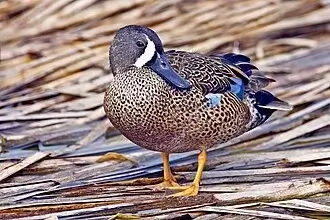
The blue-winged teal (Spatula discors) is a species of bird in the duck, goose, and swan family Anatidae. One of the smaller members of the dabbling duck group, it occurs in North America, where it breeds from southern Alaska to Nova Scotia, and south to northern Texas. It winters along the Pacific and Atlantic coasts and south into the Caribbean islands and Central America.
Habitat & Range
Blue-winged teal inhabit shoreline more often than open water and prefer calm water or sluggish currents to fast water. They inhabit inland marshes, lakes, ponds, pools, and shallow streams with dense emergent vegetation. In coastal areas, breeding occurs in salt-marsh meadows with adjoining ponds or creeks. Blue-winged teal use rocks protruding above water, muskrat houses, trunks or limbs of fallen trees, bare stretches of shoreline, or mud flats for resting sites. Blue-winged teal winter on shallow inland freshwater marshes and brackish and saltwater marshes. They build their nests on dry ground in grassy sites such as bluegrass meadows, hayfields, and sedge meadows. They will also nest in areas with very short, sparse vegetation. Blue-winged teal generally nest within several hundred yards of open water; however, nests have been found as far as 1.61 km (1 mi) away from water. Where the habitat is good, they nest communally. Blue-winged teal often use heavy growth of bulrushes and cattails as escape cover. Grasses, sedges, and hayfields provide nesting cover for these ducks. Erik Fritzell reported that blue-winged teal nests located in light to sparse cover were more successful than those in heavy cover. Nesting success was 47% on grazed areas and 14% on ungrazed areas. The blue-winged teal is primarily found in the northern prairies and parklands. It is the most abundant duck in the mixed-grass prairies of the Dakotas and the prairie provinces of Canada. The blue-winged teal is also found in wetlands of boreal forest associations, shortgrass prairies, tallgrass prairies, and deciduous woodlands. This duck commonly inhabits wetland communities dominated by bulrush (Scirpus spp.), cattail (Typha spp.), pondweed (Potamogeton spp.), sedges (Carex spp.), widgeongrass (Ruppia maritima), and other emergent and aquatic vegetation. During molting, it often remains among extensive beds of bulrushes and cattails. The blue-winged teal favors areas dominated by bluegrass (Poa
Life History
These birds feed by dabbling in shallow water at the edge of marshes or open water. They mainly eat plants; their diet may include molluscs and aquatic insects. Blue-winged teal are generally the first ducks south in the fall and the last ones north in the spring. Adult drakes depart the breeding grounds well before adult hens and immatures. Most blue-winged teal flocks seen after mid-September are composed largely of adult hens and immatures. The northern regions experience a steady decline in blue-winged teal populations from early September until early November. Blue-winged teal in central migration areas tend to remain through September, then diminish rapidly during October, with small numbers remaining until December. Large numbers of blue-winged teal appear on wintering grounds in Florida, Louisiana, and Texas in September. The onset of courtship among immature blue-winged teal often starts in late January or early February. In areas south of the breeding grounds, blue-winged teal are more active in courtship during the spring migration than are most other ducks. Blue-winged teal are among the last dabbling ducks to nest, generally nesting between April 15 and May 15. Few nests are started after mid-July. Chronology of nesting can vary from year to year as a result of weather conditions. At Delta Marshes, Manitoba, blue-winged teal nesting was delayed a week in 1950 due to abnormally cold weather. The nest is a shallow depression on the ground lined with grass and down, usually surrounded by vegetation. Blue-winged teal generally lay 10 to 12 eggs. Delayed nesting and renesting efforts have substantially smaller clutches, averaging five to six eggs. Clutch size can also vary with the age of the hen. Yearlings tend to lay smaller clutches. Incubation takes 21 to 27 days. Blue-winged teal are sexually mature after their first winter. During incubation, the drake leaves its mate and moves to suitable molting cover where it becomes flightless for a period of 3 to 4 weeks. Blue-winged teal ducklings can walk to water within 12 hours after hatching but do not fledge until 6 to 7 weeks.
Status, Trends & Threats
Common predators of blue-winged teal include humans, snakes, snapping turtles (Chleydra serpentina), dogs, cats, muskellunge (Esox masquinongy), American crows (Corvus brachyrhynchos), magpies (Pica spp.), ground squirrels, coyotes (Canis latrans), red foxes (Vulpes fulva), gray foxes (Urocyon cinereoargenteus), raccoons (Procyon lotor), long-tailed weasels (Mustela frenata), American minks (Mustela vison), striped skunks (Mephitis mephitis), spotted skunks (Spilogale putorius), and American badgers (Taxidea taxus). During one study, about half of the nest failures of blue-winged teal were caused by mammals. Striped and Spotted Skunks were responsible for two-thirds of these losses. All nest losses caused by birds were attributed to either crows or magpies.
Hunting Season
Early Teal (blue-winged & green-winged): Sep 20-28. Regular duck season: Nov 22-29; Dec 12 - Jan 31.
License & Regulations
A valid South Carolina hunting license is required for resident and non-resident hunters age 16 and older. Licenses can be purchased online through the Go Outdoors SC portal or at authorized license retailers. Additional permits may be required: Big Game Permit for deer, bear, and turkey; individual bear tags ($25 residents, $100 nonresidents); turkey tags ($25 residents, $125 nonresidents); antlerless deer tags; and the federal Migratory Bird Hunting and Conservation Stamp (Duck Stamp) for waterfowl. Hunters born on or after July 1, 1979 must successfully complete a hunter education course.
Frequently Asked Questions
Regulations for hunting Blue-winged Teal in South Carolina
Blue-winged teal benefit from an early teal season in September, separate from the regular duck season. The early season targets teal migrating south before the main waterfowl season begins. HIP registration and a hunting license are required for the early teal season. Shooting hours are from sunrise to sunset during the early teal season.
When is Blue-winged Teal hunting season in South Carolina?
The Blue-winged Teal hunting season in South Carolina: Early Teal (blue-winged & green-winged): Sep 20-28. Regular duck season: Nov 22-29; Dec 12 - Jan 31.
What is the bag limit for Blue-winged Teal in South Carolina?
The bag limit for Blue-winged Teal in South Carolina is: Early teal: 6 per day. Regular season: 6 ducks aggregate per day.
What's another name for Blue-winged Teal?
Blue-winged Teal is also known as Bluewing, Teal in South Carolina.
How to identify Blue-winged Teal?
The blue-winged teal (Spatula discors) is a species of bird in the duck, goose, and swan family Anatidae. One of the smaller members of the dabbling duck group, it occurs in North America, where it breeds from southern Alaska to Nova Scotia, and south to northern Texas. It winters along the Pacific and Atlantic coasts and south into the Caribbean islands and Central America.
References
| State | Category | Directory | Subcategory | Content | Source |
|---|---|---|---|---|---|
| South Carolina | Hunting | Regulations | Season Dates | Early Teal (blue-winged & green-winged): Sep 20-28. Regular duck season: Nov 22-29; Dec 12 - Jan 31. | Link |
| South Carolina | Hunting | License | License & Fees | A valid South Carolina hunting license is required for resident and non-resident hunters age 16 and older. Licenses can | Link |
| South Carolina | Hunting | Regulations | Regulations | Blue-winged teal benefit from an early teal season in September, separate from the regular duck season. The early season | Link |