Also known as: Brush wolf, Prairie wolf
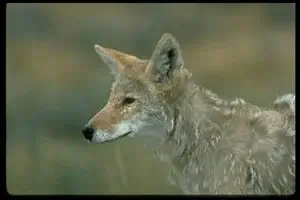
The coyote (Canis latrans) is a species of canine also known as the American jackal, prairie wolf, and brush wolf. It is native to North America, and it is smaller than its close relative, the gray wolf, and slightly smaller than the closely related eastern wolf and red wolf. It fills much of the same ecological niche as the golden jackal does in Eurasia but the coyote is generally larger. The coyote is listed as least concern by the International Union for Conservation of Nature, due to its wide distribution and abundance throughout North America. The species is versatile, able to adapt to and expand into environments modified by humans; urban coyotes are common in many cities. The coyote was sighted in eastern Panama (across the Panama Canal from their home range) for the first time in 2013. The coyote has 19 recognized subspecies. The average male weighs 8 to 20 kg (18 to 44 lb) and the average female 7 to 18 kg (15 to 40 lb). Their fur color is predominantly light gray and red or fulvous interspersed with black and white, though it varies somewhat with geography. It is highly flexible in social organization, living either in a family unit or in loosely knit packs of unrelated individuals. Primarily carnivorous, its diet consists mainly of deer, rabbits, hares, rodents, birds, reptiles, amphibians, fish, and invertebrates, though it may also eat fruits and vegetables on occasion. Its characteristic vocalization is a howl that changes rapidly in tone and pitch. Humans are the coyote's greatest threat, followed by cougars and gray wolves. While coyotes have never been known to mate with gray wolves in the wild, they do interbreed with eastern wolves and red wolves, producing "coywolf" hybrids. In the northeastern regions of North America, the eastern coyote (a larger subspecies, though still smaller than wolves) is the result of various historical and recent matings with various types of wolves. Eastern wolves also still mate with gray wolves, providing an avenue f
Habitat & Range
Prior to the near extermination of wolves and cougars, the coyote was most numerous in grasslands inhabited by bison, pronghorn, elk, and other deer, doing particularly well in short-grass areas with prairie dogs, though it was just as much at home in semiarid areas with sagebrush and jackrabbits or in deserts inhabited by cactus, kangaroo rats, and rattlesnakes. As long as it was not in direct competition with the wolf, the coyote ranged from the Sonoran Desert to the alpine regions of adjoining mountains or the plains and mountainous areas of Alberta. With the extermination of the wolf, the coyote's range expanded to encompass broken forests from the tropics of Guatemala and the northern slope of Alaska. Coyotes walk around 5–16 kilometres (3–10 mi) per day, often along trails such as logging roads and paths; they may use iced-over rivers as travel routes in winter. They are often crepuscular, being more active around evening and the beginning of the night than during the day. However, in urban areas coyotes are known to be more nocturnal, likely to avoid encounters with humans. Like many canids, coyotes are competent swimmers, reported to be able to travel at least 0.8 kilometres (0.5 mi) across water. In 2026, a coyote swam to the southern edge of Alcatraz Island, over one mile from the nearest land in San Francisco.
Life History
The coyote is ecologically the North American equivalent of the Eurasian golden jackal. Likewise, the coyote is highly versatile in its choice of food, but is primarily carnivorous, with 90% of its diet consisting of meat. Prey species include bison (largely as carrion), white-tailed deer, mule deer, moose, elk, bighorn sheep, pronghorn, rabbits, hares, rodents, birds (especially galliformes, roadrunners, young water birds and pigeons and doves), amphibians (except toads), lizards, snakes, turtles and tortoises, fish, crustaceans, and insects. Coyotes may be picky over the prey they target, as animals such as shrews, moles, and brown rats do not occur in their diet in proportion to their numbers. Terrestrial animals or burrowing small mammals such as ground squirrels and associated species (marmots, prairie dogs, chipmunks) as well as voles, pocket gophers, kangaroo rats and other ground-favoring rodents may be quite common foods, especially for lone coyotes. Examples of specific, primary mammal prey include eastern cottontail rabbits, thirteen-lined ground squirrels, and white-footed mice. More unusual prey include fishers, young black bear cubs, harp seals and rattlesnakes. Coyotes kill rattlesnakes mostly for food, but also to protect their pups at their dens, by teasing the snakes until they stretch out and then biting their heads and snapping and shaking the snakes. Birds taken by coyotes may range in size from thrashers, larks and sparrows to adult wild turkeys and, rarely, brooding adult swans and pelicans. If working in packs or pairs, coyotes may have access to larger prey than lone individuals normally take, such as various prey weighing more than 10 kg (22 lb). In some cases, packs of coyotes have dispatched much larger prey such as adult Odocoileus deer, cow elk, pronghorns and wild sheep, although the young fawn, calves and lambs of these animals are considerably more often taken even by packs, as well as domestic sheep and domestic cattle. In some cases, coyotes can bring down prey weighing up to 100 to 200 kg (220 to 440 lb) or more. When it comes to adult ungulates such as wild deer, they often exploit them when vulnerable such as those that are infirm, stuck in snow or ice, otherwise winter-weakened or heavily pregnant, whereas less wary domestic ungulates may be more easily exploited. Although coyotes prefer fresh meat, they will scavenge when the opportunity presents itself. Excluding the insects, fruit, and grass eaten, the coyote requires an estimated 600 g (1.3 lb) of food daily, or 250 kg (550 lb) annually. The coyote readily cannibalizes the carcasses of conspecifics, with coyote fat having been successfully used by coyote hunters as a lure or poisoned bait. The coyote's winter diet consists mainly of large ungulate carcasses, with very little plant matter. Rodent prey increases in importance during the spring, summer, and fall. The coyote feeds on a variety of different produce, including strawberries, blackberries, blue
Hunting Season
Private: No closed season, day or night (night hunting requires property registration). WMA: During daylight hours where permitted.
License & Regulations
A valid South Carolina hunting license is required for resident and non-resident hunters age 16 and older. Licenses can be purchased online through the Go Outdoors SC portal or at authorized license retailers. Additional permits may be required: Big Game Permit for deer, bear, and turkey; individual bear tags ($25 residents, $100 nonresidents); turkey tags ($25 residents, $125 nonresidents); antlerless deer tags; and the federal Migratory Bird Hunting and Conservation Stamp (Duck Stamp) for waterfowl. Hunters born on or after July 1, 1979 must successfully complete a hunter education course.
Frequently Asked Questions
Regulations for hunting Coyote in South Carolina
Coyotes may be hunted year-round in South Carolina with no bag limit. Night hunting is allowed on registered private property. Bait and electronic calls are legal on private land. South Carolina operates a Coyote Harvest Incentive Program with 16 tagged coyotes (4 per game zone) carrying a $3,000 reward each. Hunters should be aware that dogs may not be used to hunt coyotes in Game Zones 1 and 2 during still gun and muzzleloader hunts for deer or bear.
When is Coyote hunting season in South Carolina?
The Coyote hunting season in South Carolina: Private: No closed season, day or night (night hunting requires property registration). WMA: During daylight hours where permitted.
What's another name for Coyote?
Coyote is also known as Brush wolf, Prairie wolf in South Carolina.
Can I hunt coyotes at night in South Carolina?
Yes, coyotes may be hunted at night on private land in South Carolina with proper property registration. Artificial lights, night vision devices, and electronic calls are permitted. There is no closed season and no bag limit. Hunting from or across public paved roads is prohibited, and no shooting within 300 yards of a residence without occupant permission.
How to identify Coyote?
The coyote (Canis latrans) is a species of canine also known as the American jackal, prairie wolf, and brush wolf. It is native to North America, and it is smaller than its close relative, the gray wolf, and slightly smaller than the closely related eastern wolf and red wolf. It fills much of the same ecological niche as the golden jackal does in Eurasia but the coyote is generally larger. The coyote is listed as least concern by the International Union for Conservation of Nature, due to its wid...
References
| State | Category | Directory | Subcategory | Content | Source |
|---|---|---|---|---|---|
| South Carolina | Hunting | Regulations | Season Dates | Private: No closed season, day or night (night hunting requires property registration). WMA: During daylight hours where | Link |
| South Carolina | Hunting | License | License & Fees | A valid South Carolina hunting license is required for resident and non-resident hunters age 16 and older. Licenses can | Link |
| South Carolina | Hunting | Regulations | Regulations | Coyotes may be hunted year-round in South Carolina with no bag limit. Night hunting is allowed on registered private pro | Link |