Also known as: Cottontail rabbit, Rabbit
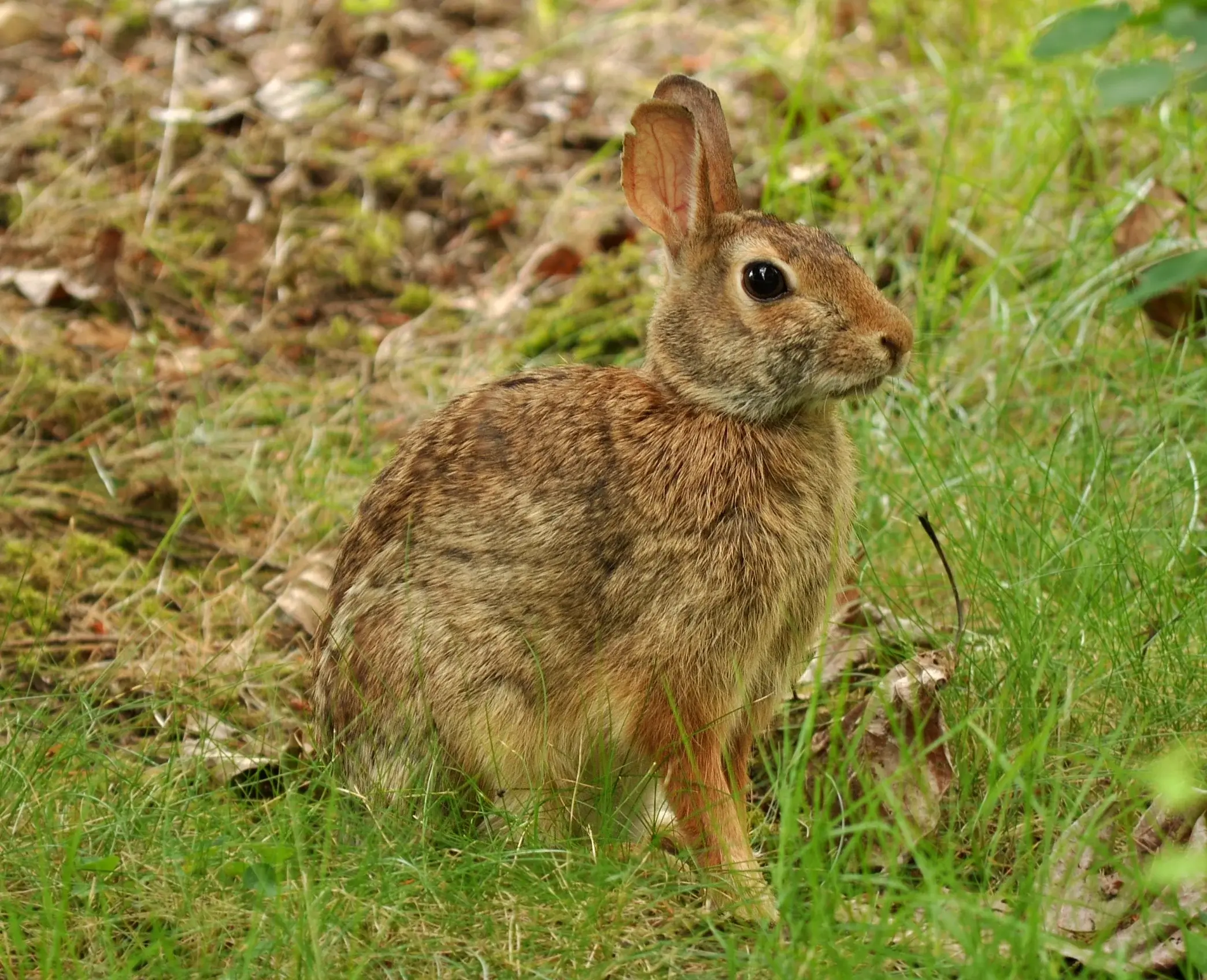
The eastern cottontail (Sylvilagus floridanus) is a species of rabbit in the family Leporidae. It is the most widespread and abundant rabbit species in North America, inhabiting a wide range that extends from southern Canada throughout most of the United States and into parts of Mexico, Central America, and the northern regions of South America. Known for its distinctive fluffy white tail, which resembles a cotton ball and gives the species its common name, the eastern cottontail typically inhabits open fields, meadows, and brushy areas where it can easily find cover and food. It is a primarily herbivorous, crepuscular mammal that feeds on grasses, herbs, twigs, and bark, and plays an important role in the ecosystem as prey for a variety of predators including foxes, hawks, and owls. Due to its adaptability to human-altered landscapes such as suburban and agricultural areas, the eastern cottontail has maintained stable population levels and is not considered threatened. It is also well known for its high reproductive rate, with females capable of producing multiple large litters annually, which contributes to its widespread presence.
Habitat & Range
The eastern cottontail inhabits meadows, shrubby areas, and edge habitats throughout the eastern and south-central United States, southern Canada, eastern Mexico, Central America, and northernmost South America. It is also present on Margarita Island in the Caribbean. The species is especially abundant across the Midwest of North America, and its range expanded northward as forests were cleared by settlers. Originally absent from New England, it has since been introduced there, where it now competes with the native New England cottontail (Sylvilagus transitionalis). It has also been introduced to parts of Oregon, Washington, and British Columbia. In the 1950s and 1960s, the species was introduced to France and northern Italy, where it underwent rapid territorial expansion and population growth. Populations in the mountainous regions of the southwestern United States and western Mexico are now considered a separate species, the robust cottontail (S. holzneri). Optimal eastern cottontail habitat includes open grassy areas, clearings, and old fields that support abundant green vegetation, with shrubs or hedgerows providing cover. Critical habitat components include dense, well-distributed escape cover interspersed with open foraging areas such as pastures or grasslands. In the western United States, they occupy diverse habitats such as ponderosa pine, mixed conifer, and pinyon (Pinus spp.)–juniper (Juniperus spp.) woodlands, where woody debris, shrubby understories, and patchy cover are important for survival. Eastern cottontails also thrive in agricultural and suburban environments, especially near fencerows, forest edges, and thickets. They can be found in swamps and marshes but generally avoid dense forests.
Life History
Eastern cottontails reach sexual maturity at 2–3 months of age. Breeding season varies by latitude and climate, beginning as early as January in the southern United States and around March in New England, continuing through late summer. Mating is promiscuous, with males competing for access to females. The nest is typically a slanted hole in soft soil lined with fur and grasses, measuring about 7.1 in × 4.9 in × 4.7 in (18 cm × 12 cm × 12 cm). Gestation lasts 25–35 days (average 28). Kits are born blind with fine hair and a white blaze on the forehead, which fades as they mature. Their eyes open at 4–7 days, and they begin leaving the nest by 12–16 days. Weaning occurs by 4–5 weeks, and dispersal begins around 7 weeks. Females can have 1–7 litters per year (averaging 3–4), with 3–8 kits per litter (average 5). In southern states, breeding is nearly continuous, while northern populations have shorter seasons but larger litters. Eastern cottontails feed primarily on a wide variety of plants, with some studies documenting 70–145 plant species in their diet. They prefer tender herbaceous vegetation, such as grasses, clovers (Trifolium spp.), crabgrasses (Digitaria spp.), and wild rye (Elymus spp.). In Connecticut, their summer diet includes alfalfa, timothy (Phleum pratense), quackgrass (Elytrigia repens), ragweed (Ambrosia psilostachya), goldenrod (Solidago spp.), plantains (Plantago spp.), chickweed (Stellaria media), and dandelion (Taraxacum officinale). During winter or when snow covers vegetation, cottontails browse on twigs, buds, and bark of woody plants such as gray birch (Betula populifolia), red maple (Acer rubrum), and smooth sumac (Rhus glabra). They are also coprophagous, re-ingesting soft fecal pellets to extract additional nutrients.
Status, Trends & Threats
The eastern cottontail is preyed upon by a wide variety of natural and introduced predators, forming a significant part of the diets of many carnivores and raptors in eastern North America. Common predators include domestic cats (Felis catus) and dogs (Canis lupus familiaris), foxes (Vulpes and Urocyon spp.), coyote (C. latrans), bobcat (Lynx rufus), weasels (Mustela spp.), raccoon (Procyon lotor), mink (Neogale vison), great horned owl (Bubo virginianus), barred owl (Strix varia), hawks (particularly Buteo spp.), corvids (Corvus spp.), and various snakes. Nestlings are especially vulnerable to predation by raccoons, badgers (Taxidea taxus), skunks (Mephitis and Spilogale spp.), crows (Corvus brachyrhynchos), and Virginia opossums (Didelphis virginiana). In central Missouri, eastern cottontails made up the majority of prey biomass consumed by red-tailed hawks (Buteo jamaicensis) during the nesting season. In Pennsylvania, the great horned owl is considered the primary predator. In the Southwest, eastern cottontails comprise between 7% and 25% of the diet of the northern goshawk (Accipiter gentilis). In Texas, they are most heavily preyed upon by coyotes in early spring and fall. In southwestern North Dakota, eastern and desert cottontails (Sylvilagus auduboni) are a key prey item for bobcats. Juveniles are rarely taken by short-eared owls (Asio flammeus), and only trace remains of eastern cottontails have been detected in the scat of black bears (Ursus americanus). The eastern cottontail species, due to its abundance and large, expanding range, is not considered to be under any threat. Individual populations may face local habitat loss. The species is considered "secure" by NatureServe and is listed as least-concern by the international Union for Conservation of Nature.
Hunting Season
Private: Dogs only Mar 2 - Nov 26, 2025 & Mar 2 - Nov 25, 2026; Guns & dogs Nov 27 - Mar 1. WMA: Dogs only Sep 1-15; Guns & dogs Nov 27 - Feb 28.
License & Regulations
A valid South Carolina hunting license is required for resident and non-resident hunters age 16 and older. Licenses can be purchased online through the Go Outdoors SC portal or at authorized license retailers. Additional permits may be required: Big Game Permit for deer, bear, and turkey; individual bear tags ($25 residents, $100 nonresidents); turkey tags ($25 residents, $125 nonresidents); antlerless deer tags; and the federal Migratory Bird Hunting and Conservation Stamp (Duck Stamp) for waterfowl. Hunters born on or after July 1, 1979 must successfully complete a hunter education course.
Frequently Asked Questions
Regulations for hunting Eastern Cottontail in South Carolina
Eastern cottontail rabbit hunting features a dogs-only training period in spring/summer followed by the guns-and-dogs season from late November through March. Daily bag limit is 5 rabbits. A youth rabbit day is held in early March. Rabbits are most abundant in brushy field edges, early successional habitats, and areas with dense ground cover.
When is Eastern Cottontail hunting season in South Carolina?
The Eastern Cottontail hunting season in South Carolina: Private: Dogs only Mar 2 - Nov 26, 2025 & Mar 2 - Nov 25, 2026; Guns & dogs Nov 27 - Mar 1. WMA: Dogs only Sep 1-15; Guns & dogs Nov 27 - Feb 28.
What is the bag limit for Eastern Cottontail in South Carolina?
The bag limit for Eastern Cottontail in South Carolina is: 5 per day.
What's another name for Eastern Cottontail?
Eastern Cottontail is also known as Cottontail rabbit, Rabbit in South Carolina.
How to identify Eastern Cottontail?
The eastern cottontail (Sylvilagus floridanus) is a species of rabbit in the family Leporidae. It is the most widespread and abundant rabbit species in North America, inhabiting a wide range that extends from southern Canada throughout most of the United States and into parts of Mexico, Central America, and the northern regions of South America. Known for its distinctive fluffy white tail, which resembles a cotton ball and gives the species its common name, the eastern cottontail typically inhab...
References
| State | Category | Directory | Subcategory | Content | Source |
|---|---|---|---|---|---|
| South Carolina | Hunting | Regulations | Season Dates | Private: Dogs only Mar 2 - Nov 26, 2025 & Mar 2 - Nov 25, 2026; Guns & dogs Nov 27 - Mar 1. WMA: Dogs only Sep 1-15; Gun | Link |
| South Carolina | Hunting | License | License & Fees | A valid South Carolina hunting license is required for resident and non-resident hunters age 16 and older. Licenses can | Link |
| South Carolina | Hunting | Regulations | Regulations | Eastern cottontail rabbit hunting features a dogs-only training period in spring/summer followed by the guns-and-dogs se | Link |