Also known as: Fox squirrel
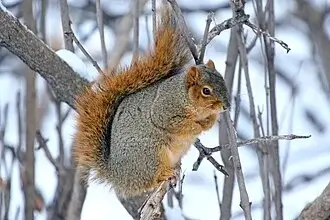
The fox squirrel (Sciurus niger), also known as the eastern fox squirrel or Bryant's fox squirrel, is the largest species of tree squirrel native to North America. It is sometimes mistaken for the American red squirrel or eastern gray squirrel in areas where the species coexist, though they differ in size and coloration.The word Sciurus came from the ancient Greek words, ‘skia’ meaning shade and ‘oura’ meaning tail. Niger refers to the black coloration.
Habitat & Range
The fox squirrel's natural range extends through most of the eastern United States, north into the southern prairie provinces of Canada, west to the Dakotas, Colorado, and Texas, and south to the northern parts of Coahuila, Nuevo León (as far south as the Valle de las Salinas) and Tamaulipas. It is absent (except for vagrants) in New England, New Jersey, most of New York, northern and eastern Pennsylvania, Ontario, Quebec, and the Atlantic provinces of Canada. It has been introduced to both northern and southern California, Oregon, Idaho, Montana, Washington, and New Mexico, as well as Ontario and British Columbia in Canada. While very versatile in their habitat choices, fox squirrels are most often found in forest patches of 40 hectares or less with an open understory, or in urban neighborhoods with trees. They thrive among oak, hickory, walnut, pecan and pine trees, storing their nuts for winter. Western range extensions in Great Plains regions such as Kansas are associated with riverine corridors of cottonwood. Some subspecies native to several eastern U.S. states are the Delmarva Peninsula fox squirrel (S. n. cinereus), and the southern fox squirrel (S. n. niger). Fox squirrels are most abundant in open forest stands with little understory vegetation; they are not found in stands with dense undergrowth. Ideal habitat is small stands of large trees interspersed with agricultural land. The size and spacing of pines and oaks are among the important features of fox squirrel habitat. The actual species of pines and oaks themselves may not always be a major consideration in defining fox squirrel habitat. Fox squirrels are often observed foraging on the ground several hundred meters from the nearest woodlot. Fox squirrels also commonly occupy forest edge habitat. Fox squirrels have two types of shelters: leaf nests (dreys) and tree dens. They may have two tree cavity homes or a tree cavity and a leaf nest. Tree dens are preferred over leaf nests during the winter and f
Life History
Food habits of fox squirrels depend largely on geographic location. In general, fox squirrel foods include mast, tree buds, insects, tubers, bulbs, roots, bird eggs, pine nuts and spring-fruiting trees, and fungi. Agricultural crops such as corn, soybeans, oats, wheat, and fruit are also eaten. Mast eaten by fox squirrels commonly includes turkey oak (Quercus laevis), southern red oak (Quercus falcata), blackjack oak (Quercus marilandica), bluejack oak (Quercus incana), post oak (Quercus stellata), and live oak (Quercus virginiana). In Illinois, fox squirrels rely heavily on hickories from late August through September. Pecans, black walnuts (Juglans nigra), osage orange (Maclura pomifera) fruits, and corn are also important fall foods. In early spring, elm buds and seeds are the most important food. In May and June, mulberries (Morus spp.) are heavily used. By early summer, corn in the milk stage becomes a primary food. During the winter in Kansas, osage orange is a staple item supplemented with seeds of the Kentucky coffee tree (Gymnocladus dioicus) and honey locust (Gleditsia triacanthos), corn, wheat, eastern cottonwood (Populus deltoides var. deltoides) bark, ash seeds, and eastern red cedar (Juniperus virginiana) berries. In the spring, fox squirrels feed primarily on buds of elm, maple, and oaks but also on newly sprouting leaves and insect larvae. Fox squirrels in Ohio prefer hickory nuts, acorns, corn, and black walnuts. The squirrels are absent where two or more of these mast trees are missing. Fox squirrels also eat buckeyes, seeds and buds of maple and elm, hazelnuts (Corylus spp.), blackberries (Rubus spp.), and tree bark. In March, they feed mainly on buds and seeds of elm, maple, and willow. In Ohio, eastern fox squirrels have the following order of food preference: white oak (Quercus alba) acorns, black oak (Quercus velutina) acorns, red oak (Quercus rubra) acorns, walnuts, and corn. In eastern Texas, fox squirrels prefer the acorns of bluejack oak, pecans, southern red oak (Q. falcata), and overcup oak (Q. lyrata). The least preferred foods are acorns of swamp chestnut oak (Q. michauxii) and overcup oak. In California, fox squirrels feed on English walnuts (J. regia), oranges, avocados, strawberries, and tomatoes. In midwinter, they feed on eucalyptus seeds. In Michigan, fox squirrels feed on a variety of foods throughout the year. Spring foods are mainly tree buds and flowers, insects, bird eggs, and seeds of red maple (Acer rubrum), silver maple (Acer saccharinum), and elms. Summer foods include a variety of berries, plum and cherry pits, fruits of basswood (Tilia americana), fruits of box elder (Acer negundo), black oak acorns, hickory nuts, seeds of sugar (Acer saccharum) and black maple (Acer nigrum), grains, insects, and unripe corn. Autumn foods consist mainly of acorns, hickory nuts, beechnuts, walnuts, butternuts (Juglans cinerea), and hazelnuts. Caches of acorns and hickory nuts are heavily used in winter. Female fox s
Hunting Season
Same as eastern gray squirrel. Private: Dogs only Mar 2 - Nov 23; Guns & dogs Oct 1 - Mar 1. WMA: Dogs only Sep 1-15; Guns & dogs Oct 1 - Feb 28.
License & Regulations
A valid South Carolina hunting license is required for resident and non-resident hunters age 16 and older. Licenses can be purchased online through the Go Outdoors SC portal or at authorized license retailers. Additional permits may be required: Big Game Permit for deer, bear, and turkey; individual bear tags ($25 residents, $100 nonresidents); turkey tags ($25 residents, $125 nonresidents); antlerless deer tags; and the federal Migratory Bird Hunting and Conservation Stamp (Duck Stamp) for waterfowl. Hunters born on or after July 1, 1979 must successfully complete a hunter education course.
Frequently Asked Questions
Regulations for hunting Fox Squirrel in South Carolina
Fox squirrels are managed under the same season and bag limits as eastern gray squirrels in South Carolina. The combined daily bag limit is 10 squirrels. Fox squirrels are typically found in more open woodlands and pine forests compared to gray squirrels.
When is Fox Squirrel hunting season in South Carolina?
The Fox Squirrel hunting season in South Carolina: Same as eastern gray squirrel. Private: Dogs only Mar 2 - Nov 23; Guns & dogs Oct 1 - Mar 1. WMA: Dogs only Sep 1-15; Guns & dogs Oct 1 - Feb 28.
What is the bag limit for Fox Squirrel in South Carolina?
The bag limit for Fox Squirrel in South Carolina is: 10 per day combined with eastern gray squirrel.
What's another name for Fox Squirrel?
Fox Squirrel is also known as Fox squirrel in South Carolina.
How to identify Fox Squirrel?
The fox squirrel (Sciurus niger), also known as the eastern fox squirrel or Bryant's fox squirrel, is the largest species of tree squirrel native to North America. It is sometimes mistaken for the American red squirrel or eastern gray squirrel in areas where the species coexist, though they differ in size and coloration.The word Sciurus came from the ancient Greek words, ‘skia’ meaning shade and ‘oura’ meaning tail. Niger refers to the black coloration.
References
| State | Category | Directory | Subcategory | Content | Source |
|---|---|---|---|---|---|
| South Carolina | Hunting | Regulations | Season Dates | Same as eastern gray squirrel. Private: Dogs only Mar 2 - Nov 23; Guns & dogs Oct 1 - Mar 1. WMA: Dogs only Sep 1-15; Gu | Link |
| South Carolina | Hunting | License | License & Fees | A valid South Carolina hunting license is required for resident and non-resident hunters age 16 and older. Licenses can | Link |
| South Carolina | Hunting | Regulations | Regulations | Fox squirrels are managed under the same season and bag limits as eastern gray squirrels in South Carolina. The combined | Link |