Also known as: Gray fox
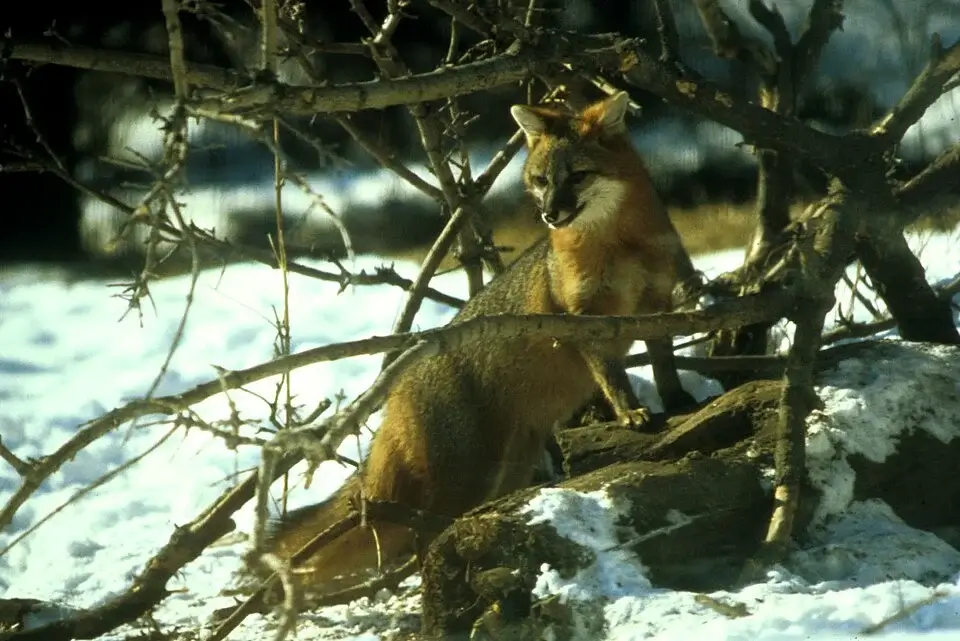
The gray fox (Urocyon cinereoargenteus), or grey fox, is an omnivorous mammal of the family Canidae, widespread throughout North America and Central America. This species and its only congener, the diminutive island fox (Urocyon littoralis) of the California Channel Islands, are the only living members of the genus Urocyon, which is considered to be genetically sister to all other living canids. Its species name cinereoargenteus means "ashen silver". It was once the most common fox in the eastern United States, and though still found there, human advancement and deforestation allowed the red fox to become the predominant fox-like canid. Despite this post-colonial competition, the gray fox has been able to thrive in urban and suburban environments, one of the best examples being southern Florida. The Pacific States and Great Lakes region still have the gray fox as their prevalent fox.
Habitat & Range
The species occurs throughout most rocky, wooded, brushy regions of the southern half of North America from southern Canada (Manitoba through southeastern Quebec) to the northern part of South America (Venezuela and Colombia), excluding the mountains of northwestern United States. The species prefers a mix of wooded and agricultural land in the Midwest, juniper forests as well as ponderosa pine in the west, and deciduous forests in the east. It is the only canid whose natural range spans both North and South America. In some areas, high population densities exist near brush-covered bluffs. The species prefers a mix of forest and agricultural land towards the southern part of their range (Belize ). In southeastern Mexico, the species prefers areas with a human presence such as near roads.
Life History
The gray fox is specifically adapted to climb trees. Its strong, hooked claws allow it to scramble up trees to escape many predators, such as the domestic dog or the coyote, or to reach tree-bound or arboreal food sources. It can climb branchless, vertical trunks to heights of 18 metres (59 ft) and jump from branch to branch. It descends primarily by jumping from branch to branch, or by descending slowly backwards like a domestic cat. The gray fox is primarily nocturnal or crepuscular and makes its den in hollow trees, stumps or appropriated burrows during the day. Such gray fox tree dens may be located 30 ft (9 m) above the ground. For the most part, they rest on the ground rather than higher up in trees. Prior to European colonization of North America, the red fox was found primarily in boreal forest and the gray fox in deciduous forest. With the increase in human populations in North America, their habitat selection has adapted: Gray foxes that live near human populations tend to choose areas near hardwood trees, locations used primarily by humans, or roads to utilize as their habitat. The increase of coyote populations around North America has reduced certain fox populations, so gray foxes choose habitats that will allow escape from coyotes, therefore the foxes's tendency to live nearer to areas where humans are active. The larger predators of the gray fox, like coyotes and bobcats, tend to avoid human-use areas and paved roads. They heavily utilize the edges of forests as a travel corridor, which is used for primary movement from place to place. Their choices do not change based on sex, the season, or the time of day. They also do the majority of their hunting in edges, and use them to escape from predators as well. Gray foxes are thus known as an "edge species." The gray fox is assumed to be monogamous, like other foxes. The breeding season of the gray fox varies geographically; in Michigan, the gray fox mates in early March, in Alabama, breeding peaks occur in February. The gestation period lasts approximately 53 days. Litter size ranges from 1–7, with a mean of 3.8 young per female. The sexual maturity of females is around 10 months of age. Kits begin to hunt with their parents at the age of 3 months. By the time that they are 4 months old, the kits will have developed their permanent dentition and can now easily forage on their own. The family group remains together until the autumn, when the young males reach sexual maturity, then they disperse. In a study of 9 juvenile gray foxes, only the males dispersed, moving up to 84 km (52 mi). The juvenile females stayed within proximity of the den within 3 km (1.9 mi) and always returned. Adult gray foxes showed no signs of dispersion for either sex. The gray fox will typically live between six and ten years. The annual reproductive cycle of males has been described through epididymal smears. They become fertile earlier and remain fertile longer than females. Logs, trees, rocks, burrows, or ab
Hunting Season
Private: Dogs only Mar 2 - Nov 26; Guns & dogs Nov 27 - Mar 1. WMA: Dogs only (night) Sep 2 - Nov 26; Guns & dogs (night) Nov 27 - Feb 28.
License & Regulations
A valid South Carolina hunting license is required for resident and non-resident hunters age 16 and older. Licenses can be purchased online through the Go Outdoors SC portal or at authorized license retailers. Additional permits may be required: Big Game Permit for deer, bear, and turkey; individual bear tags ($25 residents, $100 nonresidents); turkey tags ($25 residents, $125 nonresidents); antlerless deer tags; and the federal Migratory Bird Hunting and Conservation Stamp (Duck Stamp) for waterfowl. Hunters born on or after July 1, 1979 must successfully complete a hunter education course.
Frequently Asked Questions
Regulations for hunting Gray Fox in South Carolina
Gray fox hunting in South Carolina features a dogs-only training period from March through November, followed by the guns-and-dogs season from late November through March. No bag limit. Foxes may be hunted at night. Gray foxes are more common in forested areas than red foxes in South Carolina.
When is Gray Fox hunting season in South Carolina?
The Gray Fox hunting season in South Carolina: Private: Dogs only Mar 2 - Nov 26; Guns & dogs Nov 27 - Mar 1. WMA: Dogs only (night) Sep 2 - Nov 26; Guns & dogs (night) Nov 27 - Feb 28.
What's another name for Gray Fox?
Gray Fox is also known as Gray fox in South Carolina.
How to identify Gray Fox?
The gray fox (Urocyon cinereoargenteus), or grey fox, is an omnivorous mammal of the family Canidae, widespread throughout North America and Central America. This species and its only congener, the diminutive island fox (Urocyon littoralis) of the California Channel Islands, are the only living members of the genus Urocyon, which is considered to be genetically sister to all other living canids. Its species name cinereoargenteus means "ashen silver". It was once the most common fox in the easter...
References
| State | Category | Directory | Subcategory | Content | Source |
|---|---|---|---|---|---|
| South Carolina | Hunting | Regulations | Season Dates | Private: Dogs only Mar 2 - Nov 26; Guns & dogs Nov 27 - Mar 1. WMA: Dogs only (night) Sep 2 - Nov 26; Guns & dogs (night | Link |
| South Carolina | Hunting | License | License & Fees | A valid South Carolina hunting license is required for resident and non-resident hunters age 16 and older. Licenses can | Link |
| South Carolina | Hunting | Regulations | Regulations | Gray fox hunting in South Carolina features a dogs-only training period from March through November, followed by the gun | Link |