Also known as: Mallard duck, Greenhead (male), Susie (female)
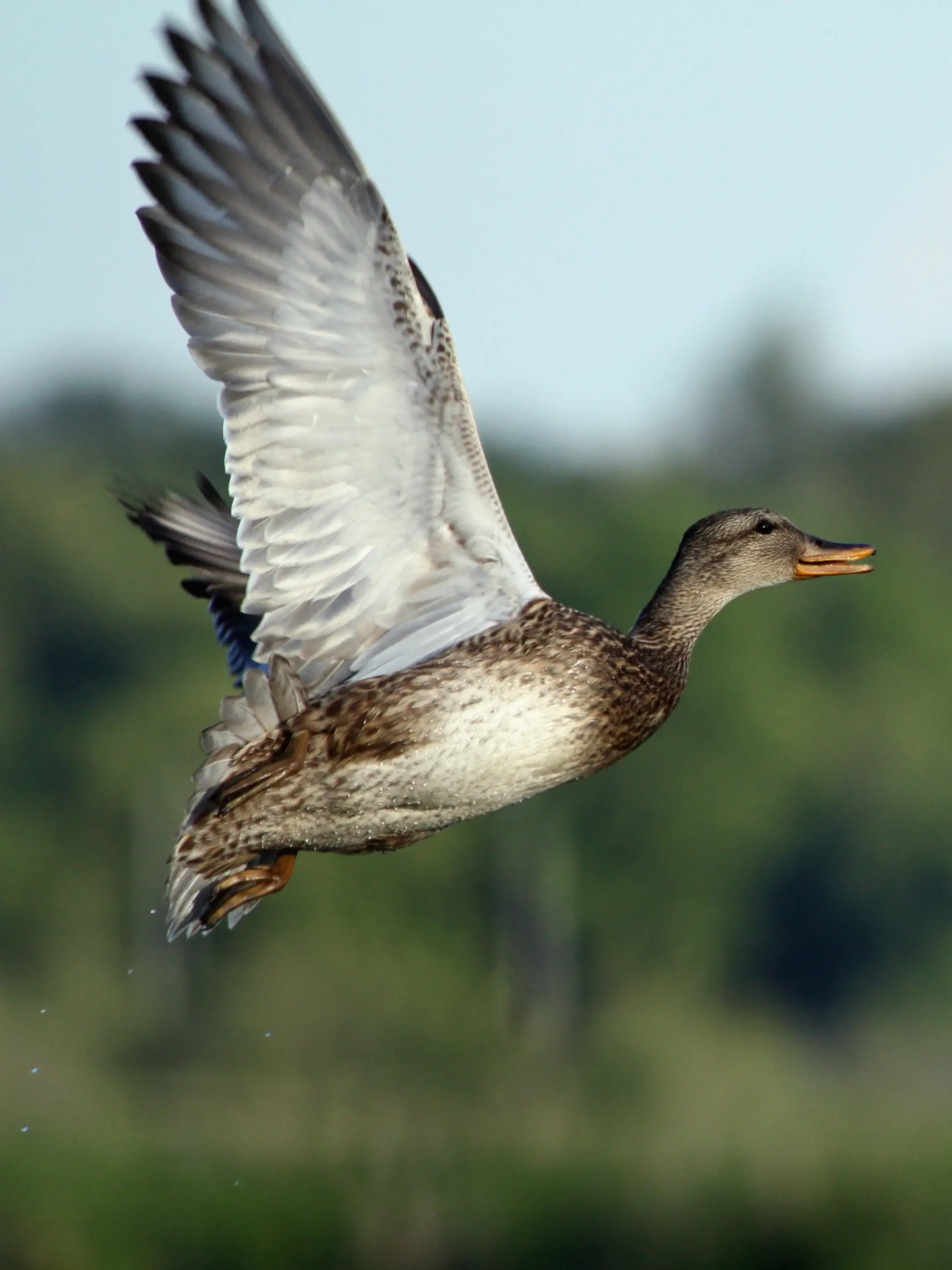
The mallard () or wild duck (Anas platyrhynchos) is a dabbling duck that breeds throughout the temperate and subtropical Americas, Eurasia, and North Africa. It has been introduced to New Zealand, Australia, Peru, Brazil, Uruguay, Argentina, Chile, Colombia, the Falkland Islands, and South Africa. Belonging to the subfamily Anatinae of the waterfowl family Anatidae, mallards live in wetlands, eat water plants and small animals, and are social animals preferring to congregate in groups or flocks of varying sizes. Males (drakes) have green heads, while the females (ducks) have mainly brown-speckled plumage. Both sexes have an area of white-bordered black or iridescent purple or blue feathers called a speculum on their wings; males especially tend to have blue speculum feathers. The mallard is 50–65 cm (20–26 in) long, of which the body makes up around two-thirds the length. The wingspan is 81–98 cm (32–39 in) and the bill is 4.4 to 6.1 cm (1.7 to 2.4 in) long. It is often slightly heavier than most other dabbling ducks, weighing 0.7–1.6 kg (1.5–3.5 lb). The female lays 8 to 13 creamy white to greenish-buff spotless eggs, on alternate days. Incubation takes 27 to 28 days and fledging takes 50 to 60 days. The ducklings are precocial and fully capable of swimming as soon as they hatch. The non-migratory mallard interbreeds with indigenous wild ducks of closely related species through genetic pollution by producing fertile offspring. Complete hybridisation of various species of wild duck gene pools could result in the extinction of many indigenous waterfowl. This species is the main ancestor of most breeds of domestic duck, and its naturally evolved wild gene pool has been genetically polluted by the domestic and feral mallard populations. The mallard is considered to be a species of least concern by the International Union for Conservation of Nature (IUCN), and, unlike many waterfowl, is considered an invasive species in some regions. It is a very adaptable species, bein
Habitat & Range
The mallard is widely distributed across the Northern and Southern Hemispheres; in North America its range extends from southern and central Alaska to Mexico, the Hawaiian Islands, across the Palearctic, from Iceland and southern Greenland and parts of Morocco (North Africa) in the west, Scandinavia and Britain to the north, and to Siberia, Japan, and South Korea. Also in the east, it ranges to south-eastern and south-western Australia and New Zealand in the Southern Hemisphere. It is strongly migratory in the northern parts of its breeding range, and winters farther south. For example, in North America, it winters south to the southern United States and northern Mexico, but also regularly strays into Central America and the Caribbean between September and May. A drake later named "Trevor" attracted media attention in 2018 when it turned up on the island of Niue, an atypical location for mallards. The mallard inhabits a wide range of habitats and climates, from the Arctic tundra to subtropical regions. It is found in both fresh- and salt-water wetlands, including parks, small ponds, rivers, lakes and estuaries, as well as shallow inlets and open sea within sight of the coastline. Water depths of less than 0.9 metres (3.0 ft) are preferred, with birds avoiding areas more than a few metres deep. They are attracted to bodies of water with aquatic vegetation.
Hunting Season
Nov 22-29; Dec 12 - Jan 31.
License & Regulations
A valid South Carolina hunting license is required for resident and non-resident hunters age 16 and older. Licenses can be purchased online through the Go Outdoors SC portal or at authorized license retailers. Additional permits may be required: Big Game Permit for deer, bear, and turkey; individual bear tags ($25 residents, $100 nonresidents); turkey tags ($25 residents, $125 nonresidents); antlerless deer tags; and the federal Migratory Bird Hunting and Conservation Stamp (Duck Stamp) for waterfowl. Hunters born on or after July 1, 1979 must successfully complete a hunter education course.
Frequently Asked Questions
Regulations for hunting Mallard in South Carolina
Mallard hunting follows federal migratory bird regulations with state-specific season frameworks. The duck season is split into two segments: late November and mid-December through January. HIP registration and federal Migratory Bird Hunting and Conservation Stamp (Duck Stamp) are required. Mallards are the most abundant duck species in South Carolina's wintering waterfowl populations.
When is Mallard hunting season in South Carolina?
The Mallard hunting season in South Carolina: Nov 22-29; Dec 12 - Jan 31.
What is the bag limit for Mallard in South Carolina?
The bag limit for Mallard in South Carolina is: 6 ducks per day aggregate. Mallard sub-limit: 4 per day (max 2 hens).
What's another name for Mallard?
Mallard is also known as Mallard duck, Greenhead (male), Susie (female) in South Carolina.
Where can I hunt ducks in South Carolina?
South Carolina offers excellent duck hunting opportunities along the coast, including the ACE Basin, Santee Delta, and Winyah Bay areas. Inland hunting is available on rivers, lakes, and beaver ponds throughout the state. Public hunting is available on WMAs and through the SCDNR waterfowl draw system. Layout hunting, flooded timber, and impoundment hunting are popular techniques.
How to identify Mallard?
The mallard () or wild duck (Anas platyrhynchos) is a dabbling duck that breeds throughout the temperate and subtropical Americas, Eurasia, and North Africa. It has been introduced to New Zealand, Australia, Peru, Brazil, Uruguay, Argentina, Chile, Colombia, the Falkland Islands, and South Africa. Belonging to the subfamily Anatinae of the waterfowl family Anatidae, mallards live in wetlands, eat water plants and small animals, and are social animals preferring to congregate in groups or flocks ...
References
| State | Category | Directory | Subcategory | Content | Source |
|---|---|---|---|---|---|
| South Carolina | Hunting | Regulations | Season Dates | Nov 22-29; Dec 12 - Jan 31. | Link |
| South Carolina | Hunting | License | License & Fees | A valid South Carolina hunting license is required for resident and non-resident hunters age 16 and older. Licenses can | Link |
| South Carolina | Hunting | Regulations | Regulations | Mallard hunting follows federal migratory bird regulations with state-specific season frameworks. The duck season is spl | Link |