Also known as: Armadillo
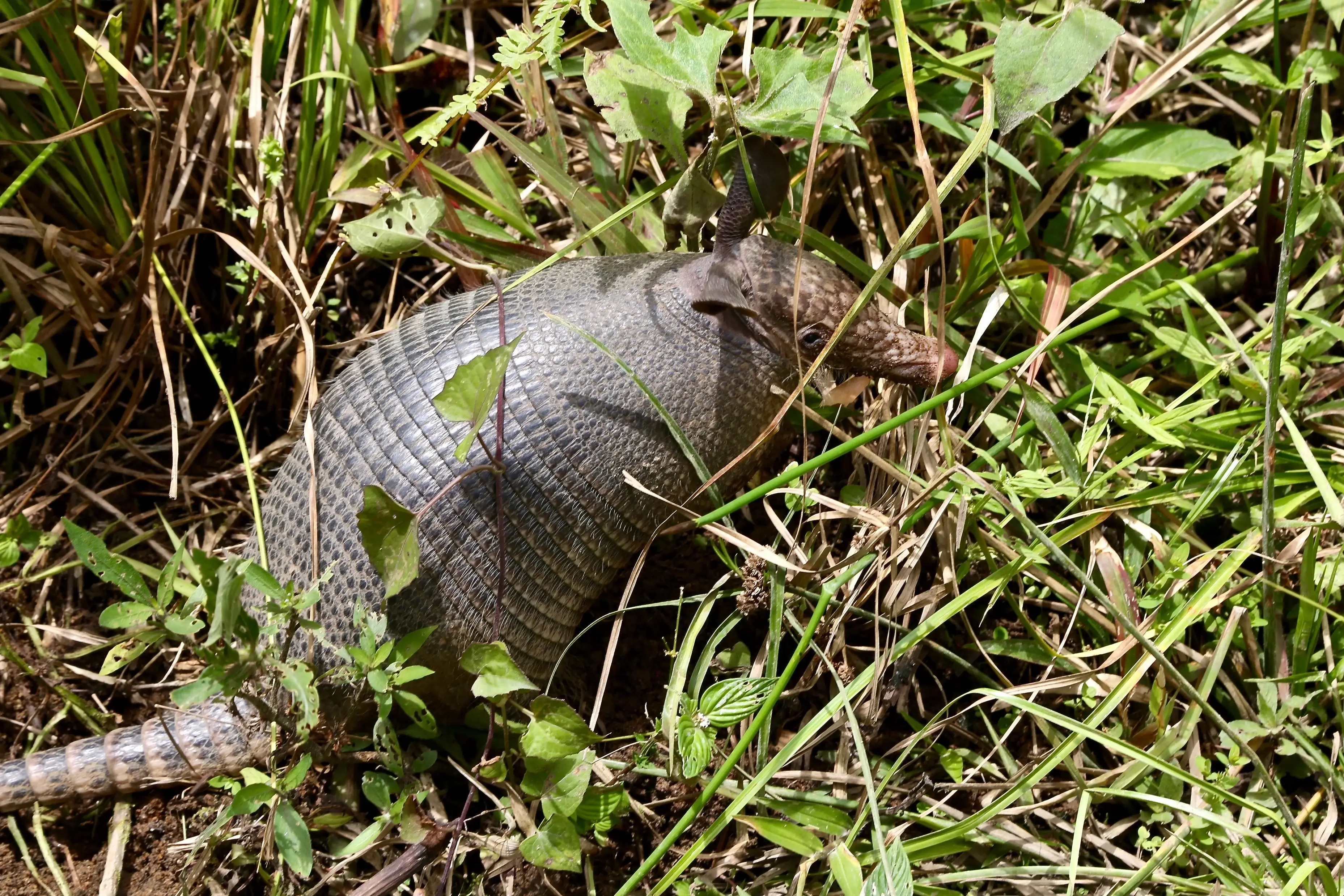
The nine-banded armadillo (Dasypus novemcinctus), also called the nine-banded long-nosed armadillo or common armadillo, is a species of armadillo native to South America. The Mexican long-nosed armadillo of North America was formerly treated as a subspecies of the nine-banded armadillo. The nine-banded armadillo is a solitary, mainly nocturnal animal, found in many kinds of habitats, from mature and secondary rainforests to grassland and dry scrub. It is an insectivore, feeding chiefly on ants, termites, and other small invertebrates. The armadillo can jump 91–120 cm (3–4 ft) straight in the air if sufficiently frightened, making it a particular danger on roads.
Habitat & Range
The nine-banded armadillo evolved in a warm, rainy environment, and is still most commonly found in regions resembling its ancestral home. As a very adaptable animal, though, it can also be found in scrublands, open prairies, and tropical rainforests. It cannot thrive in particularly cold or dry environments, as its large surface area, which is not well insulated by fat, makes it especially susceptible to heat and water loss.
Life History
Nine-banded armadillos are generally insectivores. They forage for meals by thrusting their snouts into loose soil and leaf litter and frantically digging in erratic patterns, stopping occasionally to dig up grubs, beetles (perhaps the main portion of this species' prey selection), ants, termites, grasshoppers, other insects, millipedes, centipedes, arachnids, worms, and other terrestrial invertebrates, which their sensitive noses can detect through 8 in (20 cm) of soil. They then lap up the insects with their sticky tongues. Nine-banded armadillos have been observed to roll about on ant hills to dislodge and consume the resident ants. They supplement their diets with amphibians and small reptiles, especially in more wintery months when such prey tends to be more sluggish, and occasionally bird eggs and baby mammals. Carrion is also eaten, although perhaps the species is most attracted to the maggots borne by carcasses rather than the meat itself. Less than 10% of the diet of this species is composed by nonanimal matter, though fungi, tubers, fruits, and seeds are occasionally eaten. Nine-banded armadillos are solitary, largely nocturnal animals that come out to forage around dusk. They are extensive burrowers, with a single animal sometimes maintaining up to 12 burrows on its range. These burrows are roughly 20 cm (8 in) wide, 210 cm (7 ft) deep, and 760 cm (25 ft) long. Armadillos mark their territory with urine, feces, and excretions from scent glands found on the eyelids, nose, and feet. Males hold breeding territories and may become aggressive in order to keep other males out of their home range to increase chances of pairing with a female. Territorial disputes are settled by kicking and chasing. When they are not foraging, armadillos shuffle along fairly slowly, stopping occasionally to sniff the air for signs of danger. Mating takes place during a two-to-three month long mating season, which occurs from November–January. A single egg is fertilized and develops into a blastocyst, but implantation is delayed for three to four months to ensure the young will not be born during an unfavorable time. Once the blastocyst does implant in the uterus it splits into four identical embryos via collapse of the common amnion and subsequent division of the embryonic shield. Each of the four embryos has a separate amnion and umbilical cord, but all four are attached to a common placenta. The gestation period is four months. At birth, they weigh 85 g (3 oz). After birth, the quadruplets remain in the burrow, living off the mother's milk for about three months. They then begin to forage with the mother, eventually leaving after six months to a year. Nine-banded armadillos reach sexual maturity at the age of one year, and reproduce every year for the rest of their 12-to-15-year lifespans. A single female can produce up to 56 young over the course of her life. This high reproductive rate is a major cause of the species' rapid expansion.
Hunting Season
Private: No closed season, day or night (night hunting requires property registration). WMA: During daylight hours where permitted.
License & Regulations
A valid South Carolina hunting license is required for resident and non-resident hunters age 16 and older. Licenses can be purchased online through the Go Outdoors SC portal or at authorized license retailers. Additional permits may be required: Big Game Permit for deer, bear, and turkey; individual bear tags ($25 residents, $100 nonresidents); turkey tags ($25 residents, $125 nonresidents); antlerless deer tags; and the federal Migratory Bird Hunting and Conservation Stamp (Duck Stamp) for waterfowl. Hunters born on or after July 1, 1979 must successfully complete a hunter education course.
Frequently Asked Questions
Regulations for hunting Nine-banded Armadillo in South Carolina
Nine-banded armadillos may be hunted year-round on private land in South Carolina with no bag limit. Night hunting is allowed on registered private property. Armadillos are considered a nuisance species and have expanded their range throughout the state. They are most active at dawn and dusk, digging for insects and grubs.
When is Nine-banded Armadillo hunting season in South Carolina?
The Nine-banded Armadillo hunting season in South Carolina: Private: No closed season, day or night (night hunting requires property registration). WMA: During daylight hours where permitted.
What's another name for Nine-banded Armadillo?
Nine-banded Armadillo is also known as Armadillo in South Carolina.
How to identify Nine-banded Armadillo?
The nine-banded armadillo (Dasypus novemcinctus), also called the nine-banded long-nosed armadillo or common armadillo, is a species of armadillo native to South America. The Mexican long-nosed armadillo of North America was formerly treated as a subspecies of the nine-banded armadillo. The nine-banded armadillo is a solitary, mainly nocturnal animal, found in many kinds of habitats, from mature and secondary rainforests to grassland and dry scrub. It is an insectivore, feeding chiefly on ants, ...
References
| State | Category | Directory | Subcategory | Content | Source |
|---|---|---|---|---|---|
| South Carolina | Hunting | Regulations | Season Dates | Private: No closed season, day or night (night hunting requires property registration). WMA: During daylight hours where | Link |
| South Carolina | Hunting | License | License & Fees | A valid South Carolina hunting license is required for resident and non-resident hunters age 16 and older. Licenses can | Link |
| South Carolina | Hunting | Regulations | Regulations | Nine-banded armadillos may be hunted year-round on private land in South Carolina with no bag limit. Night hunting is al | Link |