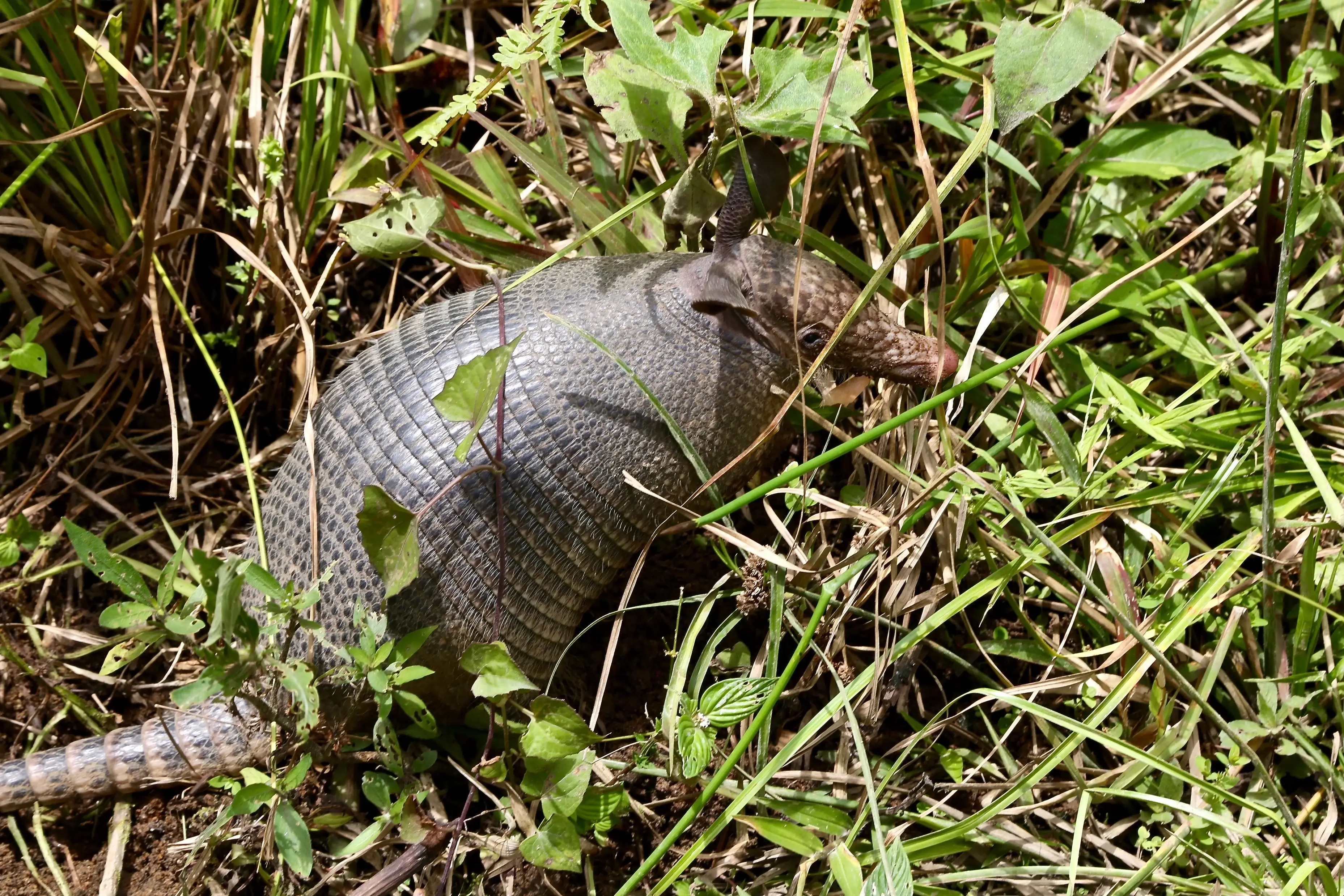
The Nine-banded Armadillo is a cat-sized, armored, insect-eating mammal with a bony, scaled shell similar in form to an anteater. Body measurements: 15–17 inches in length; tail 14–16 inches; weight 8–17 pounds. The shell shields it from predator attacks. They are frequently found dead on roadsides due to automobiles. It is the state small mammal of Texas.
Habitat & Range
Found across Texas except the western Trans-Pecos portion, in varied environments including brush, woods, scrub, and grasslands. Distribution depends largely on soil conditions — the animal is absent where soil is too hard to dig. Originally native to South America, the range now extends northward through Texas, Oklahoma, Kansas, and Louisiana.
Life History
Armadillos feed on insects and other invertebrates. They are skilled at digging for grubs and will occasionally eat berries and bird eggs. They are prolific diggers, creating many burrows and excavating for food. Their lawn-digging habit is motivated by an appetite for grubs. Many other wildlife species use and benefit from abandoned armadillo burrows. Breeding occurs in July, but the embryo remains in a dormant state until November. Four young are born in March inside a burrow. All four young, always of the same sex, are identical quadruplets developed from one egg sharing a single placenta. Armadillos are the only mammals in which multiple young form from a single egg with any regularity.
Status, Trends & Threats
No formal conservation status is assigned. The main threat is vehicle collisions — armadillos often fall victim to automobiles.
Frequently Asked Questions
Why do armadillos dig up lawns?
They are searching for grubs, which are part of their diet. While homeowners may find this inconvenient, the grubs themselves can also harm lawns.
Are all armadillo offspring identical?
Yes. A female produces four young of the same sex each litter, all identical quadruplets that develop from a single fertilized egg — a reproductive trait unique among mammals.
Where in Texas can armadillos be found?
They occur in all of Texas except the far western Trans-Pecos region, occupying habitats such as brush, woods, scrub, and grasslands where the soil is soft enough to dig.