Also known as: Alligator, gator
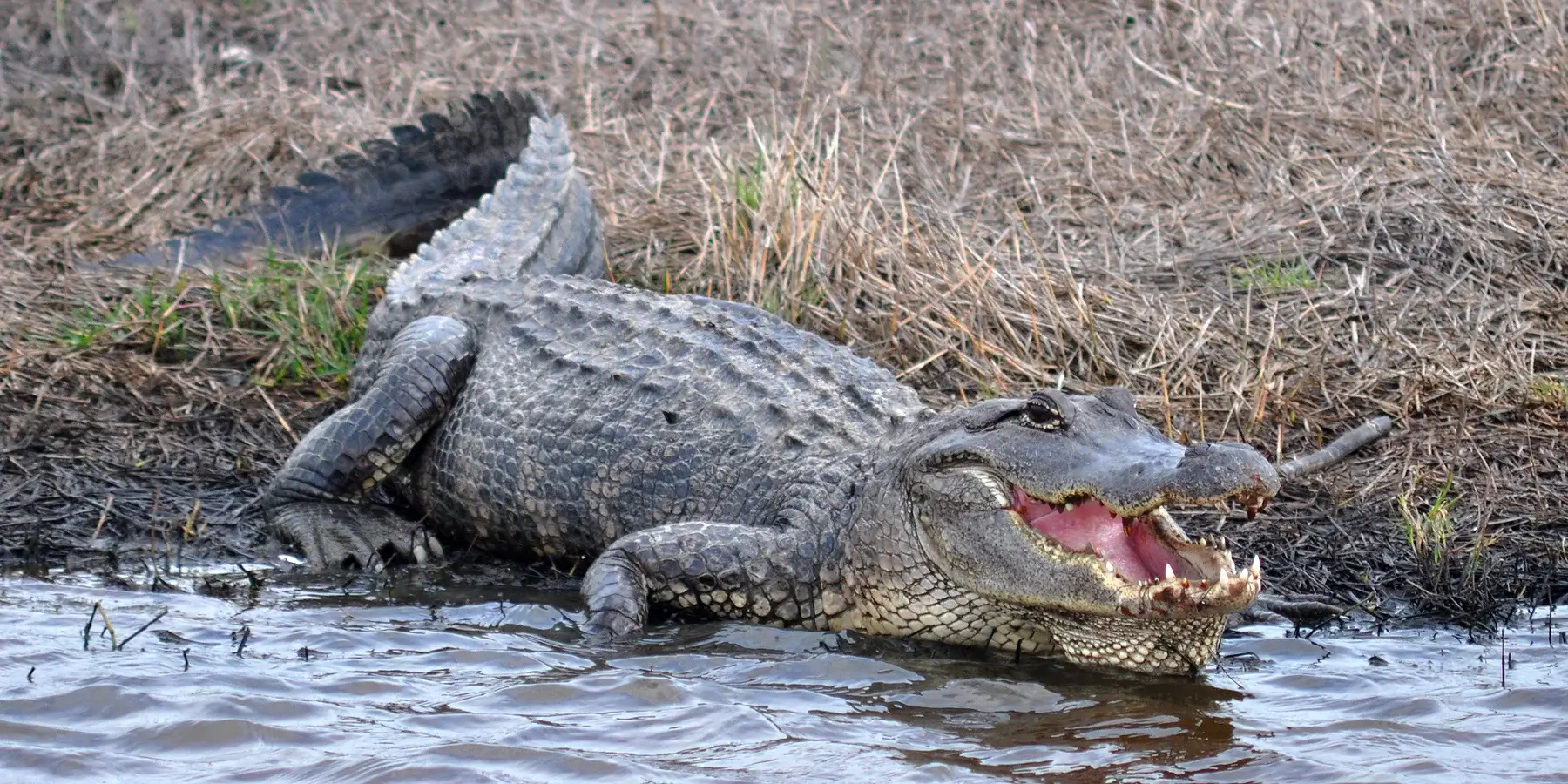
The American alligator, sometimes referred to as a common alligator or just gator, is a large crocodilian reptile native to the Southeastern United States. It is one of the two extant species in the genus Alligator, and is larger than the only other living alligator species, the Chinese alligator.
Habitat & Range
American alligators, being native both to theNearcticandNeotropicalrealms, are found in the wild in theSoutheastern United States, from theLowcountryinSouth Carolina, south toEverglades National Parkin Florida, and west toSouth Texas.[75]They are found in parts ofNorth Carolina, South Carolina,Georgia, Florida, Louisiana,Alabama,Mississippi,Arkansas,Oklahoma, andTexas. Some of these locations appear to be relatively recent introductions, with often small but reproductive populations.[76]Louisiana has the largest American alligator population of any U.S. state. In the future, possible American alligator populations may be found in areas ofMexicoadjacent to the Texas border.[77]The range of the American alligator is slowly expanding northwards, including into areas they once found unsuitable, such as Virginia.[78]American alligators have been naturally expanding their range intoTennessee,[79]and have established a small population in the southwestern part of that state via inland waterways, according to the state's wildlife agency.[80]They have beenextirpatedfromVirginia, and occasionalvagrantsfrom North Carolina wander into theGreat Dismal Swamp.[81] In 2021, an individual was found inCalvert County,Maryland, nearChesapeake Bay, where it was shot and killed by a hunter using acrossbow. Additional reports of American alligators from this region exist, though they are believed to be escaped or released exotic pets.[82] American alligators inhabit swamps, streams, rivers, ponds, and lakes as well as wetland prairies interspersed with shallow open water and canals with associated levees.[85]A lone American alligator was spotted for over 10 years living in a river north of Atlanta, Georgia.[86]Females and juveniles are also found inCarolina Baysand other seasonal wetlands. While they prefer fresh water, American alligators may sometimes wander intobrackishwater,[87]but are less tolerant of salt water than American crocodiles, as thesalt glandson their tongues do not function.[88]One study of American alligators in north-central Florida found the males preferred open lake water during the spring, while females used both swampy and open-water areas. During summer, males still preferred open water, while females remained in the swamps to construct their nests and lay their eggs. Both sexes may den underneath banks or clumps of trees during the winter.[52] In some areas of their range, American alligators are an unusual example ofurban wildlife; golf courses are often favored by the species due to an abundance of water and a frequent supply of prey animals such as fish and birds.[89][90] Recent research on juvenile American alligators has found that young alligators can adjust behavior in reaction to stressful environments, particularly with higher salt levels. Rather than adapting physically, juveniles have been shown to change their everyday habits – things like basking in the sun or moving between habitats – to avoid dehydration from salt water[91]. As sea levels continue to rise, it is especially important that alligators can adapt and maintain regular body function, despite changing environments.
Life History
Crocodilus mississipiensis[sic]Daudin, 1802; Crocodilus luciusCuvier, 1807; Crocodilus cuvieriLeach, 1815; Alligator lucius—A.M.C. Duméril&Bibron, 1836; Alligator mississippiensis[sic]—Holbrook, 1842 TheAmerican alligator(Alligatormississippiensis), sometimes referred to as acommon alligatoror justgator, is a largecrocodilianreptilenative to theSoutheastern United States. It is one of the twoextant speciesin thegenusAlligator, and is larger than the only other living alligator species, theChinese alligator. Adult male American alligators measure 3.4 to 4.8 m (11.2 to 15.7 ft) in length, and can weigh up to 900 kg (2,000 lb), with unverified sizes of up to 5.84 m (19.2 ft) and weights of 1,000 kg (2,200 lb) making it the heaviest member of thefamilyAlligatoridae, and the second longest one, after theblack caiman. Females are smaller, measuring 2.6 to 3.35 m (8.5 to 11.0 ft) in length.[5][6][7][8][9]The American alligator inhabitssubtropicalandtropicalfreshwaterwetlands, such asmarshesand cypressswamps, from southern Oklahoma and Texas toNorth Carolina.[10]It is distinguished from thesympatricAmerican crocodileby its broader U-shaped snout, with overlapping jaws and darker coloration, and is less tolerant of saltwater but more tolerant of cooler climates than the American crocodile, which is found only in tropical and warm subtropical climates. American alligators areapex predatorsand consume fish,amphibians, reptiles, birds,mammals, and other American alligators. Hatchlings feed mostly oninvertebrates. They play an important role asecosystem engineersinwetlandecosystems through the creation of alligator holes, which provide both wet and dry habitats for other organisms. Throughout the year (in particular during the breeding season), American alligators bellow to declare territory, and locate suitable mates.[11]Male American alligators useinfrasoundto attract females. Eggs are laid in a nest of vegetation, sticks, leaves, and mud in a sheltered spot on land near water. Young are born with yellow bands around their bodies and are protected by their mother for up to one year.[12]This species displays parental care, which is rare for most reptiles. Mothers protect their eggs during the incubation period, and move the hatchlings to the water using their mouths.[13]American alligators exhibit parental care for up to 3 years post birth. The conservation status of the American alligator is listed asLeast Concernby theInternational Union for Conservation of Nature. Historically, hunting had decimated their population, and the American alligator was listed as anendangered speciesby theEndangered Species Act of 1973. Subsequent conservation efforts have allowed their numbers to increase and the species was removed from endangered status in 1987. The species is the officialstate reptileof three states:Florida,Louisiana, andMississippi. Thebreedingseason begins in the spring. On spring nights, American alligators gather in large numbers for group courtship, in the aforementioned "water dances".[144]A study conducted in the 1980s at an alligator farm showed that homosexual courtship is common, with two-thirds of the recorded instances of sexual behaviour having been between two males.[145]Multiple paternity is thought to occur.[146]The female builds a nest of vegetation, sticks, leaves, and mud in a sheltered spot in or near the water. After the female lays her 20 to 50 white eggs, about the size of a goose egg, she covers them with more vegetation, which heats as it decays, helping to keep the eggs warm. This differs from Nile crocodiles, which lay their eggs in pits.[92]The temperature at which American alligator eggs develop determines their sex (seetemperature-dependent sex determination). Studies have found that eggs hatched at a temperature below 88.7 °F (31.5 °C) or a temperature above 94.1 °F (34.5 °C) will produce female offspring, while those at a temperature between 90.5 and 92.3 °F (32.5 and 33.5 °C) will produce male offspring.[147]The nests built onleveesare warmer, thus produce males, while the cooler nests of wet marsh produce females.[148]The female remains near the nest throughout the 65-dayincubationperiod, protecting it from intruders. When the young begin to hatch — their "yelping" calls can sometimes even be heard just before hatching commences — the mother quickly digs them out and carries them to the water in her mouth,[28]as some other crocodilian species are known to do. The young are tiny replicas of adults, with a series of yellow bands around their bodies that serve as camouflage.[28]Hatchlings gather into pods and are guarded by their mother and keep in contact with her through their "yelping" vocalizations. Young American alligators eat small fish, frogs, crayfish, and insects.[149]They are preyed on by large fish, birds, raccoons, Florida panthers, and adult American alligators.[28]Mother American alligators eventually become more aggressive towards their young, which encourages them to disperse.[149]Young American alligators grow 3–8 in (7.6–20.3 cm) a year and reach adulthood at 6 ft (1.8 m).[87]
Status, Trends & Threats
American alligators are listed asleast concernby theIUCN Red List,[2]even though from the 19th century to the mid-20th century, they were being hunted and poached by humans unsustainably. Historically, hunting and habitat loss have severely affected American alligator populations throughout their range, and whether the species would survive was in doubt. In 1967, the American alligator was listed as an endangered species (under a law that was the precursor to theEndangered Species Actof 1973), since it was believed to be in danger ofextinctionthroughout all or a significant portion of its range.[83] Both theUnited States Fish and Wildlife Service(USFWS) and state wildlife agencies in theSouthcontributed to the American alligator's recovery. Protection under the Endangered Species Act allowed the species to recuperate in many areas where it had been depleted. States began monitoring their American alligator populations to ensure that they would continue to grow. In 1987, the USFWS removed the animal from the endangered species list, as it was considered to be fully recovered.[84]The USFWS still regulates the legal trade in American alligators and their products to protect still endangered crocodilians that may be passed off as American alligators during trafficking.[83] American alligators are listed under Appendix II of theConvention on International Trade in Endangered Species(CITES) meaning that international trade in the species (including parts and derivatives) is regulated.[3]
Hunting Season
Limited permit-only season. Typically Aug 13 - Sep 30. Check ADCNR regulations for current season dates.
Frequently Asked Questions
Regulations for hunting American Alligator in Alabama
American alligator hunting in Alabama is by limited permit drawing only. The season typically runs from mid-August through September. Hunters must complete an alligator hunting education course. Only one alligator per permit may be harvested. Alligators must be checked and tagged. Alabama's alligator population has recovered significantly since listing as endangered.
When is American Alligator hunting season in Alabama?
Limited permit-only season. Typically Aug 13 - Sep 30. Check ADCNR regulations for current season dates.
What is the bag limit for American Alligator in Alabama?
1 alligator per permit.
What is another name for American Alligator?
American Alligator is also known as Alligator, gator in Alabama.
References
| State | Category | Directory | Subcategory | Content | Source |
|---|---|---|---|---|---|
| Alabama | Hunting | Regulations | Season Dates | Limited permit-only season. Typically Aug 13 - Sep 30. Check ADCNR regulations for current season dates. | Link |
| Alabama | Hunting | Regulations | Regulations | American alligator hunting in Alabama is by limited permit drawing only. The season typically runs from mid-August throu | Link |