Also known as: Black bear
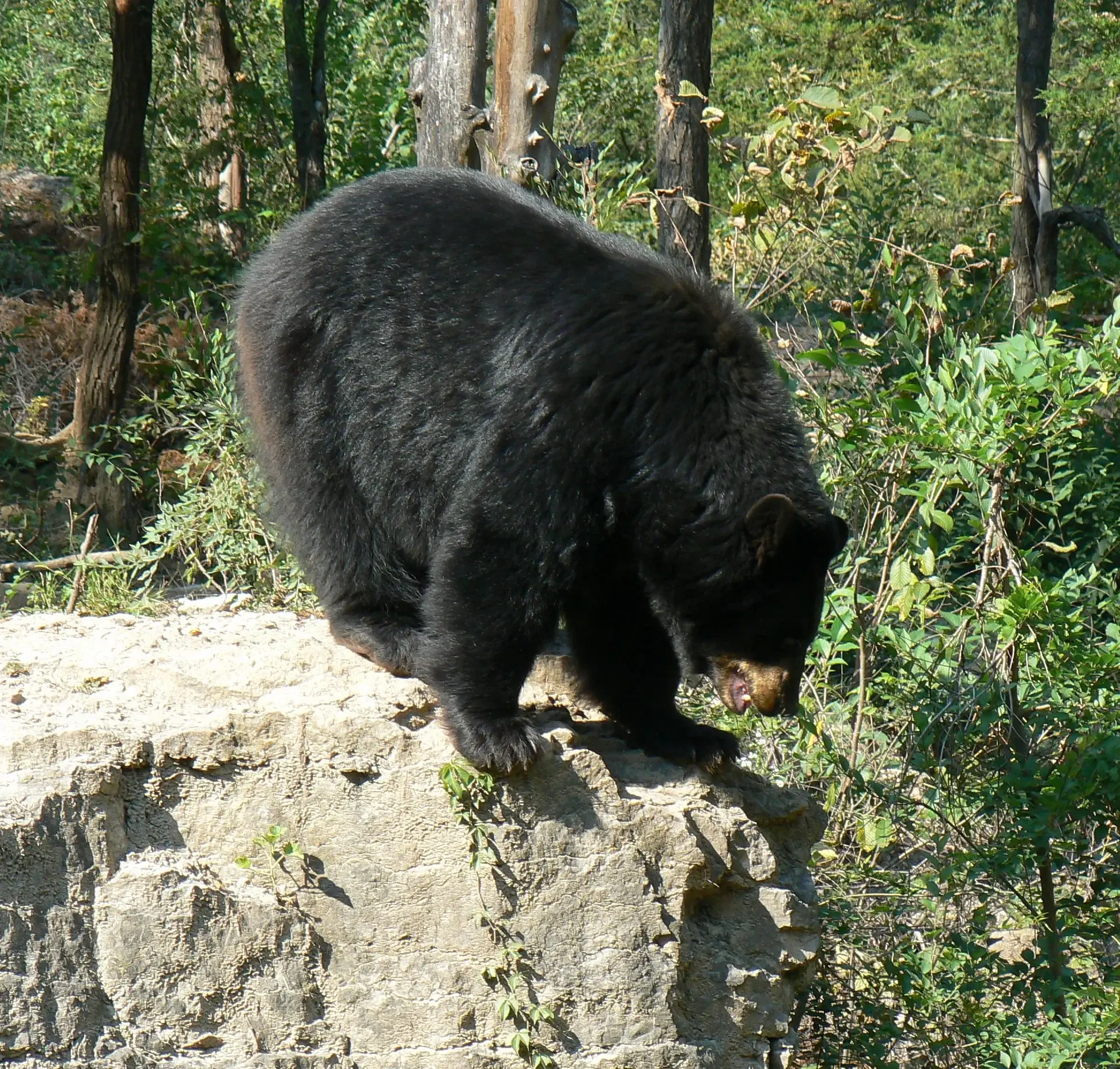
The American black bear, or simply black bear, is a species of medium-sized bear which is endemic to North America. It is the continent's smallest and most widely distributed bear species. It is an omnivore, with a diet varying greatly depending on season and location. It typically lives in largely forested areas; it will leave forests in search of food and is sometimes attracted to human communities due to the immediate availability of food.
Habitat & Range
Throughout their range, habitats preferred by American black bears have a few shared characteristics. They are often found in areas with relatively inaccessible terrain, thick understory vegetation and large quantities of edible material (especiallymasts). The adaptation to woodlands and thick vegetation in this species may have originally been because the bear evolved alongside larger, more aggressive bear species, such as the extinct giant short-faced bear and the grizzly bear, that monopolized more open habitats[45]and the historic presence of larger predators, such asSmilodonand theAmerican lion, that could have preyed on black bears. Although found in the largest numbers in wild, undisturbed areas and rural regions, American black bears can adapt to surviving in some numbers inperi-urbanregions, as long as they contain easily accessible foods and some vegetative coverage.[46] In most of the contiguous United States, American black bears today are usually found in heavily vegetated mountainous areas, from 400 to 3,000 m (1,300 to 9,800 ft) in elevation. For American black bears living in theAmerican Southwestand Mexico, habitat usually consists of stands ofchaparralandPinyon–juniper woodlands. In this region, bears occasionally move to more open areas to feed onprickly pear cactus. At least two distinct, prime habitat types are inhabited in theSoutheastern United States. American black bears in the southernAppalachian Mountainssurvive in predominantlyoak-hickoryand mixedmesophyticforests. In the coastal areas of the southeast (such asFlorida, theCarolinasandLouisiana), bears inhabit a mixture offlatwoods,baysand swampy hardwood sites.[citation needed] In the northeastern part of the range (the United States and Canada), prime habitat consists of a forest canopy ofhardwoodssuch asbeech,maple,birchandconiferousspecies.Corncrops and oak-hickory mast are also common sources of food in some sections of the northeast; small, thick swampy areas provide excellent refuge cover largely in stands ofwhite cedar. Along the Pacific coast,redwood,Sitka spruceandhemlockspredominate as overstory cover. Within these northern forest types are early successional areas important for American black bears, such as fields of brush, wet and drymeadows, hightidelands,riparian areasand a variety of mast-producing hardwood species. Thespruce-firforest dominates much of the range of the American black bear in theRockies. Important non-forested areas here are wet meadows, riparian areas, avalanche chutes, roadsides, burns, sidehill parks andsubalpine ridgetops.[citation needed] In areas where human development is relatively low, such as stretches of Canada and Alaska, American black bears tend to be found more regularly in lowland regions.[45]In parts of eastern Canada, especiallyLabrador, American black bears have adapted exclusively to semi-open areas that are more typical habitat in North America for brown bears (likely due to the absence there of brown and polar bears, as well as other large carnivore species).[46]
Life History
Euarctos americanus; Ursus (Euarctos) vitabilisGidley, 1913 TheAmerican black bear(Ursus americanus), or simplyblack bear, is aspeciesof medium-sizedbearwhich isendemictoNorth America. It is the continent's smallest and most widely distributed bear species. It is anomnivore, with a diet varying greatly depending on season and location. It typically lives in largely forested areas; it will leave forests in search of food and is sometimes attracted to human communities due to the immediate availability of food. TheInternational Union for Conservation of Nature(IUCN) lists the American black bear as aleast-concern speciesbecause of its widespread distribution and a large population, estimated to be twice that of all other bear species combined. Along with thebrown bear(Ursus arctos), it is one of the two modern bear species not considered by the IUCN to be globally threatened with extinction.
Hunting Season
No open season. Protected species in Alabama.
Frequently Asked Questions
Regulations for hunting American Black Bear in Alabama
The American black bear is a protected species in Alabama. There is no open hunting season. Black bears were once extirpated from Alabama but have been naturally recolonizing the state, with a small breeding population in the Mobile-Tensaw Delta. Sightings should be reported to ADCNR.
What is another name for American Black Bear?
American Black Bear is also known as Black bear in Alabama.
Where can I hunt American Black Bear in Alabama?
American Black Bear can be hunted in designated areas throughout Alabama. Check current ADCNR regulations for specific seasons and areas.
References
| State | Category | Directory | Subcategory | Content | Source |
|---|---|---|---|---|---|
| Alabama | Hunting | Regulations | Season Dates | No open season. Protected species in Alabama. | Link |
| Alabama | Hunting | Regulations | Regulations | The American black bear is a protected species in Alabama. There is no open hunting season. Black bears were once extirp | Link |