Also known as: Bullfrog
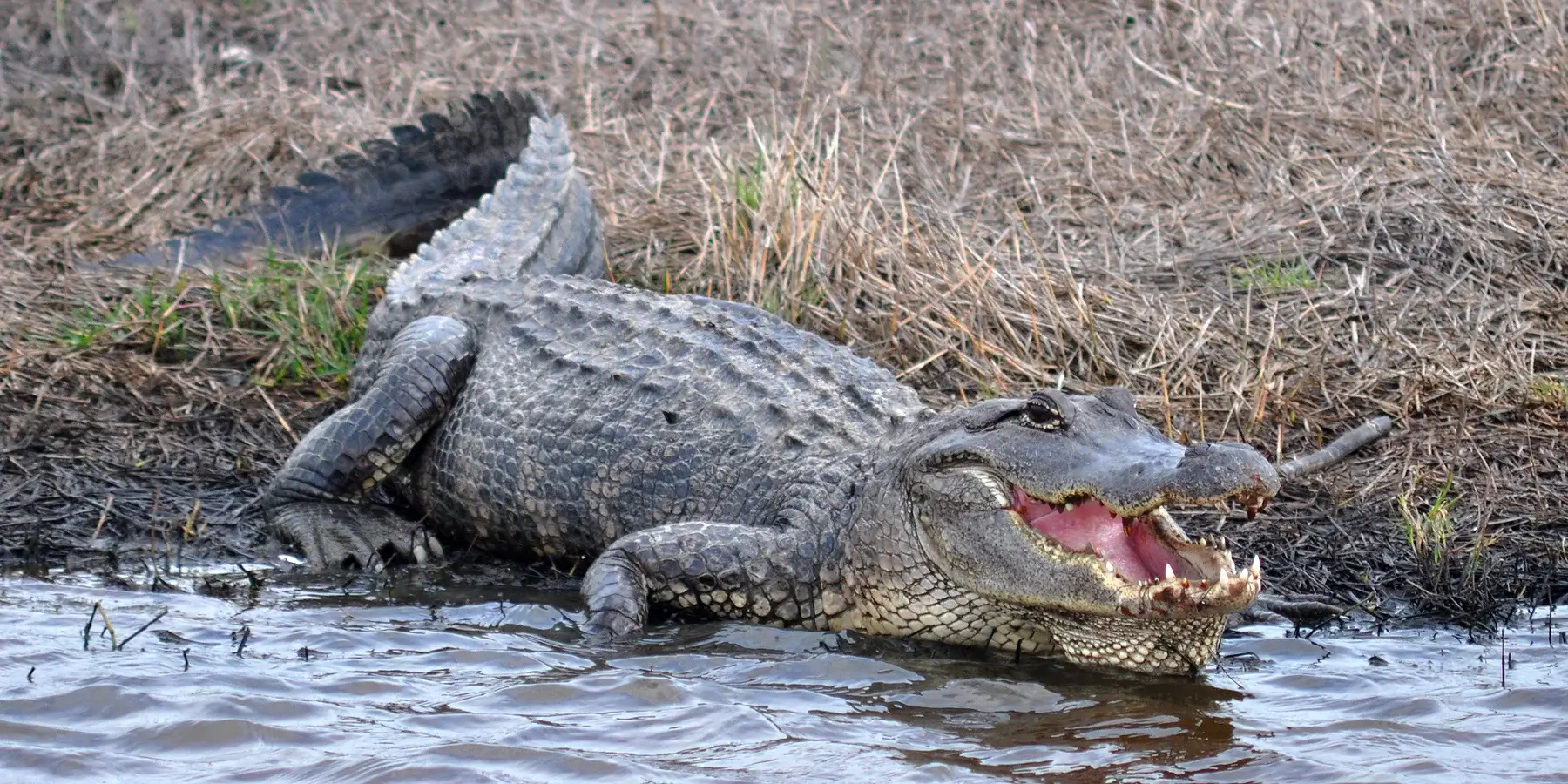
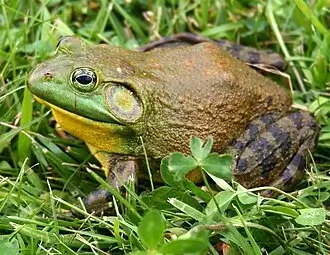
The American bullfrog, often simply known as the bullfrog in Canada and the United States, is a large true frog native to eastern North America. It typically inhabits large permanent water bodies such as swamps, ponds, and lakes. Bullfrogs can also be found in manmade habitats such as pools, koi ponds, canals, ditches, reservoirs and culverts. The bullfrog gets its name from the sound the male makes during the breeding season, which sounds similar to a bull bellowing. They are generalist carnivores, consuming a wide variety of prey. In turn, they are eaten by predators such as alligators, snakes, and birds.
Habitat & Range
The bullfrog isoriginally nativetoeastern North America, where it is commonly found in every U.S. state east of theMississippi River. Its natural range extends from the eastern CanadianMaritime Provincesto as far west asIdahoandTexas, and as far north asMichigan(including theUpper Peninsula),MinnesotaandMontana; it is largely absent inNorth Dakota.[20] Within North America, the bullfrog has beenintroducedtoNantucketisland, as well as portions of thewestern U.S., includingArizona,California,Colorado,Idaho,Nevada,New Mexico,Oregon,Utah,WashingtonandWyoming. In these states, it is considered to be aninvasive species, as concerns exist that it mayoutcompeteor prey upon native species of reptiles and amphibians, disrupting the delicate ecological balance of certain areas.[20]It is very common on theWest Coast, especially inCalifornia, where it is believed to pose a threat to theCalifornia red-legged frog, and is considered to be a factor in the decline of thatvulnerable species.[21]Bullfrogs have been found to feed on the young of several snakes, including the California endemicgiant garter snake, a threatened species.[22]In early 2023, theUtahDepartment of Natural Resources begantweetingtips on how to catch and cook bullfrogs in an effort to encourage residents to help control the growing population by catching the invasive frogs for food.[23] The bullfrog has also been introduced toHawaii,South America,Asia, theCaribbean, andEuropefor various purposes includingfrog farmingandpopulation controlof other species.[24]Specifically, the bullfrog has been introduced to the extreme south ofBritish Columbia,Canada, nearly every state inMexico, as well asBelgium,Cuba, theDominican Republic,Haiti,Italy,Jamaica, theNetherlands, andPuerto Rico.[25]It is also found inArgentina,Brazil,China,Colombia,Japan,South Korea,UruguayandVenezuela.[26][27]The reasons for introducing the bullfrog to these areas have largely been intentional, either to provide humans with a source of food[28]or asbiological control agents. In addition, the unintended escape of frogs from breeding establishments or scientific research facilities, captive escapees or released pets are also a possibility.[25]Conservationists are concerned that the bullfrog is relatively immune to thefungal infectionchytridiomycosis(also called 'chytrid' fungus) which has been ravaging numerous frog species: as it invades new territories, it may assist in the spread of this lethal fungus as anasymptomatic carrier, spreading the fungus to more susceptible, native species of frog it encounters.[29][27]
Life History
Rana catesbeianaShaw, 1802Rana pipiens–Daudin, 1802Rana taurinaCuvier, 1817Rana mugiensMerrem, 1820Rana scapularisHarlan, 1826Rana conspersaLeConte, 1855Rana catesbyanaCope, 1889Rana catesbyanaWerner, 1909Rana (Rana) catesbeiana–Boulenger, 1920Rana nantaiwuensisHsü, 1930Rana mugicusAngel, 1947Rana catesbyanaSmith, 1978Rana (Rana) catesbeianaDubois, 1987Rana (Aquarana) catesbeianaDubois, 1992Rana (Novirana, Aquarana) catesbeianaHillis & Wilcox, 2005Lithobates (Aquarana) catesbeianusDubois, 2006Rana (Lithobates) catesbeianaFouquette and Dubois, 2014; Rana catesbeianaShaw, 1802; Rana pipiens–Daudin, 1802; Rana taurinaCuvier, 1817; Rana mugiensMerrem, 1820; Rana scapularisHarlan, 1826; Rana conspersaLeConte, 1855; Rana catesbyanaCope, 1889; Rana catesbyanaWerner, 1909; Rana (Rana) catesbeiana–Boulenger, 1920; Rana nantaiwuensisHsü, 1930; Rana mugicusAngel, 1947; Rana catesbyanaSmith, 1978; Rana (Rana) catesbeianaDubois, 1987; Rana (Aquarana) catesbeianaDubois, 1992; Rana (Novirana, Aquarana) catesbeianaHillis & Wilcox, 2005; Lithobates (Aquarana) catesbeianusDubois, 2006; Rana (Lithobates) catesbeianaFouquette and Dubois, 2014 Rana catesbeianaShaw, 1802; Rana pipiens–Daudin, 1802; Rana taurinaCuvier, 1817; Rana mugiensMerrem, 1820; Rana scapularisHarlan, 1826; Rana conspersaLeConte, 1855; Rana catesbyanaCope, 1889; Rana catesbyanaWerner, 1909; Rana (Rana) catesbeiana–Boulenger, 1920; Rana nantaiwuensisHsü, 1930; Rana mugicusAngel, 1947; Rana catesbyanaSmith, 1978; Rana (Rana) catesbeianaDubois, 1987; Rana (Aquarana) catesbeianaDubois, 1992; Rana (Novirana, Aquarana) catesbeianaHillis & Wilcox, 2005; Lithobates (Aquarana) catesbeianusDubois, 2006; Rana (Lithobates) catesbeianaFouquette and Dubois, 2014 TheAmerican bullfrog(Lithobates catesbeianus), often simply known as thebullfroginCanadaand theUnited States, is a largetrue frognative to easternNorth America. It typically inhabits large permanent water bodies such asswamps,ponds, andlakes. Bullfrogs can also be found in manmade habitats such as pools,koi ponds,canals,ditches, reservoirs andculverts.[3]The bullfrog gets its name from the sound the male makes during thebreeding season, which sounds similar to abullbellowing. They aregeneralistcarnivores, consuming a wide variety of prey. In turn, they are eaten by predators such asalligators, snakes, and birds. The bullfrog is large and iscommonly eatenthroughout its range, especially in the southernUnited Stateswhere they are plentiful. Their use as a food source has led to bullfrogs beingintroducedoutside of their native range. Bullfrogs have been introduced to more than 40 countries and many continents includingWestern United States,the Caribbean,South America,Western Europe,Belgium,Italy,Spain,Greece,China,Japan,South Korea,Malaysia,Southeast Asia, and more.[4]In these places they are considered aninvasive speciesdue to their voracious appetite and the large number of eggs they produce, which has a negative effect on native amphibians, certain insects and other fauna. Bullfrogs are very skittish which can make their capture difficult and thus they often become established. Other than for food, bullfrogs are also used fordissectionin science classes.Albinobullfrogs are sometimes kept as pets, and bullfrogtadpolesare often sold at ponds or fish stores. Thedorsal(upper) surface of the bullfrog has anolive-greenbackground color, either plain or withmottlingand banding of grayish brown. Theventral(under) surface is off-white blotched with yellow or gray. Often, a marked contrast in color is seen between the green upper lip and the pale lower lip.[12]Theteethare tiny and are useful only in grasping.[13]The eyes are prominent with brownirisesand horizontal,almond-shapedpupils. Thetympana(eardrums) are easily seen just behind the eyes and thedorsolateralfolds of skin enclose them. The limbs are blotched or banded with gray. The fore legs are short and sturdy and the hind legs are long. The front toes are notwebbed, but the back toes have webbing between the digits with the exception of the fourth toe, which is unwebbed.[12] Bullfrogs aresexually dimorphic, with males being smaller than females and having yellow throats.[14]Males have tympana larger than their eyes, whereas the tympana in females are about the same size as the eyes.[12]Bullfrogs measure about 3.6 to 6 in (9 to 15 cm) in snout–to–ventlength. They grow fast in the first eight months of life, typically increasing in weight from 5 to 175 g (0.18 to 6.17 oz),[15]and large, mature individuals can weigh up to 500 g (1.1 lb).[16]In some cases bullfrogs have been recorded as attaining 800 g (1.8 lb) and measuring up to 8 in (20 cm) from snout to vent. The American bullfrog is the largest species oftrue frogin North America.[15][17] Bullfrogs are voracious, opportunistic,ambush predatorsthat prey on any small animal they can overpower and consume. Bullfrog stomachs have been found to containrodents, smalllizardsandsnakes, otherfrogsandtoads, otheramphibians,crayfish, othercrustaceans,[30]small birds,scorpions,tarantulasandbats,[31][32]as well as the many types ofinvertebrates, such assnails,wormsandinsects, which are the usual food of ranid frogs.[33]These studies revealed the bullfrog's diet to be unique among North American ranids in the inclusion of a large percentage of aquatic animals, such as fish, tadpoles,ram's horn snails, anddytiscid beetles, as well as the aquatic eggs of fish, frogs, insects, orsalamanders.[30]Cannibalismhas been observed in bullfrog populations in resource-limited environments.[34]Bullfrogs are able to capture large, strong prey because of the powerful grip of their jaws after the initial ranid tongue strike. However, there is a correlation found with size of prey relative to body size of the bullfrog. Juveniles and adults typically go after prey that is relative to their own body size.[35]The bullfrog is able to make allowance for lightrefractionat the water-air interface by striking at a position posterior to the target's perceived location. The comparative ability of bullfrogs to capture submerged prey, compared to that of the green frog, leopard frog, and wood frog (L. clamitans,L. pipiens, andL. sylvaticus, respectively) was also demonstrated in laboratory experiments.[13] Prey motion elicits feeding behavior. First, if necessary, the frog performs a single, orienting bodily rotation ending with the frog aimed towards the prey, followed by approaching leaps, if necessary. Once within striking distance, the bullfrog begins its feeding strike, which consists of a ballistic lunge (eyes closed as during all leaps) that ends with the mouth opening. At this stage, the fleshy, mucus-coated tongue is extended towards the prey, often engulfing it, while the jaws continue their forward travel to close (bite) just as the tongue is retracted. Large prey that do not fit entirely into the mouth are stuffed in with the hands. In laboratory observations, bullfrogs taking mice usually swam underwater with prey in mouth, apparently with the advantageous result of altering the mouse's defense from counter-attack to struggling for air.Asphyxiationis the most likely cause of death ofwarm-bloodedprey.[13] Bullfrogs are an important item of prey to many birds (especially largeherons),North American river otters(Lontra canadensis),predatory fish, and occasionally other amphibians. Predators of American bullfrogs once in their adult stages can range from 150 g (5.3 oz)belted kingfishers(Megaceryle alcyon) to 1,100 lb (500 kg)American alligators(Alligator mississippiensis).[36][37]The eggs and larvae are unpalatable to manysalamandersandfish, but the high levels of activity of the tadpoles may make them more noticeable to a predator not deterred by their unpleasant taste. Humans hunt bullfrogs asgameand consume their legs. Adult frogs try to escape by splashing and leaping into deep water. A trapped individual may squawk or emit a piercing scream, which may surprise the attacker sufficiently for the frog to escape. An attack on one bullfrog is likely to alert others in the vicinity to danger and they will all retreat into the safety of deeper water. Bullfrogs may be at least partially resistant to thevenomof copperhead (Agkistrodon contortrix) and cottonmouth (Agkistrodon piscivorus) snakes, though these species are known natural predators of bullfrogs as arenorthern water snakes(Nerodia sipedon).[27][38][39] Multiple traits ofL. catesbeianuscontribute to itscompetitiveability, especially as an invasive. The generalist diet of the American bullfrog allows for it to consume food in different environments. They directly predate indigenous frog species, leading to numerous frog declines.[40]When observing the contents of American bullfrog stomachs, it was discovered that adult bullfrogs regularly consume predators of bullfrog young, includingdragonfly nymphs, garter snakes, andgiant water bugs. Thus, the ecological check on American bullfrog juveniles in invaded areas become less effective.L. catesbeianusseems to exhibit traits of immunity or resistance against theantipredator defensesof other organisms, with analysis of stomach contents from New Mexican bullfrogs showing the regular consumption ofwasps, with no conditioned avoidance due to the wasps' stingers. Along the Colorado river,L. catesbeianusstomach contents indicate the ability to withstand the discomforting spines of thestickleback fish. Reports of American bullfrogs eatingscorpionsandrattlesnakesalso exist.[41] Analysis of the American bullfrog's realized niche at various sites in Mexico, and comparisons with the niches of endemic frogs show that it is possible that the American bullfrog capable of niche shift, and pose a threat to many endemic Mexican frog species, even those that are not currently in competition with the American bullfrog.[42] Self-sustaining populations of American bullfrogs became established in the United Kingdom around 1999, where their introduction was likely due to accidental escapes and deliberate releases from captivity. These populations appear to be quite small, and are undergoing control byNatural Englandas the species poses a threat to native amphibians.[43] The American bullfrog has been known to spread the amphibian pathogenBatrachochytrium dendrobatidisamong populations that it has been introduced to.[44] After selecting a male, the female deposits eggs in his territory.[50]Duringamplexus, the male rides on top of the female, grasping her just behind her fore limbs. The female chooses a site in shallow water among vegetation, and lays a batch of up to 20,000 eggs, and the male simultaneously releases sperm, resulting inexternal fertilization.[63]The eggs form a thin, floating sheet which may cover an area of 0.5 to 1.0 m2(5.4 to 10.8 sq ft). The embryos develop best at water temperatures between 24 and 30 °C (75 and 86 °F) and hatch in three to five days. Tadpole; Froglet with tail; Juvenile with a small, grey, oval-shaped area on top of the head, theparietal eye If the water temperature rises above 32 °C (90 °F), developmental abnormalities occur, and if it falls below 15 °C (59 °F), normal development ceases.[20]Newly hatched tadpoles show a preference for living in shallow water on fine gravel bottoms. American bullfrog tadpoles have also "showed a preference for habitats containing structure."[64]This may reflect a lesser number of predators in these locations. As they grow, they tend to move into deeper water. The tadpoles initially have three pairs of external gills and several rows of labial teeth. They pump water through theirgillsby movements of the floor of their mouths, trapping bacteria, single-celledalgae,protozoans, pollen grains, and other small particles on mucus in a filtration organ in theirpharynges. As they grow, they begin to ingest larger particles and use their teeth for rasping. They have downward-facing mouths, deep bodies, and tails with broad dorsal and ventral fins.[65] Time tometamorphosisranges from a few months in the southern part of the range to 3 years in the north, where the colder water slows development.[63]Maximum lifespan in the wild is estimated to be 8 to 10 years, but one frog lived for almost 16 years in captivity.[63]
Hunting Season
No closed season. Year-round harvest allowed.
Frequently Asked Questions
Regulations for hunting American Bullfrog in Alabama
American bullfrogs may be harvested year-round in Alabama with no bag limit. Frogs may be taken by hand, gig, spear, or hook and line. A valid hunting or fishing license is required.
When is American Bullfrog hunting season in Alabama?
No closed season. Year-round harvest allowed.
What is another name for American Bullfrog?
American Bullfrog is also known as Bullfrog in Alabama.
References
| State | Category | Directory | Subcategory | Content | Source |
|---|---|---|---|---|---|
| Alabama | Hunting | Regulations | Season Dates | No closed season. Year-round harvest allowed. | Link |
| Alabama | Hunting | Regulations | Regulations | American bullfrogs may be harvested year-round in Alabama with no bag limit. Frogs may be taken by hand, gig, spear, or | Link |