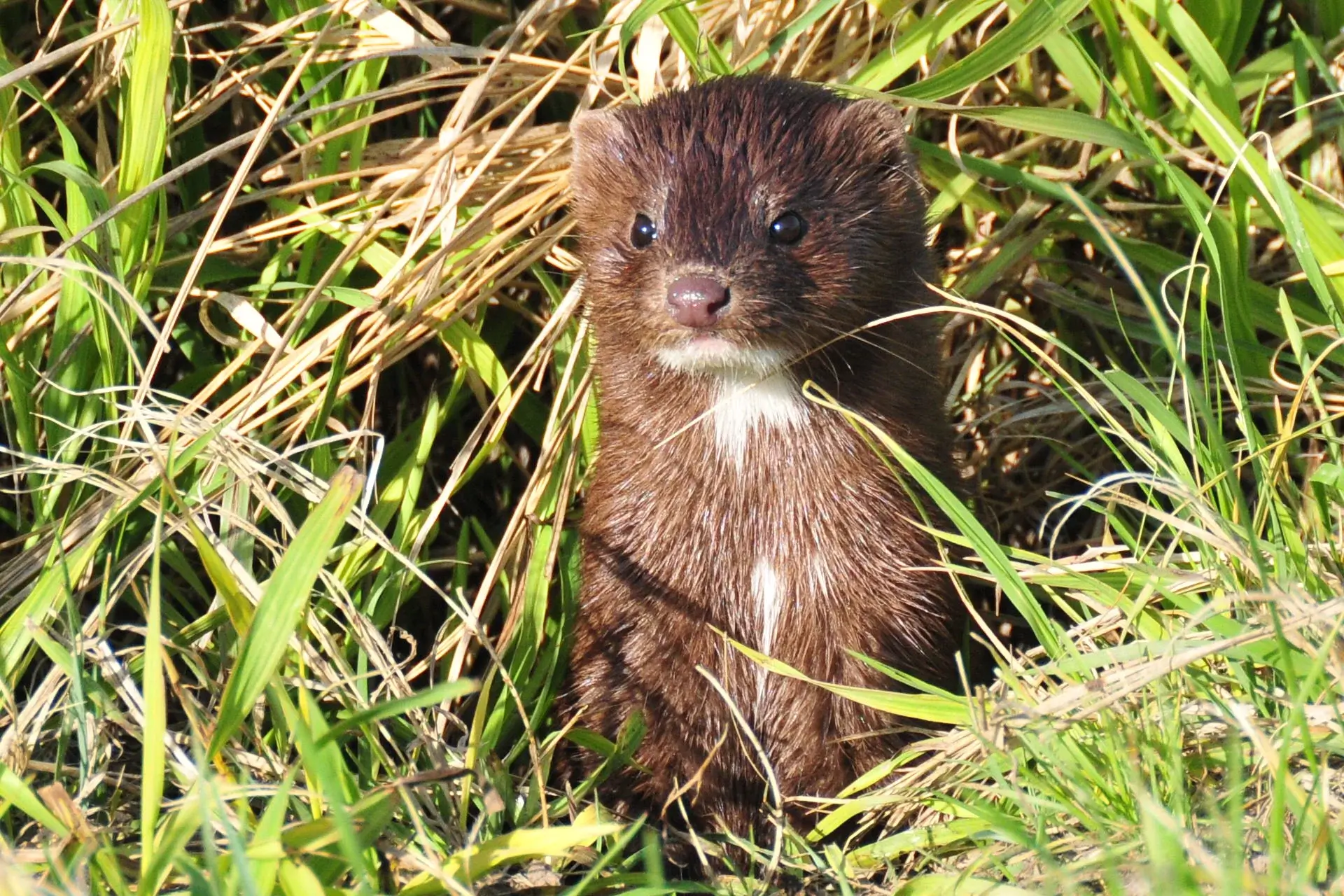
Adult American minks are almost entirely brown with a white chin and irregular white spots on the throat, chest, and belly. Males reach 27 inches long and 3 pounds, while females are smaller at up to 21 inches and 2 pounds. Unlike river otters, a mink's tail is not thick at the base or flat on the bottom. They have musk glands in the anal region that produce a strong odor.
Habitat & Range
Minks need permanent water and prefer woods nearby, dwelling along river and stream banks, shores of lakes and marshes, and farm ponds. They live under tree roots, in cavities in banks, under logs or stumps, in hollow trees, or in muskrat burrows and lodges.
Life History
Minks prey on mice, rabbits, fish, crayfish, and other animals, carrying food to a den to eat. Breeding begins in late February through early April, with gestation averaging 51 days; a single annual litter of 4–5 young appears in early May, and the family stays together until late August.
Status, Trends & Threats
The species is described as uncommon in Missouri, with harvest regulated in accordance with the mink population density. Minks prey on small animals while also serving as prey for larger predators from great horned owls to coyotes.
Frequently Asked Questions
Is mink trapping legal in Missouri?
Yes, minks are classified as a furbearer in Missouri and may be trapped during the prescribed trapping season. A valid Missouri trapping permit is required.
What is the best trapping method for mink in Missouri?
Minks are commonly trapped using foothold traps or body-grip traps set along waterways, near den entrances, or on mink runs. Traps should be placed in shallow water or at the water's edge.
What is the mink trapping season in Missouri?
Mink trapping season in Missouri typically runs from mid-November through February. Exact season dates are established annually by the Missouri Conservation Commission. Hunters and trappers should consult the current regulations.