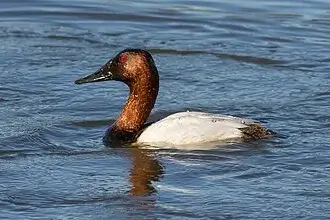
The adult male canvasback has a chestnut head, long sloping blackish bill, black chest and under tail coverts, and a white body. Females are light brown with grayish back and sides. Like other bay ducks, canvasbacks typically dive completely underwater and must run along the water's surface to take flight, patting their feet as they gain lift. They reach about 21 inches in length.
Habitat & Range
Canvasbacks are usually found on lakes, rivers, and marshes, and compared to similar diving ducks they are more frequently found in deeper water. In fall and winter, they are often observed in large rafts or groups on open water, most commonly along the Mississippi River in Missouri.
Life History
Canvasbacks forage on the bottom for invertebrates and plants, and can also dabble when needed. Their species name references Vallisneria americana (American eelgrass or wild celery), a favored food. Prime breeding habitat is the prairie pothole lakes from Iowa to Alberta, extending to interior Alaska, and they build floating nests among cattails and other emergent plants.
Status, Trends & Threats
Listed as a common migrant and an uncommon winter resident along the Mississippi River, rare elsewhere in the state. Habitat protection, especially of their prairie pothole breeding grounds, is critical to maintaining canvasback populations.
Frequently Asked Questions
Why are canvasbacks considered a prized duck for hunting?
The canvasback was long considered one of the best-tasting duck species, making it a highly sought-after game bird. Their large size, excellent table quality, and challenging diving behavior make them a trophy species for many waterfowl hunters.
Where is the best place to hunt canvasbacks in Missouri?
Canvasbacks are most commonly found along the Mississippi River in Missouri, where they occur as uncommon winter residents. They prefer deeper water on lakes, rivers, and marshes compared to other diving ducks, and can often be found in large rafts on open water during fall and winter.
How can I identify a canvasback in the field?
The male canvasback is distinctive with a chestnut head, long sloping blackish bill, black chest, and white body. They are larger than most diving ducks at about 21 inches. Unlike dabbling ducks, they must run along the water's surface to take flight, and their feet sit farther back on their bodies, making them sit upright on land.