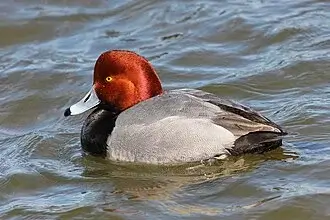
The adult male redhead features a chestnut-red head, black breast and rear end, and gray body with wing stripes, while females are brown with a darker back, black-tipped blue bill, and buffy eye ring. These diving ducks must run along the water's surface to take flight, with feet positioned farther back on their bodies than dabbling ducks. They reach about 19 inches in length.
Habitat & Range
Redheads inhabit marshes, sloughs, ponds, lakes, reservoirs, and streams with abundant submerged aquatic vegetation and open, ice-free water. They often occur in mixed-species flocks with other diving ducks such as lesser scaup, ring-necked ducks, and canvasbacks.
Life History
Redheads dive completely underwater to forage on aquatic plant roots, shoots, and parts, along with small aquatic animals like snails and clams. Females frequently engage in nest parasitism, laying eggs in other redhead nests and those of other ducks, though unlike cowbirds, those parasitic eggs rarely hatch.
Status, Trends & Threats
The species is an uncommon migrant in Missouri and is not known to breed in the state, though rarely observed in summer. They are rarely reported statewide in winter in small groups, and their numbers are tracked with game laws structured to keep populations healthy.
Frequently Asked Questions
How can I distinguish a redhead from a canvasback while hunting?
The canvasback is differentiated from the redhead by its white body, blackish long bill, sloping head profile, and larger size. Redheads have a rounder head, blue-tipped bill, and gray body, making them distinguishable in flight and on the water.
Where can I find redheads in Missouri?
Redheads are uncommon migrants in Missouri, found in marshes, sloughs, ponds, lakes, reservoirs, and streams with abundant submerged aquatic vegetation and open water. They often mix with other diving ducks like scaup, ring-necked ducks, and canvasbacks.
When are redheads present in Missouri for hunting?
Redheads migrate through Missouri in spring and fall between northern breeding grounds and western North American overwintering territory. They are uncommon migrants and rarely seen in Missouri in winter, so peak opportunities occur during migration periods.