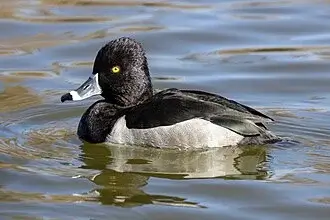
This medium-sized diving duck reaches 17 inches and has a peaked head and sloping forehead. The male is all dark with well-defined gray sides and a white stripe between sides and breast, while the female is dark brown with lighter sides and a white eye ring. Despite its name, the cinnamon neck ring is usually not visible in the field.
Habitat & Range
Found statewide in Missouri, the ring-necked duck occurs in marshes, swamps, sloughs, ponds, lakes, reservoirs, and large rivers, often in areas free of emergent aquatic vegetation. It seems to prefer shallow, acid marshes.
Life History
Like other diving ducks, ring-necked ducks dive completely underwater to forage, eating aquatic vegetation and invertebrates. They are migratory and are most often seen in Missouri as they fly through in spring and fall between northern breeding grounds and western overwintering territory.
Status, Trends & Threats
Listed as a common migrant and common winter resident, especially in southern Missouri. Not known to breed in the state. Numbers are tracked and game laws are structured to keep populations healthy. They are easily seen at Mingo National Wildlife Refuge or Duck Creek Conservation Area in winter.
Frequently Asked Questions
Where are the best places to hunt ring-necked ducks in Missouri?
Ring-necked ducks are common winter residents in southern Missouri and can be easily found at Mingo National Wildlife Refuge and Duck Creek Conservation Area. They prefer shallow marshes, swamps, ponds, and lakes, often in areas free of emergent aquatic vegetation.
How can I identify a ring-necked duck in flight?
Ring-necked ducks have a distinctive peaked head and sloping forehead. They must run along the water's surface, patting their feet, to take flight. Their feet sit farther back on their bodies than dabbling ducks, making them sit more upright on land. The cinnamon neck ring is usually not visible, so look for the peaked head shape and the male's dark body with gray sides.
When is the best time to hunt ring-necked ducks in Missouri?
Ring-necked ducks are most commonly seen in Missouri during spring and fall migration, and they are common winter residents especially in southern Missouri. They congregate in rafts or groups on open water in fall and winter, often mixed with lesser scaup, redheads, and canvasbacks.