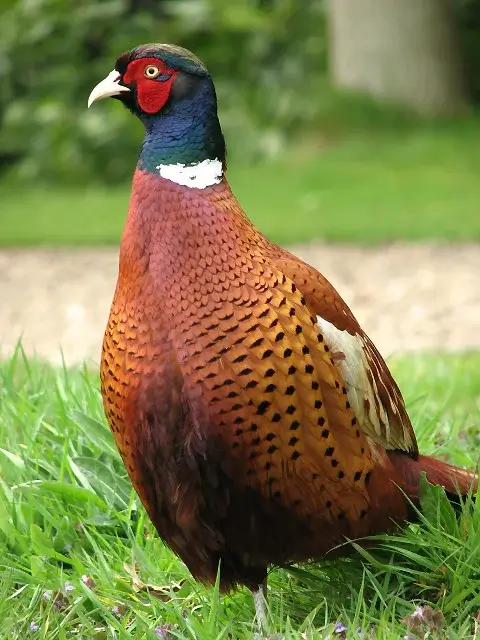
This long-tailed, chickenlike bird is native to Asia and introduced to North America. The adult male shows an iridescent mix of bronze, green, and black with a red patch around the eye and usually a white neck ring. Females are brown with a pointed tail, unlike the rounded tail of grouse and prairie-chickens.
Habitat & Range
Pheasants use hayfields, pastures, idle grasslands, wetlands, and Conservation Reserve Program lands. They prefer undisturbed dense vegetation 9–17 inches tall near brush, shrubs, and trees within a quarter mile of grain, where about 50 percent of the land is cultivated.
Life History
Males perform mating displays in spring, attracting hens with a harsh two-syllable call, and may crow throughout the year. Nests are on the ground with 7–15 eggs, hatching in 23 days, and the precocial young can leave the nest in just a few hours. They eat grain, seeds, leaves, berries, and insects, foraging by scratching and pecking on the ground.
Status, Trends & Threats
Described as a nonnative, uncommon permanent resident in northern Missouri's Glaciated Plains and rare in the central Mississippi Lowlands. Attempts to establish huntable populations of this introduced gamebird in Missouri have had only limited success.
Frequently Asked Questions
Is there a pheasant hunting season in Missouri?
Yes, Missouri has a pheasant hunting season, but it is limited to specific northern counties where huntable populations exist. The season typically runs from early November through mid-January.
What is the bag limit for ring-necked pheasant in Missouri?
The daily bag limit for ring-necked pheasant in Missouri is typically 2 roosters (males only), with a possession limit of 4. Hunters should verify current limits in the Missouri Small Game Hunting Regulations.
Where are the best areas for pheasant hunting in Missouri?
Pheasants in Missouri are primarily found in the northern Glaciated Plains region, where agricultural landscapes with hayfields, pastures, and Conservation Reserve Program lands provide suitable habitat. They are uncommon and rare outside this region.