Also known as: Eastern wild turkey
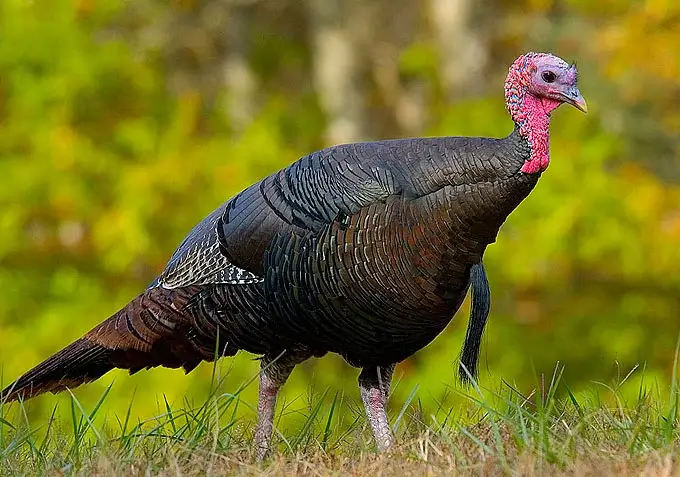
Scientific Name:Meleagris gallopavoClassification:Big GameAbundance:Common throughout state Report Wild Turkey Observations When early European settlers arrived in America turkeys were plentiful in North Carolina and were probably found throughout the entire state. By the turn of the century, however, few turkeys remained. The decline was primarily due to unregulated and heavy market hunting, rapid deforestation and habitat destruction throughout the state. This decline continued into the 1960s. Turkeys are once again common in North Carolina, thanks to a restoration program implemented by the N.C. Wildlife Resources Commission that involved live-trapping and relocating wild turkeys from sites in North Carolina and other states to areas in the state where the bird had previously disappeared. The male eastern wild turkey has dark plumage with striking bronze, copper and green iridescent colors. On the inside of their legs, males have pointed growths known as spurs that they use when battling other males for mates. Males also have a growth of bristle-like feathers known as the “beard” that extends from the chest. It is not uncommon, however, to find females with a beard. The head and neck of adult males is largely bare and varies in color from red to blue to white, depending on the bird’s mood. Females are usually duller in color than males, which help camouflage them while they are nesting. The eastern wild turkey thrives best in areas with a mix of forested and open land habitats. Forested areas are used for cover, foraging, and for roosting in trees at night. Open land areas are used for foraging, mating, and brood rearing. Trouble Shooting Turkeys- Ever been plagued by a gobbler gremlin? These common maladies and cures could be the closest thing to a turkey hunting quick fix. Since 1953, 6,031 wild turkeys have been released on 358 restoration sites across the state. Almost three-fourths of these birds (4,443) have been relocated just since 1990. Wild turkey restoration is now complete in North Carolina. Since 1989, 1,744 wild turkeys have been acquired from other states (AL, AR, CT, IA, MI, PA, SC, VA, & WI) through the National Wild Turkey Federation’s Super Fund Program to supplement in-state trapping efforts. These birds were acquired at cost of $925,727 ($608,000 was funded by the NC Wildlife Resources Commission and $309,477 was funded by the NC State Chapter, NWTF). An additional 150 birds were acquired from West Virginia in a trade for 100 river otters. The wild turkey population has increased from an estimated 2,000 birds in 1970 to an estimated 265,000 birds in 2015. Wild turkeys now exist in all 100 counties in the state and all 100 counties now have a spring gobbler season. The reported wild turkey harvest has increased from 144 birds in 1977, when mandatory reporting began, to 8,846 birds in 2004. The first winter harvest in over three decades was held in nine counties in January of 2004 with 181 birds being reported for a combined total harvest in 2004 of 9,027 birds. Gobbling Chronology Project Report Wild Turkey Disease Project - Lymphoproliferative Disease Virus LPDV 2016
Habitat & Range
When early European settlers arrived in America turkeys were plentiful in North Carolina and were probably found throughout the entire state. By the turn of the century, however, few turkeys remained. The decline was primarily due to unregulated and heavy market hunting, rapid deforestation and habitat destruction throughout the state. This decline continued into the 1960s. The eastern wild turkey thrives best in areas with a mix of forested and open land habitats. Forested areas are used for cover, foraging, and for roosting in trees at night. Open land areas are used for foraging, mating, and brood rearing.
Hunting Season
Spring season: April 5-May 10 (youth weekend: April 5-6). Fall season: Oct 18-Nov 29 (East), Oct 18-Nov 22 (West) - only in select counties.
Frequently Asked Questions
Regulations for hunting Wild Turkey in North Carolina
Wild turkey hunting in North Carolina has a spring gobbler season (April-May) in all 100 counties and a limited fall season in select counties. Spring limit is 1 bearded gobbler per day, 2 per season. Fall limits vary by zone. Hunting hours are 30 minutes before sunrise until noon in spring. Shotguns with #4 or smaller shot are required for spring turkey. Hunter orange not required when hunting turkey. A Big Game Harvest Report Card is required.
How many wild turkeys are in North Carolina?
The wild turkey population has rebounded dramatically from about 2,000 birds in 1970 to approximately 270,000 birds in 2020, thanks to a successful live-trapping and relocation program. The restoration officially ended in 2005.
How do you tell a male from a female wild turkey?
Male turkeys (toms/gobblers) have dark plumage with iridescent bronze, copper, and green colors, leg spurs, and a beard of bristle-like chest feathers. Their bare heads change color from red to blue to white depending on mood. Females are duller in color for nesting camouflage.
When is Wild Turkey hunting season in North Carolina?
The hunting season for Wild Turkey in North Carolina is: Spring season: April 5-May 10 (youth weekend: April 5-6). Fall season: Oct 18-Nov 29 (East), Oct 18-Nov 22 (West) - only in select counties.
What is the bag limit for Wild Turkey in North Carolina?
The bag limit for Wild Turkey in North Carolina is: Spring: 1 bearded gobbler per day, 2 per season. Fall: 1 either-sex per day, 2 per season (West), 1 per day (East, bearded only).
What's another name for Wild Turkey?
Wild Turkey is also known as Eastern wild turkey in North Carolina.
References
| State | Category | Directory | Subcategory | Content | Source |
|---|---|---|---|---|---|
| North Carolina | Hunting | Regulations | Season Dates | Spring season: April 5-May 10 (youth weekend: April 5-6). Fall season: Oct 18-Nov 29 (East), Oct 18-Nov 22 (West) - only | Link |
| North Carolina | Hunting | Regulations | Regulations | Wild turkey hunting in North Carolina has a spring gobbler season (April-May) in all 100 counties and a limited fall sea | Link |