Also known as: Black duck, Eastern black duck, Red-legged black duck
The American black duck (Anas rubripes) is a large dabbling duck in the family Anatidae. It was described by William Brewster in 1902. It is the heaviest species in the genus Anas, weighing 720–1,640 g (1.6–3.6 lb) on average and measuring 54–59 cm (21–23 in) in length with an 88–95 cm (35–37 in) wingspan. It somewhat resembles the female and eclipse male mallard in coloration, but has a darker plumage. The male and female are generally similar in appearance, but the male's bill is yellow while the female's is dull green with dark marks on the upper mandible. It is native to eastern North America. During the breeding season, it is usually found in coastal and freshwater wetlands from Saskatchewan to the Atlantic in Canada and the Great Lakes and the Adirondacks in the United States. It is a partially migratory species, mostly wintering in the east-central United States, especially in coastal areas.
It interbreeds regularly and extensively with the mallard, to which it is closely related. The female lays six to fourteen oval eggs, which have smooth shells and come in varied shades of white and buff green. Hatching takes 30 days on average. Incubation usually takes 25 to 26 days, with both sexes sharing duties, although the male usually defends the territory until the female reaches the middle of her incubation period. It takes about six weeks to fledge. Once the eggs hatch, the hen leads the brood to rearing areas with abundant invertebrates and vegetation.
The American black duck is considered to be a species of least concern by the International Union for Conservation of Nature (IUCN), although some populations of the species are in decline. It has long been valued as a game bird. Habitat loss due to drainage, global warming, filling of wetlands due to urbanization and rising sea levels are major reasons for the declining population of the American black duck. The United States Fish and Wildlife Service has been purchasing and managing the habitat of this species in many areas to support the migratory stopover, wintering and breeding populations. The Atlantic Coast Joint Venture also protects habitat through restoration and land acquisition projects, mostly within their wintering and breeding areas.
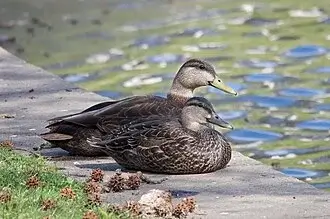
The American black duck weighs 720–1,640 g (1.59–3.62 lb) and measures 54–59 cm (21–23 in) in length with a 88–95 cm (35–37 in) wingspan. This species has the highest mean body mass in the genus Anas, with a sample of 376 males averaging 1.4 kg (3.1 lb) and 176 females averaging 1.1 kg (2.4 lb), although its size is typically quite similar to that of the familiar mallard. The American black duck somewhat resembles the female mallard in coloration, although the black duck's plumage is darker. Males and females are generally similar in appearance, but the male's bill is yellow while the female's is dull green with dark marks on the upper mandible, which is occasionally flecked with black. The head is brown, but is slightly lighter in tone than the darker brown body. The cheeks and throat are streaked brown, with a dark streak going through the crown and dark eye. The speculum feathers are iridescent violet-blue with predominantly black margins. The fleshy orange feet of the duck have dark webbing.
Both male and female American black ducks produce similar calls to their close relative, the mallard, with the female producing a loud sequence of quacks which falls in pitch.
In flight, the white lining of the underwings can be seen in contrast to the blackish underbody and upperside. The purple speculum lacks white bands at the front and rear, and rarely has a white trailing edge. A dark crescent is visible on the median underwing primary coverts.
Juveniles resemble adult females, but have broken narrow pale edges of underpart feathers, which give a slightly streaked rather than scalloped appearance, and the overall appearance is browner rather than uniformly blackish. Juvenile males have brownish-orange feet while juvenile females have brownish feet and a dusky greyish-green bill.
Habitat & Range
The American black duck is endemic to eastern North America. In Canada, the range extends from northeastern Saskatchewan to Newfoundland and Labrador. In the United States, it is found in northern Illinois, Michigan, New Jersey, Ohio, Connecticut, Vermont, South Dakota, central West Virginia, Maine and on the Atlantic coast to North Carolina.
The American black duck is a habitat generalist as it is associated with tidal marshes and present throughout the year in salt marshes from the Gulf of Maine to coastal Virginia. It usually prefers freshwater and coastal wetlands throughout northeastern America, including brackish marshes, estuaries and edges of backwater ponds and rivers lined by speckled alder. It also inhabits beaver ponds, shallow lakes with sedges and reeds, bogs in open boreal and mixed hardwood forests, as well as forested swamps. Populations in Vermont have also been found in glacial kettle ponds surrounded by bog mats. During winter, the American black duck mostly inhabits brackish marshes bordering bays, agricultural marshes, flooded timber, agricultural fields, estuaries and riverine areas. Ducks usually take shelter from hunting and other disturbances by moving to brackish and fresh impoundments on conservation land.
Life History
Feeding: The American black duck is an omnivorous species with a diverse diet. It feeds by dabbling in shallow water and grazing on land. Its plant diet primarily includes a wide variety of wetland grasses and sedges, and the seeds, stems, leaves and root stalks of aquatic plants, such as eelgrass, pondweed and smartweed. Its animal diet includes mollusks, snails, amphipods, insects, mussels and small fishes.
During the breeding season, the diet of the American black duck consists of approximately 80% plant food and 20% animal food. The animal food diet increases to 85% during winter. During nesting, the proportion of invertebrates increases. Ducklings mostly eat water invertebrates for the first 12 days after hatching, including aquatic snowbugs, snails, mayflies, dragonflies, beetles, flies, caddisflies and larvae. After this, they shift to seeds and other plant food.
Breeding: The breeding habitat includes alkaline marshes, acid bogs, lakes, ponds, rivers, marshes, brackish marshes and the margins of estuaries and other aquatic environments in northern Saskatchewan, Manitoba, across Ontario, Quebec and the Atlantic Canadian Provinces, plus the Great Lakes and the Adirondacks in the United States. It is partially migratory, and many winter in the east-central United States, especially coastal areas; some remain year-round in the Great Lakes region. This duck is a rare vagrant to Great Britain and Ireland, where over the years several birds have settled in and bred with the local mallard. The resulting hybrid can present considerable identification difficulties.
Nest sites are well-concealed on the ground, often in uplands. Egg clutches have six to fourteen oval eggs, which have smooth shells and come in varied shades of white and buff green. On average, they measure 59.4 mm (2.34 in) long, 43.2 mm (1.70 in) wide and weigh 56.6 g (0.125 lb). Hatching takes 30 days on average. The incubation period varies, but usually takes 25 to 26 days. Both sexes share duties, although the male usually defends the territory until the female reaches the middle of her incubation period. It takes about six weeks to fledge. Once the eggs hatch, the hen leads the brood to rearing areas with abundant invertebrates and vegetation.
The American black duck interbreeds regularly and extensively with the mallard, to which it is closely related. Some authorities even consider the black duck to be a subspecies of the mallard instead of a separate species. Mank et al. argue that this is in error as the extent of hybridization alone is not a valid means to delimitate Anas species.
It has been proposed that the American black duck and the mallard were formerly separated by habitat preference, with the American black duck's dark plumage giving it a selective advantage in shaded forest pools in eastern North America, and the mallard's lighter plumage giving it an adva
Status, Trends & Threats
Status And Conservation: Since 1988, the American black duck has been rated as least concern on the IUCN Red List of Endangered Species. This is because the range of this species is extremely large, which is not near the threshold of vulnerable species. In addition, t
Hunting Season
North Zone: Oct 18 - Oct 25 and Nov 22 - Jan 22. South Zone: Oct 18 - Oct 25 and Nov 22 - Jan 22. Coastal Zone: Nov 22 - Jan 30.
Frequently Asked Questions
Regulations for hunting American Black Duck in New Jersey
American black duck is a prized waterfowl species in New Jersey with a restrictive bag limit of 2 per day. Same season dates and zone structure as other ducks. New Jersey is an important wintering area for black ducks along the Atlantic Flyway.
When is American Black Duck hunting season in New Jersey?
North Zone: Oct 18 - Oct 25 and Nov 22 - Jan 22. South Zone: Oct 18 - Oct 25 and Nov 22 - Jan 22. Coastal Zone: Nov 22 - Jan 30.
What is the bag limit for American Black Duck in New Jersey?
2 American black ducks per day (within the 6-duck aggregate limit).
What is another name for American Black Duck?
American Black Duck is also known as Black duck, Eastern black duck, Red-legged black duck in New Jersey.
References
| State | Category | Directory | Subcategory | Content | Source |
|---|---|---|---|---|---|
| New Jersey | Waterfowl | Regulations | Season Dates | North Zone: Oct 18 - Oct 25 and Nov 22 - Jan 22. South Zone: Oct 18 - Oct 25 and Nov 22 - Jan 22. Coastal Zone: Nov 22 - | Link |
| New Jersey | Waterfowl | Regulations | Regulations | American black duck is a prized waterfowl species in New Jersey with a restrictive bag limit of 2 per day. Same season d | Link |