Also known as: Coot, Mud hen, Marsh hen
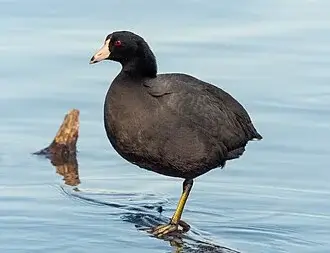
The American coot (Fulica americana), also known as a mud hen or pouldeau, is a bird of the family Rallidae. Though commonly mistaken for ducks, American coots are only distantly related to ducks, belonging to a separate order. Unlike the webbed feet of ducks, coots have broad, lobed scales on their lower legs and toes that fold back with each step to facilitate walking on dry land. Coots live near water, typically inhabiting wetlands and open water bodies in North America. Groups of coots are called covers or rafts. The oldest known coot lived to be 22 years old.
The American coot is a migratory bird that occupies most of North America. It lives in the Pacific and southwestern United States and Mexico year-round and occupies more northeastern regions during the summer breeding season. In the winter they can be found as far south as Panama. Coots generally build floating nests and lay 8–12 eggs per clutch. Females and males have similar appearances, but they can be distinguished during aggressive displays by the larger ruff (head plumage) on the male. American coots eat primarily algae and other aquatic plants but also animals (both vertebrates and invertebrates) when available.
The American coot is closely related to the Eurasian coot (Fulica atra), which occupies the same ecological niche in Eurasia and Australia as the American coot does in North America. Eurasian coots can be distinguished from this species by the absence of a red callus above the bird's frontal shield.
The American coot is listed as "Least Concern" under the IUCN conservation ratings. Hunters generally avoid killing American coots because their meat is not as sought after as that of ducks.
American coots display several interesting breeding habits; mothers will preferentially feed offspring with the brightest plume feathers, which has resulted in coot chicks having brightly ornamented plumage which becomes drabber as they age. American coots are also susceptible to conspecific brood parasitism and have evolved mechanisms to differentiate their offspring from those of parasitic females.
The American coot measures 34–43 cm (13–17 in) in length with a wingspan of 58 to 71 cm (23 to 28 in). Adults have a short, thick, white bill and white frontal shield, which usually has a reddish-brown spot near the top of the bill between the eyes. Males and females look alike, but females are smaller. Body mass in females ranges from 427 to 628 g (0.941 to 1.385 lb) and in males from 576 to 848 g (1.270 to 1.870 lb). Juvenile birds have olive-brown crowns and a gray body. They become adult-colored around 4 months of age.
Habitat & Range
American coots are found near water reed-ringed lakes and ponds, open marshes, and sluggish rivers. They prefer freshwater environments but may temporarily live in saltwater environments during the winter months.
The American coot's breeding habitat extends from marshes in southern Quebec to the Pacific coast of North America and as far south as northern South America. Birds from temperate North America east of the Rocky Mountains migrate to the southern United States and southern British Columbia. It is often a year-round resident where water remains open in winter. The number of birds that stay year-round near the northern limit of the species' range seems to be increasing.
Autumn migration occurs from August to December, with males and non-breeders moving south before the females and juveniles. Spring migration to breeding ranges occurs from late February to mid-May, with males and older birds moving North first. There has been evidence of birds travelling as far north as Greenland and Iceland.
Life History
Feeding: The American coot can dive for food but can also forage and scavenge on land. Their principal source of food is aquatic vegetation, especially algae. Yet they are omnivorous, also eating arthropods, fish, and other aquatic animals. During breeding season, coots are more likely to eat aquatic insects and mollusks—which constitute the majority of a chick's diet.
Breeding: The coot mating season occurs during May and June. Coot mate pairings are monogamous throughout their life, given they have a suitable territory. A typical reproductive cycle involves multiple stages: pairing, nesting, copulation, egg deposition, incubation, and hatching.
The American coot typically has long courtship periods. This courtship period is characterized by billing, bowing, and nibbling. Males generally initiate billing, which is the touching of bills between individuals. As the pair bond becomes more evident, both males and females will initiate billing only with each other and not other males or females. After a pair bond is cemented, the mating pair looks for a territory to build a nest in. A pair bond becomes permanent when a nesting territory is secured. Copulation behavior among coot pairs always falls under the same general pattern. First the male chases the female. Then, the female moves to the display platform and squats with her head under the water. The male then mounts the female, using his claws and wings to balance on the female's back while she brings her head above the water. Sexual intercourse usually takes no longer than two seconds.
Hunting Season
North Zone: Oct 18 - Oct 25 and Nov 22 - Jan 22. South Zone: Oct 18 - Oct 25 and Nov 22 - Jan 22. Coastal Zone: Nov 22 - Jan 30.
Frequently Asked Questions
Regulations for hunting American Coot in New Jersey
American coot hunting in New Jersey shares the same season dates and zones as duck hunting. The generous daily bag limit of 15 is separate from the 6-duck aggregate. Nontoxic shot required. HIP certification required.
When is American Coot hunting season in New Jersey?
North Zone: Oct 18 - Oct 25 and Nov 22 - Jan 22. South Zone: Oct 18 - Oct 25 and Nov 22 - Jan 22. Coastal Zone: Nov 22 - Jan 30.
What is the bag limit for American Coot in New Jersey?
15 coots per day.
What is another name for American Coot?
American Coot is also known as Coot, Mud hen, Marsh hen in New Jersey.
References
| State | Category | Directory | Subcategory | Content | Source |
|---|---|---|---|---|---|
| New Jersey | Waterfowl | Regulations | Season Dates | North Zone: Oct 18 - Oct 25 and Nov 22 - Jan 22. South Zone: Oct 18 - Oct 25 and Nov 22 - Jan 22. Coastal Zone: Nov 22 - | Link |
| New Jersey | Waterfowl | Regulations | Regulations | American coot hunting in New Jersey shares the same season dates and zones as duck hunting. The generous daily bag limit | Link |