Also known as: Common crow, Eastern crow
The American crow (Corvus brachyrhynchos) is a large passerine bird species of the family Corvidae. It is a common bird found throughout much of North America, only absent from the tundra biome. The American crow is the New World counterpart to the carrion crow and the hooded crow of Eurasia, occupying similar ecological niches.
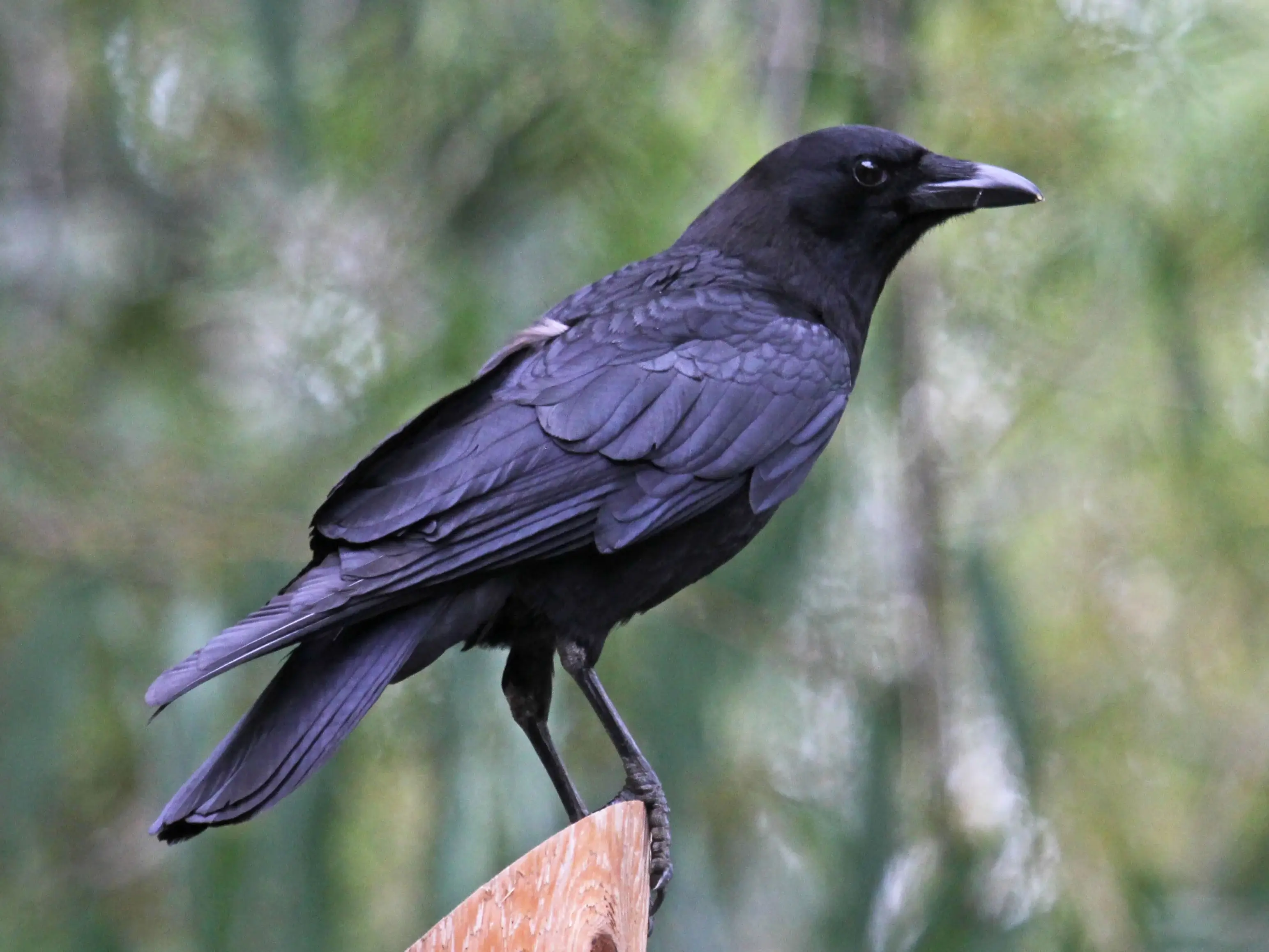
The American crow has all-black plumage, with iridescent feathers. It looks similar to other all-black corvids. It is highly intelligent, similar to other Corvidae, and is adaptable to human environments.
The American crow can be distinguished from the common raven by its smaller size and a slightly less pronounced beak, and from the carrion crow by its size, as the carrion crow is larger and of a stockier build. The American crow can be difficult to distinguish from the fish crow; however, the fish crow tends to fluff its throat feathers when calling. The American crow is an omnivore, feeding on insects, seeds, nuts, and preying on small animals. It also rarely feeds on carrion, leading to associations with death, thieves, and bad luck in some cultures; however, in Native American and some Gaelic cultures, crows are considered good luck due to their intelligence.
The American crow is common, widespread, and susceptible to the West Nile virus, making it a useful bioindicator for tracking the virus's spread. Direct transmission of the virus from crows to humans is impossible. According to BirdLife International, there are 31 million American crows as of 2012.
The American crow is a large, distinctive bird with iridescent black feathers all over. Its legs, feet, and bill are also black. They measure 40–53 cm (16–21 in) in length, of which the tail makes up about 40%. The wing chord is 24.5 to 33 cm (9.6 to 13.0 in), with the wingspan ranging from 85 to 100 cm (33 to 39 in). The bill length can be from 3 to 5.5 cm (1.2 to 2.2 in), varying strongly according to location. The tarsus is 5.5 to 6.5 cm (2.2 to 2.6 in) and the tail is 13.5 to 19 cm (5.3 to 7.5 in). The body mass can vary from 316 to 620 g (11.1 to 21.9 oz). Males tend to be larger than females.
The most usual call is a loud, short, and rapid caaw-caaw-caaw. Usually, the birds thrust their heads up and down as they utter this call. American crows can also produce a wide variety of sounds and sometimes mimic noises made by other animals, including other birds, such as barred owls.
Visual differentiation from the fish crow (C. ossifragus) is extremely difficult and often inaccurate. Nonetheless, differences apart from size do exist. Fish crows tend to have more slender bills and feet. There may also be a small, sharp hook at the end of the fish crow's upper bill. Fish crows also appear as if they have shorter legs when walking. More dramatically, when calling, fish crows tend to hunch and fluff their throat feathers.
If seen flying at a distance from where size estimates are unreliable, the distinctly larger common ravens (C. corax) can be distinguished by their almost lozenge-shaped tail and their larger-looking heads. They also fluff their throat feathers when calling, similarly to fish crows. Ravens also soar for extended periods, unlike crows, which rarely fly more than a few seconds without flapping their wings. Crows have been noted to be intelligent. They have the same brain-weight-to-body ratio as humans. This has led to some studies that have identified that crows are self-aware and that young crows take time to learn from tolerant parents. While a human has a neocortex, the crow uses a different area in its brain, the pallium, to perform similar tasks. They can remember and identify people based on their appearance.
The average lifespan of the American crow in the wild is 7–8 years. Captive birds are known to have lived up to 30 years. The West Nile virus is a major cause of death in crows.
Habitat & Range
The American crow has a large range, extending from the Pacific Ocean to the Atlantic Ocean in Canada, on the French islands of Saint-Pierre and Miquelon, south through the United States, and into northern Mexico. They have also been recorded in Bermuda from 1876 onwards. The increase in trees throughout the Great Plains during the past century due to fire suppression and tree planting facilitated range expansions of the American crow as well as range expansions of other species of birds such as the barred owl. The American crow inhabits virtually all types of country – from wilderness, farmland, parks, and open woodland to towns and major cities – and is absent only from tundra habitat. The American crow is a permanent resident in most of the US, but most Canadian birds migrate some distance southward in winter. Outside the nesting season, these birds often gather in large communal roosts of thousands or even millions of crows at night.
Life History
Reproduction: American crows are socially monogamous cooperative breeding birds. Mated pairs form large families of up to 15 individuals from several breeding seasons that remain together for many years. Offspring from a previous nesting season will usually remain with the family to assist in rearing new nestlings. American crows do not reach breeding age for at least two years. Most do not leave the nest to breed for four to five years.
The nesting season starts early, with some birds incubating eggs by early April. American crows build bulky stick nests, nearly always in trees but sometimes also in large bushes and, very rarely, on the ground. They will nest in a wide variety of trees, including large conifers, although oaks are most often used. Three to six eggs are laid and incubated for 18 days. The young are usually fledged by about 36 days after hatching. Predation primarily occurs at the nest site, and eggs and nestlings are frequently eaten by snakes, raccoons, ravens, and domestic cats. Adults are less frequently predated but face potential attack from great horned owls, red-tailed hawks, peregrine falcons, and both North American eagles. They may be attacked by predators such as coyotes or bobcats at carrion when incautious, although this is even rarer. American crows have been shown to be more wary of disturbances in urban environments. The American crow experiences inbreeding depression, yet research indicates they maintain a preference for such behavior.
Diet: The American crow is omnivorous. It will feed on invertebrates of all types, carrion, scraps of human food, fruits, nuts such as walnuts and almonds, seeds, eggs and nestlings, stranded fish on the shore, and various grains. American crows are active hunters and will prey on mice, young rabbits, frogs, and other small animals. In the winter and autumn, the diet of American crows is more dependent on nuts and acorns. Occasionally, they will visit bird feeders. The American crow is one of only a few species of birds that have been observed modifying and using tools to obtain food.
Like most crows, they will scavenge at landfills, scattering garbage in the process. Where available, corn, wheat, and other crops are a favorite food. These habits have historically caused the American crow to be considered a nuisance. However, it is suspected that the harm to crops is offset by the service the American crow provides by eating insect pests.
Hunting Season
Aug 11 - Nov 29 and Dec 15 - Mar 21. Hunting days only: Monday, Thursday, Friday, Saturday.
Frequently Asked Questions
Regulations for hunting American Crow in New Jersey
American crow hunting in New Jersey is restricted to specific days of the week (Mon, Thu, Fri, Sat). No bag limits. Hunting hours: sunrise to 1/2 hour after sunset. Electronic calls are permitted. No Sunday hunting. Crow hunting is a popular late-summer through spring activity.
When is American Crow hunting season in New Jersey?
Aug 11 - Nov 29 and Dec 15 - Mar 21. Hunting days only: Monday, Thursday, Friday, Saturday.
What is another name for American Crow?
American Crow is also known as Common crow, Eastern crow in New Jersey.
References
| State | Category | Directory | Subcategory | Content | Source |
|---|---|---|---|---|---|
| New Jersey | Upland Game Birds | Regulations | Season Dates | Aug 11 - Nov 29 and Dec 15 - Mar 21. Hunting days only: Monday, Thursday, Friday, Saturday. | Link |
| New Jersey | Upland Game Birds | Regulations | Regulations | American crow hunting in New Jersey is restricted to specific days of the week (Mon, Thu, Fri, Sat). No bag limits. Hunt | Link |