Also known as: Wildcat, bay lynx
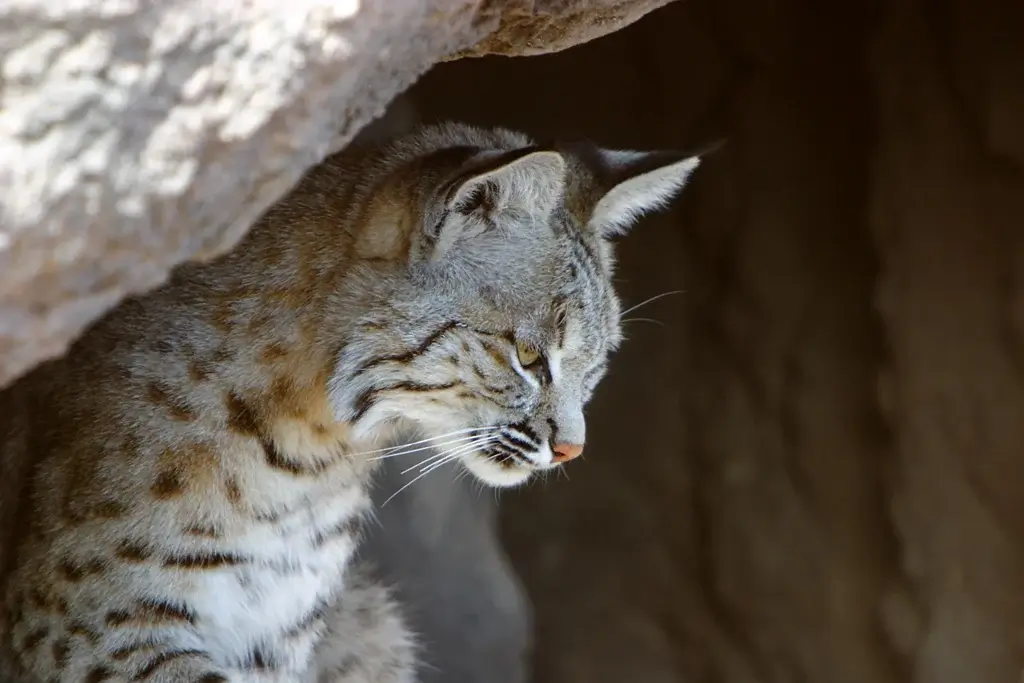
The bobcat, also known as the wildcat, bay lynx, or red lynx, is one of the four extant species within the medium-sized wild cat genus Lynx. Native to North America, it ranges from southern Canada through most of the contiguous United States to Oaxaca in Mexico. It is listed as Least Concern on the IUCN Red List since 2002, due to its wide distribution and large population. Although it has been hunted extensively both for sport and fur, populations have proven stable, though declining in some areas.
Habitat & Range
The bobcat is an adaptable species. It prefers woodlands—deciduous,coniferous, or mixed—but does not depend exclusively on the deep forest. It ranges from the humid swamps of Florida to desert lands of Texas or rugged mountain areas. It makes its home near agricultural areas, if rocky ledges, swamps, or forested tracts are present; its spotted coat serves as camouflage.[46]The population of the bobcat depends primarily on the population of its prey; other principal factors in the selection of habitat type include protection from severe weather, availability of resting and den sites, dense cover for hunting and escape, and freedom from disturbance.[47] The bobcat's range does not seem to be limited by human populations, but by availability of suitable habitat; only large, intensively cultivated tracts are unsuitable for the species.[39]The animal may appear in back yards in "urban edge" environments, where human development intersects with natural habitats.[48]If chased by a dog, it usually climbs up a tree.[46] The historical range of the bobcat was from southern Canada, throughout the United States, and as far south as the Mexican state ofOaxaca, and it still persists across much of this area. In the 20th century, it was thought to have lost territory in the USMidwestand parts of the Northeast, including southern Minnesota, eastern South Dakota, and much of Missouri, mostly due to habitat changes from modern agricultural practices.[29][39][46]While thought to no longer exist in western New York and Pennsylvania, multiple confirmed sightings of bobcats (including dead specimens) have been recently reported in New York'sSouthern Tierand incentral New York, and a bobcat was captured in 2018 on a tourist boat in DowntownPittsburgh,Pennsylvania.[49][50]In addition, bobcat sightings have been confirmed in northern Indiana, and one was killed near Albion, Michigan, in 2008.[51]In early March 2010, a bobcat was sighted (and later captured by animal control authorities) in a parking garage in downtownHouston.[52]By 2010, bobcats appear to have recolonized many states, occurring in every state in the contiguous 48 except Delaware.[1] The bobcat population in Canada is limited due to both snow depth and the presence of the Canada lynx. The bobcat does not tolerate deep snow, and waits out heavy storms in sheltered areas;[53]it lacks the large, padded feet of the Canada lynx and cannot support its weight on snow as efficiently. The bobcat is not entirely at a disadvantage where its range meets that of the larger felid: displacement of the Canada lynx by the aggressive bobcat has been observed where they interact inNova Scotia, while the clearing of coniferous forests for agriculture has led to a northward retreat of the Canada lynx's range to the advantage of the bobcat.[39]In northern and central Mexico, the cat is found in dryscrublandand forests of pine and oak; its range ends at the tropical southern portion of the country.[39]
Life History
Thebobcat(Lynx rufus), also known as thewildcat,bay lynx,[2][3]orred lynx,[4]is one of the fourextantspecies within the medium-sized wildcatgenusLynx. Native toNorth America, it ranges from southernCanadathrough most of thecontiguous United StatestoOaxacainMexico. It is listed asLeast Concernon theIUCN Red Listsince 2002, due to its wide distribution and large population. Although it has been hunted extensively both for sport and fur, populations have proven stable, though declining in some areas.[1] It has distinctive black bars on its forelegs and a black-tipped, stubby (or "bobbed") tail, from which it derives its name. It reaches a total length (including the tail) of up to 125 cm (50 in). It is an adaptablepredatorinhabiting wooded areas, semidesert, urban edge, forest edge, and swampland environments. It remains in some of its original range, but populations are vulnerable toextirpationbycoyotesand domestic animals. Though the bobcat prefersrabbitsandhares, it huntsinsects,chickens,geeseand otherbirds, smallrodents, anddeer. Prey selection depends on location andhabitat, season, and abundance. Like most cats, the bobcat is territorial and largely solitary, although with some overlap in home ranges. It uses several methods tomark its territorial boundaries, including claw marks and deposits of urine or feces. The bobcat breeds from winter into spring and has a gestation period of about two months. Twosubspeciesare recognized: one east of theGreat Plains, and the other west of the Great Plains. It is featured in some stories of the indigenous peoples of North and Central America, and in the folklore of European-descended inhabitants of the Americas. The bobcat resembles other species of the midsize genusLynx, but is on average the smallest of the four. Its coat is variable, though generally tan to grayish-brown, with black streaks on the body and dark bars on the forelegs and tail. Its spotted patterning acts as camouflage. The ears are black-tipped and pointed, with short, black tufts. Generally, an off-white color is seen on the lips, chin, and underparts. Bobcats in the desert regions of the southwest have the lightest-colored coats, while those in the northern, forested regions are darkest. Kittens are born well-furred and already have their spots.[24]A fewmelanisticbobcats have been sighted and captured in Florida, USA and New Brunswick, Canada.[25]They appear black, but may still exhibit a spot pattern.[26] The face appears wide due to ruffs of extended hair beneath the ears. Bobcat eyes are yellow with black slit pupils[27]. The nose of the bobcat is pinkish-red, and it has a base color of gray or yellowish- or brownish-red on its face, sides, and back.[28]The pupils widen during nocturnal activity to maximize light reception.[29]The bobcat has sharp hearing and vision, and a good sense of smell. It is an excellent climber and swims when it needs to, but normally avoids water.[30] The adult bobcat is 47.5–125 cm (18.7–49.2 in) long from the head to the base of its distinctive stubby tail, averaging 82.7 cm (32.6 in); the tail is 9 to 20 cm (3.5 to 7.9 in) long.[28]Its "bobbed" appearance gives the species its name.[31][32][33][34]An adult stands about 30 to 60 cm (12 to 24 in) at the shoulders.[24] Adult males can range in weight from 6.4–18.3 kg (14–40 lb), with an average of 9.6 kg (21 lb); females at 4–15.3 kg (8.8–33.7 lb), with an average of 6.8 kg (15 lb).[35]The largest bobcat accurately measured on record weighed 22.2 kg (49 lb), although unverified reports have them reaching 27 kg (60 lb).[36]Furthermore, a June 20, 2012, report of a New Hampshire roadkill specimen listed the animal's weight at 27 kg (60 lb).[37]The largest-bodied bobcats were recorded in eastern Canada and northern New England, and the smallest in the southernAppalachian Mountains.[38]Consistent withBergmann's rule, the bobcat is larger in its northern range and in open habitats.[39]Amorphologicalsize comparison study in the eastern United States found a divergence in the location of the largest male and female specimens, suggesting differingselection constraintsfor the sexes.[40]Skeletal muscles make up 58.5 % of the bobcat's body weight.[41][42]At birth, it weighs270–340 g (9+1⁄2–12 oz) and is about 25 cm (10 in) in length. At the age of one year, it weighs about 4.5 kg (10 lb).[30] The bobcat iscrepuscular, and is active mostly during twilight. It keeps on the move from three hours before sunset until about midnight, and then again from before dawn until three hours after sunrise. Each night, it moves from 3 to 11 km (2 to 7 mi) along its habitual route.[30]This behavior may vary seasonally, as bobcats become morediurnalduring fall and winter in response to the activity of their prey, which are more active during the day in colder weather.[29]
Status, Trends & Threats
The bobcat is listed in Appendix II of theConvention on International Trade in Endangered Species of Wild Fauna and Flora(CITES),[88]which means it is not considered threatened with extinction, but that international trade must be closely monitored. The animal is regulated in all three of its range countries, and is found in a number ofprotected areas of the United States, its principal territory.[39]Estimates from theUS Fish and Wildlife Serviceplaced bobcat numbers between 700,000 and 1,500,000 in the US in 1988, with increased range and population density suggesting even greater numbers in subsequent years; for these reasons, the U.S. has petitioned CITES to remove the cat from Appendix II.[47]Populations in Canada and Mexico remain stable and healthy. It is listed asleast concernon theIUCN Red List, noting it is relatively widespread and abundant, but information from southern Mexico is poor.[1] The bobcat is considered endangered in Ohio, Indiana, and New Jersey. It was removed from the threatened list of Illinois in 1999 and of Iowa in 2003. In Pennsylvania, limited hunting and trapping are once again allowed, after having been banned from 1970 to 1999. The bobcat also suffered population decline in New Jersey at the turn of the 19th century, mainly because of commercial and agricultural developments causinghabitat fragmentation; by 1972, the bobcat was given full legal protection, and was listed as endangered in the state in 1991.[29]The Mexican bobcatL. r. escuinipaewas for a time considered endangered by the US Fish and Wildlife Service, but was delisted in 2005.[89]Between 2003 and 2011, a reduction in bobcat sightings in the Everglades by 87.5% has been attributed to predation by the invasiveBurmese python.[90] The bobcat has long been valued both for fur and sport; it has been hunted and trapped by humans, but has maintained a high population, even in the southern United States, where it is extensively hunted. In the 1970s and 1980s, an unprecedented rise in price for bobcatfurcaused further interest in hunting, but by the early 1990s, prices had dropped significantly.[91]Regulated hunting still continues, with half of mortality of some populations being attributed to this cause. As a result, the rate of bobcat deaths is skewed in winter, when hunting season is generally open.[60] Urbanization can result in the fragmentation of contiguous natural landscapes into patchy habitat within an urban area. Animals that live in these fragmented areas often have reduced movement between the habitat patches, which can lead to reduced gene flow and pathogen transmission between patches. Animals such as the bobcat are particularly sensitive to fragmentation because of their large home ranges.[92]A study in coastal Southern California has shown bobcat populations are affected by urbanization, creation of roads, and other developments. The populations may not be declining as much as predicted, but instead the connectivity of different populations is affected. This leads to a decrease in natural genetic diversity among bobcat populations.[93]For bobcats, preserving open space in sufficient quantities and quality is necessary for population viability. Educating local residents about the animals is critical, as well, for conservation in urban areas.[94] In bobcats using urban habitats in California, the use ofrodenticideshas been linked to both secondary poisoning by consuming poisoned rats and mice, and to increased rates of severe mite infestation (known asnotoedric mange), as an animal with a poison-weakened immune system is less capable of fighting off mange. Liver autopsies in California bobcats that have succumbed to notoedric mange have revealed chronic rodenticide exposure.[95][96]Alternative rodent control measures such as vegetation control and use of traps have been suggested to alleviate this issue.[97]
Hunting Season
Nov 15 - Feb 28.
Frequently Asked Questions
Regulations for hunting Bobcat in Alabama
Bobcat hunting season in Alabama runs from November 15 to February 28 with a season bag limit of 3. Pelts must be checked in with ADCNR. Bobcats are classified as furbearers in Alabama.
When is Bobcat hunting season in Alabama?
Nov 15 - Feb 28.
What is the bag limit for Bobcat in Alabama?
3 per season.
What is another name for Bobcat?
Bobcat is also known as Wildcat, bay lynx in Alabama.
References
| State | Category | Directory | Subcategory | Content | Source |
|---|---|---|---|---|---|
| Alabama | Hunting | Regulations | Season Dates | Nov 15 - Feb 28. | Link |
| Alabama | Hunting | Regulations | Regulations | Bobcat hunting season in Alabama runs from November 15 to February 28 with a season bag limit of 3. Pelts must be checke | Link |