Also known as: Prairie wolf, brush wolf
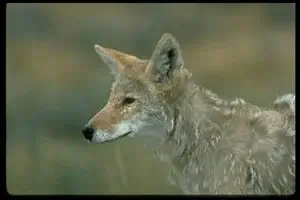
The coyote is a species of canine also known as the American jackal, prairie wolf, and brush wolf. It is native to North America, and it is smaller than its close relative, the gray wolf, and slightly smaller than the closely related eastern wolf and red wolf. It fills much of the same ecological niche as the golden jackal does in Eurasia but the coyote is generally larger.
Habitat & Range
Prior to the near extermination of wolves and cougars, the coyote was most numerous ingrasslandsinhabited bybison,pronghorn,elk, and other deer, doing particularly well in short-grass areas withprairie dogs, though it was just as much at home in semiarid areas withsagebrushandjackrabbitsor in deserts inhabited bycactus,kangaroo rats, andrattlesnakes. As long as it was not in direct competition with the wolf, the coyote ranged from theSonoran Desertto the alpine regions of adjoining mountains or the plains and mountainous areas ofAlberta. With the extermination of the wolf, the coyote's range expanded to encompass broken forests from the tropics ofGuatemalaand the northern slope ofAlaska.[27] Coyotes walk around 5–16 kilometres (3–10 mi) per day, often along trails such as logging roads and paths; they may use iced-over rivers as travel routes in winter. They are oftencrepuscular, being more active around evening and the beginning of the night than during the day. However, in urban areas coyotes are known to be more nocturnal, likely to avoid encounters with humans.[114]Like many canids, coyotes are competent swimmers, reported to be able to travel at least 0.8 kilometres (0.5 mi) across water.[115]In 2026, a coyote swam to the southern edge ofAlcatraz Island, over one mile from the nearest land in San Francisco.[116] Due to the coyote's wide range and abundance throughout North America, it is listed asLeast Concernby theInternational Union for Conservation of Nature(IUCN).[2]The coyote's pre-Columbian range was limited to the Southwest and Plains regions of North America, and northern and central Mexico. By the 19th century, the species expanded north and east, expanding further after 1900, coinciding with land conversion and the extirpation of wolves. By this time, its range encompassed the entire North American continent, including all of the contiguous United States and Mexico, southward into Central America, and northward into most of Canada and Alaska.[172]This expansion is ongoing, and the species now occupies the majority of areas between 8°N (Panama) and 70°N (northern Alaska).[2] Although it was once widely believed that coyotes are recent immigrants to southern Mexico and Central America, aided in their expansion by deforestation, Pleistocene and Early Holocene records, as well as records from the pre-Columbian period and early European colonization show that the animal was present in the area long before modern times. Range expansion occurred south ofCosta Ricaduring the late 1970s and northern Panama in the early 1980s, following the expansion of cattle-grazing lands into tropical rain forests.[173] The coyote is predicted to appear in northernBelizein the near future, as the habitat there is favorable to the species.[173]Concerns have been raised of a possible expansion into South America through thePanamanian Isthmus, should theDarién Gapever be closed by thePan-American Highway.[174]This fear was partially confirmed in January 2013, when the species was recorded in eastern Panama'sChepo District, beyond thePanama Canal.[71] A 2017 genetic study proposes that coyotes were originally not found in the area of the eastern United States. From the 1890s, dense forests were transformed into agricultural land and wolf control implemented on a large scale, leaving a niche for coyotes to disperse into. There were two major dispersals from two populations of genetically distinct coyotes. The first major dispersal to the northeast came in the early 20th century from those coyotes living in the northern Great Plains. These came to New England via the northern Great Lakes region and southern Canada, and to Pennsylvania via the southern Great Lakes region, meeting together in the 1940s in New York and Pennsylvania.[175] These coyotes have hybridized with the remnant gray wolf and eastern wolf populations, which has added to coyote genetic diversity and may have assisted adaptation to the new niche. The second major dispersal to the southeast came in the mid-20th century from Texas and reached the Carolinas in the 1980s. These coyotes have hybridized with the remnant red wolf populations before the 1970s when the red wolf was extirpated in the wild, which has also added to coyote genetic diversity and may have assisted adaptation to this new niche as well. Both of these two major coyote dispersals have experienced rapid population growth and are forecast to meet along the mid-Atlantic coast. The study concludes that for coyotes the long range dispersal, gene flow from local populations, and rapid population growth may be inter-related.[175]
Life History
Canis andersoniMerriam, 1910Canis caneloensisSkinner, 1942Canis clepticusEliot, 1903Canis estorMerriam, 1897Canis frustrorWoodhouse, 1851Canis goldmaniMerriam, 1904Canis hondurensisGoldman, 1936Canis impavidusAllen, 1903Canis irvingtonensisSavage, 1951Canis jamesiTownsend, 1912Canis lestesMerriam, 1897Canis mearnsiMerriam, 1897Canis microdonMerriam, 1897Canis nebrascensisMerriam, 1898Canis ochropusEschscholtz, 1829Canis orcuttiMerriam, 1910Canis pallidusMerriam, 1897Canis peninsulaeMerriam, 1897Canis riviveronisHay, 1917Canis vigilisMerriam, 1897Lyciscus cagottisHamilton-Smith, 1839; Canis andersoniMerriam, 1910; Canis caneloensisSkinner, 1942; Canis clepticusEliot, 1903; Canis estorMerriam, 1897; Canis frustrorWoodhouse, 1851; Canis goldmaniMerriam, 1904; Canis hondurensisGoldman, 1936; Canis impavidusAllen, 1903; Canis irvingtonensisSavage, 1951; Canis jamesiTownsend, 1912; Canis lestesMerriam, 1897; Canis mearnsiMerriam, 1897; Canis microdonMerriam, 1897; Canis nebrascensisMerriam, 1898; Canis ochropusEschscholtz, 1829; Canis orcuttiMerriam, 1910; Canis pallidusMerriam, 1897; Canis peninsulaeMerriam, 1897; Canis riviveronisHay, 1917; Canis vigilisMerriam, 1897; Lyciscus cagottisHamilton-Smith, 1839 Canis andersoniMerriam, 1910; Canis caneloensisSkinner, 1942; Canis clepticusEliot, 1903; Canis estorMerriam, 1897; Canis frustrorWoodhouse, 1851; Canis goldmaniMerriam, 1904; Canis hondurensisGoldman, 1936; Canis impavidusAllen, 1903; Canis irvingtonensisSavage, 1951; Canis jamesiTownsend, 1912; Canis lestesMerriam, 1897; Canis mearnsiMerriam, 1897; Canis microdonMerriam, 1897; Canis nebrascensisMerriam, 1898; Canis ochropusEschscholtz, 1829; Canis orcuttiMerriam, 1910; Canis pallidusMerriam, 1897; Canis peninsulaeMerriam, 1897; Canis riviveronisHay, 1917; Canis vigilisMerriam, 1897; Lyciscus cagottisHamilton-Smith, 1839 Thecoyote(Canis latrans) is aspeciesofcaninealso known as theAmerican jackal,prairie wolf, andbrush wolf. It is native toNorth America, and it is smaller than its close relative, thegray wolf, and slightly smaller than the closely relatedeastern wolfandred wolf. It fills much of the sameecological nicheas thegolden jackaldoes inEurasiabut the coyote is generally larger. The coyote is listed asleast concernby theInternational Union for Conservation of Nature, due to its wide distribution and abundance throughout North America. The species is versatile, able to adapt to and expand into environments modified by humans;urban coyotesare common in many cities. The coyote was sighted in easternPanama(across thePanama Canalfrom their home range) for the first time in 2013. The coyote has 19 recognizedsubspecies. The average male weighs 8 to 20 kg (18 to 44 lb) and the average female 7 to 18 kg (15 to 40 lb). Their fur color is predominantly light gray and red orfulvousinterspersed with black and white, though it varies somewhat with geography. It is highly flexible in social organization, living either in a family unit or in loosely knit packs of unrelated individuals. Primarilycarnivorous, its diet consists mainly ofdeer,rabbits,hares,rodents,birds,reptiles,amphibians,fish, andinvertebrates, though it may also eat fruits and vegetables on occasion. Its characteristic vocalization is ahowlthat changes rapidly in tone and pitch. Humansare the coyote's greatest threat, followed bycougarsand gray wolves. While coyotes have never been known to mate with gray wolves in the wild, they do interbreed with eastern wolves and red wolves, producing "coywolf" hybrids. In the northeastern regions of North America, theeastern coyote(a larger subspecies, though still smaller than wolves) is the result of various historical and recent matings with various types of wolves. Eastern wolves also still mate with gray wolves, providing an avenue for further genetic exchange across canid species. Genetic studies show that most North American wolves contain some level of coyote DNA. The coyote is a prominent character inNative Americanfolklore, mainly inAridoamerica, usually depicted as atricksterthat alternately assumes the form of an actual coyote or a man. As with other trickster figures, the coyote uses deception and humor to rebel against social conventions. The animal was especially respected inMesoamericancosmologyas a symbol of military might. After theEuropean colonization of the Americas, it was seen inAnglo-Americanculture as a cowardly and untrustworthy animal. Unlike wolves, which have seen their public image improve, attitudes towards the coyote remain largely negative.[6] Coyote males average 8 to 20 kg (18 to 44 lb) in weight, while females average 7 to 18 kg (15 to 40 lb), though size varies geographically. Northern subspecies, which average 18 kg (40 lb), tend to grow larger than the southern subspecies of Mexico, which average 11.5 kg (25 lb). Total length ranges on average from 1.0 to 1.35 m (3 ft 3 in to 4 ft 5 in); comprising a tail length of 40 cm (16 in), with females being shorter in both body length and height.[7]The largest coyote on record was a male killed nearAfton, Wyoming, on November19, 1937, which measured 1.5 m (4 ft 11 in) from nose to tail, and weighed 34 kg (75 lb).[8]Scent glands are located at the upper side of the base of the tail and are a bluish-black color.[9] The color and texture of the coyote's fur vary somewhat geographically.[7]The hair's predominant color is light gray and red orfulvous, interspersed around the body with black and white. Coyotes living at high elevations tend to have more black and gray shades than theirdesert-dwelling counterparts, which are more fulvous or whitish-gray.[10]The coyote's fur consists of short, soft underfur and long, coarse guard hairs. The fur of northern subspecies is longer and denser than in southern forms, with the fur of some Mexican and Central American forms being almost hispid (bristly).[11]Generally, adult coyotes (including coywolf hybrids) have a sable coat color, dark neonatal coat color, bushy tail with an activesupracaudal gland, and a white facial mask.[12]Albinismis extremely rare in coyotes. Out of a total of 750,000 coyotes killed by federal and cooperative hunters between March 1938 and June 1945, only two had traits consistent with albinism.[10] The coyote is typically smaller than the gray wolf, but has longer ears and a relatively largerbraincase,[7]as well as a thinner frame, face, and muzzle. The scent glands are smaller than the gray wolf's, but are the same color.[9]Its fur color variation is much less varied than that of a wolf.[13]The coyote also carries its tail downwards when running or walking, rather than horizontally as the wolf does.[14] Coyote tracks can be distinguished from those of dogs by their more elongated, less rounded shape.[15][16]Unlike dogs, the upper canines of coyotes extend past themental foramina.[7] The coyote is ecologically the North American equivalent of the Eurasiangolden jackal.[117]Likewise, the coyote is highly versatile in its choice of food, but is primarilycarnivorous, with 90% of its diet consisting of meat. Prey species includebison(largely ascarrion),white-tailed deer,mule deer,moose,elk,bighorn sheep,pronghorn,rabbits,hares,rodents,birds(especiallygalliformes,roadrunners, youngwater birdsandpigeons and doves),amphibians(excepttoads),lizards,snakes,turtlesandtortoises,fish,crustaceans, andinsects. Coyotes may be picky over the prey they target, as animals such asshrews,moles, andbrown ratsdo not occur in their diet in proportion to their numbers.[27] Terrestrial animalsor burrowing small mammals such asground squirrelsand associated species (marmots,prairie dogs,chipmunks) as well asvoles,pocket gophers,kangaroo ratsand other ground-favoring rodents may be quite common foods, especially for lone coyotes.[118][119][120]Examples of specific, primary mammal prey includeeastern cottontail rabbits,thirteen-lined ground squirrels, andwhite-footed mice.[121]More unusual prey includefishers,[122]youngblack bearcubs,[123]harp seals[124]andrattlesnakes. Coyotes kill rattlesnakes mostly for food, but also to protect their pups at their dens, by teasing the snakes until they stretch out and then biting their heads and snapping and shaking the snakes.[125]Birds taken by coyotes may range in size fromthrashers,larksandsparrowsto adultwild turkeysand, rarely, brooding adultswansandpelicans.[126][127][128][129] If working in packs or pairs, coyotes may have access to larger prey than lone individuals normally take, such as various prey weighing more than 10 kg (22 lb).[130][131]In some cases, packs of coyotes have dispatched much larger prey such as adultOdocoileusdeer, cowelk,pronghornsandwild sheep, although the young fawn, calves and lambs of these animals are considerably more often taken even by packs, as well asdomestic sheepanddomestic cattle. In some cases, coyotes can bring down prey weighing up to 100 to 200 kg (220 to 440 lb) or more. When it comes to adult ungulates such as wild deer, they often exploit them when vulnerable such as those that are infirm, stuck in snow or ice, otherwise winter-weakened or heavily pregnant, whereas less wary domestic ungulates may be more easily exploited.[130][132][133][134][135][136][137] Although coyotes prefer fresh meat, they willscavengewhen the opportunity presents itself. Excluding the insects, fruit, and grass eaten, the coyote requires an estimated 600 g (1.3 lb) of food daily, or 250 kg (550 lb) annually.[27]The coyote readilycannibalizesthe carcasses ofconspecifics, with coyote fat having been successfully used by coyote hunters as a lure or poisoned bait.[9]The coyote's winter diet consists mainly of large ungulate carcasses, with very little plant matter. Rodent prey increases in importance during the spring, summer, and fall.[7] The coyote feeds on a variety of differentproduce, includingstrawberries,[121]blackberries,blueberries,sarsaparillas,[121]peaches,pears,apples,prickly pears,chapotes,persimmons,peanuts,watermelons,cantaloupes, andcarrots. During the winter and early spring, the coyote eats large quantities of grass, such as greenwheatblades. Plants eaten also include theleavesofbalsam firandwhite cedar.[121]It sometimes eats unusual items such ashuman trash,cotton cake,soybeanmeal, domestic animal droppings,beans, and cultivatedgrainsuch asmaize, wheat, andsorghum.[27][121] In coastal California, coyotes now consume a higher percentage of marine-based food than their ancestors, which is thought to be due to the extirpation of the grizzly bear from this region.[138]InDeath Valley, coyotes may consume great quantities ofhawkmothcaterpillarsorbeetlesin the spring flowering months.[139]
Hunting Season
No closed season. May be taken year-round. Night hunting with light allowed with restrictions.
Frequently Asked Questions
Regulations for hunting Coyote in Alabama
Coyotes may be hunted year-round in Alabama with no bag limit. They are classified as nuisance animals. Coyotes have expanded across Alabama and are now present in every county. Night hunting with artificial light is permitted with restrictions. Landowners may take coyotes on their property without a license when causing damage.
When is Coyote hunting season in Alabama?
No closed season. May be taken year-round. Night hunting with light allowed with restrictions.
What is another name for Coyote?
Coyote is also known as Prairie wolf, brush wolf in Alabama.
References
| State | Category | Directory | Subcategory | Content | Source |
|---|---|---|---|---|---|
| Alabama | Hunting | Regulations | Season Dates | No closed season. May be taken year-round. Night hunting with light allowed with restrictions. | Link |
| Alabama | Hunting | Regulations | Regulations | Coyotes may be hunted year-round in Alabama with no bag limit. They are classified as nuisance animals. Coyotes have exp | Link |