Also known as: Mourning dove, turtle dove, wild dove
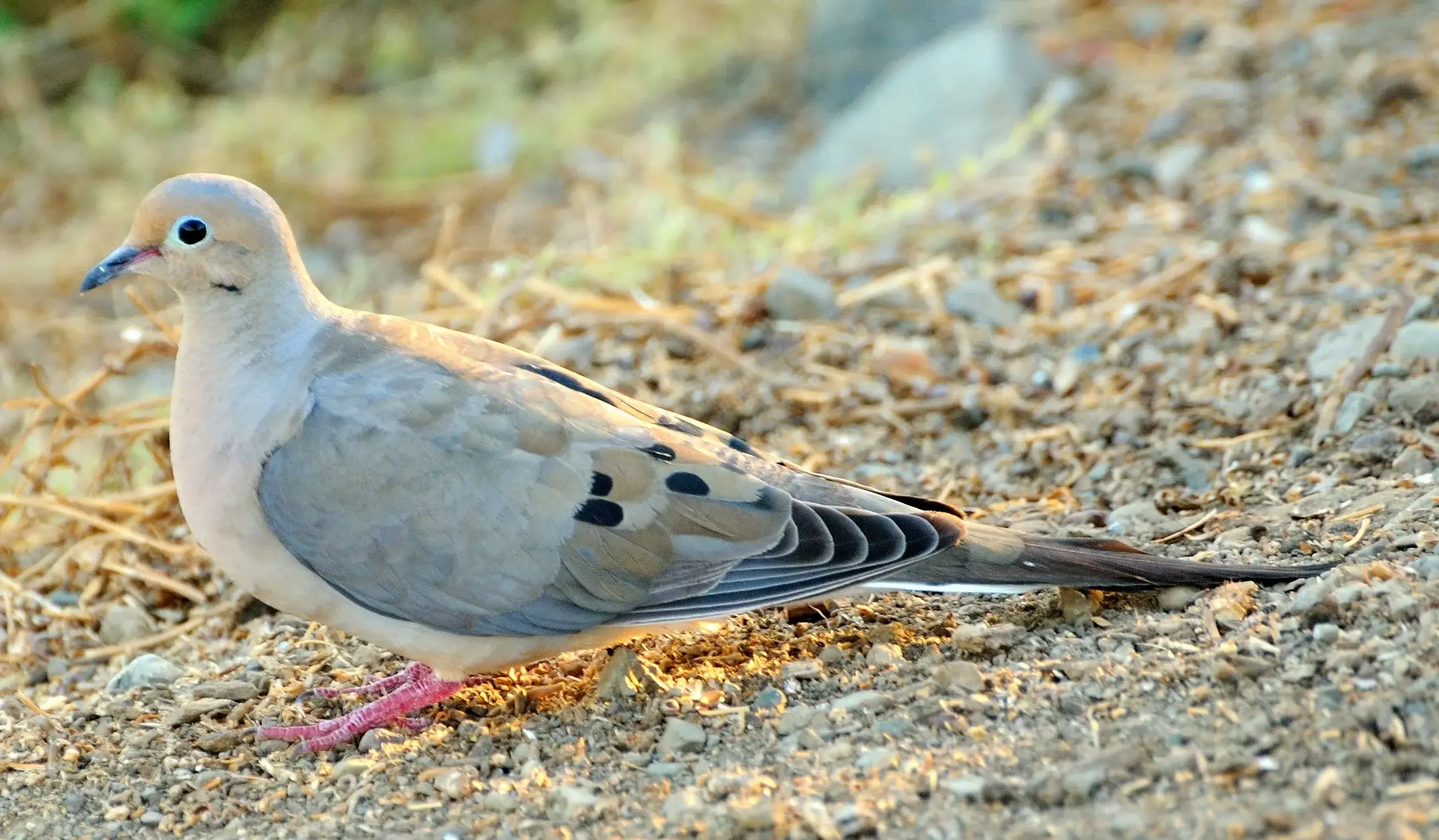
The mourning dove is a member of the dove family, Columbidae. The bird is also known as the American mourning dove, the rain dove, the chueybird, and colloquially as the turtle dove, and it was once known as the Carolina pigeon and Carolina turtledove. It is one of the most abundant and widespread North American birds and a popular gamebird, with more than 20 million birds shot annually in the U.S., both for sport and meat. Its ability to sustain its population under such pressure is due to its prolific breeding; in warm areas, one pair may raise up to six broods of two young each in a single year. The wings make an unusual whistling sound upon take-off and landing, a form of sonation. The bird is a strong flier, capable of speeds up to 88 km/h (55 mph).
Habitat & Range
The mourning dove has a largerangeof nearly 11,000,000 km2(4,200,000 sq mi).[31]The species is resident throughout theGreater Antilles, most ofMexico, theContinental United States, southernCanada, and the Atlantic archipelago ofBermuda. Much of the Canadian prairie sees these birds in summer only, and southern Central America sees them in winter only.[32]The species is avagrantin northern Canada, Alaska,[33]and South America.[15]It has been spotted as an accidental at least nine times in theWestern Palearcticwith records from the British Isles (5), Sweden (2), the Azores (1), and Iceland (1).[17][34]In 1963, the mourning dove wasintroducedtoHawaii, and in 1998 there was a small population inNorth Kona.[35]The mourning dove also appeared onSocorro Island, off the western coast of Mexico, in 1988, sixteen years after theSocorro dovewasextirpatedfrom that island.[16] The mourning dove occupies a wide variety of open and semi-open habitats, such as urban areas, farms, prairie, grassland, and lightly wooded areas. It avoidsswampsand thickforest.[33]
Life History
Columba macrouraLinnaeus, 1758; Columba carolinensisLinnaeus, 1766; Ectopistes carolinensis(Linnaeus, 1766) Themourning dove(Zenaida macroura) is a member of the dovefamily,Columbidae. The bird is also known as theAmerican mourning dove, therain dove, thechueybird, and colloquially as theturtle dove, and it was once known as theCarolina pigeonandCarolina turtledove.[2]It is one of the most abundant and widespread North American birds and a popular gamebird, with more than 20 million birds (up to 70 million in some years) shot annually in the U.S., both for sport and meat. Its ability to sustain its population under such pressure is due to its prolific breeding; in warm areas, one pair may raise up to sixbroodsof two young each in a single year. The wings make an unusual whistling sound upon take-off and landing, a form ofsonation. The bird is a strongflier, capable of speeds up to 88 km/h (55 mph).[3] Mourning doves are light gray and brown and generally muted in color. Males and females are similar in appearance. The species is generallymonogamous, with twosquabs(young) per brood. Both parents incubate and care for the young. Mourning doves eat almost exclusively seeds, but the young are fedcrop milkby their parents. The mourning dove is a medium-sized, slender dove approximately 31 cm (12 in) in length. Mourning doves weigh 112–170 g (4.0–6.0 oz), usually closer to 128 g (4.5 oz).[26]The mourning dove has a wingspan of 37–45 cm.[27]Theelliptical wingsare broad, and the head is rounded. Its tail is long and tapered ("macroura" comes from theGreekwords for "large" and "tail").[28]Mourning doves have perching feet, with three toes forward and one reversed. The legs are short and reddish colored. Thebeakis short and dark, usually a brown-black hue.[17] Theplumageis generally light gray-brown above and lighter and pinkish below. The wings have black spotting, and the outer tailfeathersare white, contrasting with the black inners. Below the eye is a distinctive crescent-shaped area of dark feathers. The eyes are dark, with light blue skin surrounding them.[17]The adult male has bright purple-pink patches on the neck sides, with light pink coloring reaching the breast. Adult males possess a distinctly bluish-grey colored crown, which females lack. Females are similar in appearance but have more brown coloring overall and are slightly smaller than males. The iridescent feather patches on the neck above the shoulders are nearly absent but can be quite vivid on males. Juvenile birds have a scaly appearance and are generally darker.[17] Feather colors are generally believed to be relatively static, changing only by small amounts over periods of months. However, a 2011 study argued that since feathers have neither nerves or blood vessels, color changes must be caused by external stimuli. Researchers analyzed how feathers of iridescent mourning doves responded to stimulus changes of adding and evaporating water. As a result, it was discovered thatiridescentfeather color changed hue, became more chromatic, and increased overall reflectance by almost 50%.Transmission electron microscopyand thin-film models revealed that color is produced bythin-film interferencefrom a single layer ofkeratinaround the edge of feather barbules, under which lies a layer of air andmelanosomes. Once the environmental conditions were changed, the most striking morphological difference was a twisting of colored barbules that exposed more of their surface area for reflection, which explains the observed increase in brightness. Overall, the researchers suggest that some plumage colors may be more changeable than previously thought possible.[29] All five subspecies of the mourning dove look similar and are not easily distinguishable.[17]The nominate subspecies possesses shorter wings and are darker and more buff-colored than the "average" mourning dove.Z. m. carolinensishas longer wings and toes, a shorter beak, and is darker in color. The western subspecies has longer wings, a longer beak, and shorter toes, and is more muted and lighter in color. The Panama mourning dove has shorter wings and legs, a longer beak, and is grayer in color. The Clarion Island subspecies possesses larger feet, a larger beak, and is darker brown in color.[18]
Status, Trends & Threats
The number of individual mourning doves was estimated to be approximately 475 million in 1994,[46]More recent reports indicate that there were approximately 337 million doves in the US as of September 2024.[47]The mourning dove is considered to be ofleast concerndue to its large population and range, meaning that the species is not at immediate risk.[31]As agamebird, the mourning dove is well-managed, with more than 20 million (and up to 40–70 million) shot by hunters each year.[48]However, reporting cautions that mourning doves are in decline in the western United States,[49]and susceptible everywhere in the country due to various pressures such as human activity, habitat loss, and lead poisoning. In some cases, the fields are specifically planted with a favored seed plant to lure them to those sites.[50][51][failed verification]
Hunting Season
Zone 1 & 2: Sep 1 - Oct 30 and Dec 1 - Jan 15. Check ADCNR migratory bird regulations for zone-specific dates.
Frequently Asked Questions
Regulations for hunting Mourning Dove in Alabama
Mourning dove hunting in Alabama follows federal migratory bird frameworks with two season segments (fall and winter). Daily bag limit is 15 doves. HIP registration is required. Doves may be hunted on dove fields and agricultural lands. Nontoxic shot is required for all migratory bird hunting.
When is Mourning Dove hunting season in Alabama?
Zone 1 & 2: Sep 1 - Oct 30 and Dec 1 - Jan 15. Check ADCNR migratory bird regulations for zone-specific dates.
What is the bag limit for Mourning Dove in Alabama?
15 per day.
What is another name for Mourning Dove?
Mourning Dove is also known as Mourning dove, turtle dove, wild dove in Alabama.
References
| State | Category | Directory | Subcategory | Content | Source |
|---|---|---|---|---|---|
| Alabama | Hunting | Regulations | Season Dates | Zone 1 & 2: Sep 1 - Oct 30 and Dec 1 - Jan 15. Check ADCNR migratory bird regulations for zone-specific dates. | Link |
| Alabama | Hunting | Regulations | Regulations | Mourning dove hunting in Alabama follows federal migratory bird frameworks with two season segments (fall and winter). D | Link |