Also known as: Sandhill crane
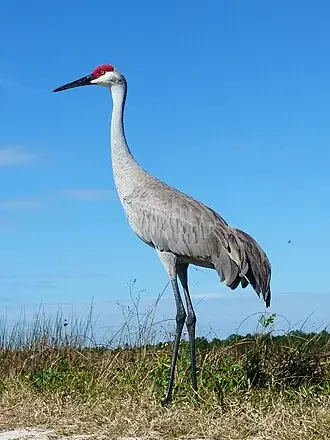
The sandhill crane is a species of large crane of North America and extreme northeastern Siberia. The common name of this bird refers to its habitat, such as the Platte River, on the edge of Nebraska's Sandhills on the American Great Plains. Sandhill cranes are known to frequent the edges of bodies of water. The central Platte River Valley in Nebraska is the most important stopover area for the nominotypical subspecies, the lesser sandhill crane (A. c. canadensis), with up to 450,000 of these birds migrating through annually.
Life History
Antigone canadensis canadensis(Linnaeus, 1758); Antigone canadensis pratensis(F. A. A. Meyer, 1794); Antigone canadensis nesiotesBangs& Zappey, 1905; Antigone canadensis tabida(J. L. Peters, 1925); Antigone canadensis rowani(disputed)Walkinshaw, 1965; Antigone canadensis pullaAldrich, 1972 and see text Ardea canadensisLinnaeus, 1758; Grus minorMiller, 1910; Grus proavusMarsh, 1872; Grus canadensis(Linnaeus, 1758) and seetext Thesandhill crane(Antigone canadensis) is aspeciesof largecraneof North America and extreme northeasternSiberia. The common name of this bird refers to itshabitat, such as thePlatte River, on the edge ofNebraska'sSandhillson the AmericanGreat Plains. Sandhill cranes are known to frequent the edges of bodies of water. The central Platte River Valley in Nebraska is the most important stopover area for thenominotypicalsubspecies, the lesser sandhill crane (A. c. canadensis), with up to 450,000 of these birdsmigratingthrough annually.[3][4] Adults are gray overall; during breeding, theirplumageis usually much worn and stained, particularly in the migratory populations, and looks nearlyochre.[12]The average weight of the larger males is 4.57 kg (10.1 lb), while the average weight of females is 4.02 kg (8.9 lb), with a range of 2.7 to 6.7 kg (6.0 to 14.8 lb) across the subspecies.[13][14]Sandhill cranes have red foreheads, white cheeks, and long, dark, pointedbills. In flight, their long, dark legs trail behind, and their long necks keep straight. Immature birds have reddish-brown upper parts and gray underparts.[15][16]The juveniles do not have the characteristic red foreheads, making distinguishing the young from the parents possible, even when they are the same height. The sexes look alike. Sizes vary among the differentsubspecies; the typical height of these birds is around 80 to 136 cm (2 ft 7 in to 4 ft 6 in).[17][18]Their wing chords are typically 41.8–60.0 cm (16.5–23.6 in), tails are 10.0–26.4 cm (3.9–10.4 in), the exposedculmensare 6.9–16 cm (2.7–6.3 in) long, and thetarsimeasure 15.5–26.6 cm (6.1–10.5 in).[19]Wingspan is 200 cm (78.7 in).[20] These cranes frequently give a loud, trumpeting call that suggests a rolled "r" in the throat, and they can be heard from a long distance. Mated pairs of cranes engage in "unison calling". The cranes stand close together, calling in a synchronized and complex duet. The female makes two calls for every one from the male. Sandhill cranes' large wingspans, typically 1.65 to 2.30 m (5 ft 5 in to 7 ft 7 in), make them very skilledsoaringbirds, similar in style tohawksandeagles.[18]Usingthermalsto obtain lift, they can stay aloft for many hours, requiring only occasional flapping of their wings, thus expending little energy. Migratory flocks contain hundreds of birds, and can create clear outlines of the normally invisible rising columns of air (thermals) they ride. Sandhill cranes fly south for the winter. In their wintering areas, they form flocks over 10,000. One place this happens is atBosque del Apache National Wildlife Refuge, 100 miles (160 km) south ofAlbuquerque, New Mexico. An annual Sandhill Crane Festival is held there in November. Sandhill crane in flight at the Llano Seco Unit of theSacramento National Wildlife Refuge Complex, California, USA; An immature Florida sandhill crane walks along the shore of Lake Cecile nearKissimmee, Florida.; Sandhill crane in flight at the Sacramento National Wildlife Refuge; Adult crane with ochre plumage Sandhill cranes are fairly social birds that usually live in pairs or family groups through the year. During migration and winter, unrelated cranes come together to form "survival groups" that forage and roost together. Such groups often congregate at migration and winter sites, sometimes in the thousands. Sandhill cranes are mainly herbivorous, but eat various types of food, depending on availability. They often feed with their bills down to the ground as they root around for seeds and other foods, in shallow wetlands with vegetation or various upland habitats. Cranes readily eat cultivated foods such ascorn,wheat,cottonseed, andsorghum. Waste corn is useful to cranes preparing for migration, providing them with nutrients for the long journey.[31]Among northern races of sandhill cranes, their diet is most varied, especially among breeding birds. They variously feed onberries, smallmammals,insects,snails,reptiles, andamphibians.[13]
Hunting Season
Limited permit-only season. Typically Dec - Feb. Check ADCNR regulations for current season dates.
Frequently Asked Questions
Regulations for hunting Sandhill Crane in Alabama
Sandhill crane hunting in Alabama is by limited permit drawing only. This is a relatively new hunting opportunity in Alabama. Hunters must apply for a permit through the ADCNR draw system. Both state and federal regulations apply.
When is Sandhill Crane hunting season in Alabama?
Limited permit-only season. Typically Dec - Feb. Check ADCNR regulations for current season dates.
What is the bag limit for Sandhill Crane in Alabama?
1 per season (limited permit drawing required).
What is another name for Sandhill Crane?
Sandhill Crane is also known as Sandhill crane in Alabama.
References
| State | Category | Directory | Subcategory | Content | Source |
|---|---|---|---|---|---|
| Alabama | Hunting | Regulations | Season Dates | Limited permit-only season. Typically Dec - Feb. Check ADCNR regulations for current season dates. | Link |
| Alabama | Hunting | Regulations | Regulations | Sandhill crane hunting in Alabama is by limited permit drawing only. This is a relatively new hunting opportunity in Ala | Link |