Also known as: Possum
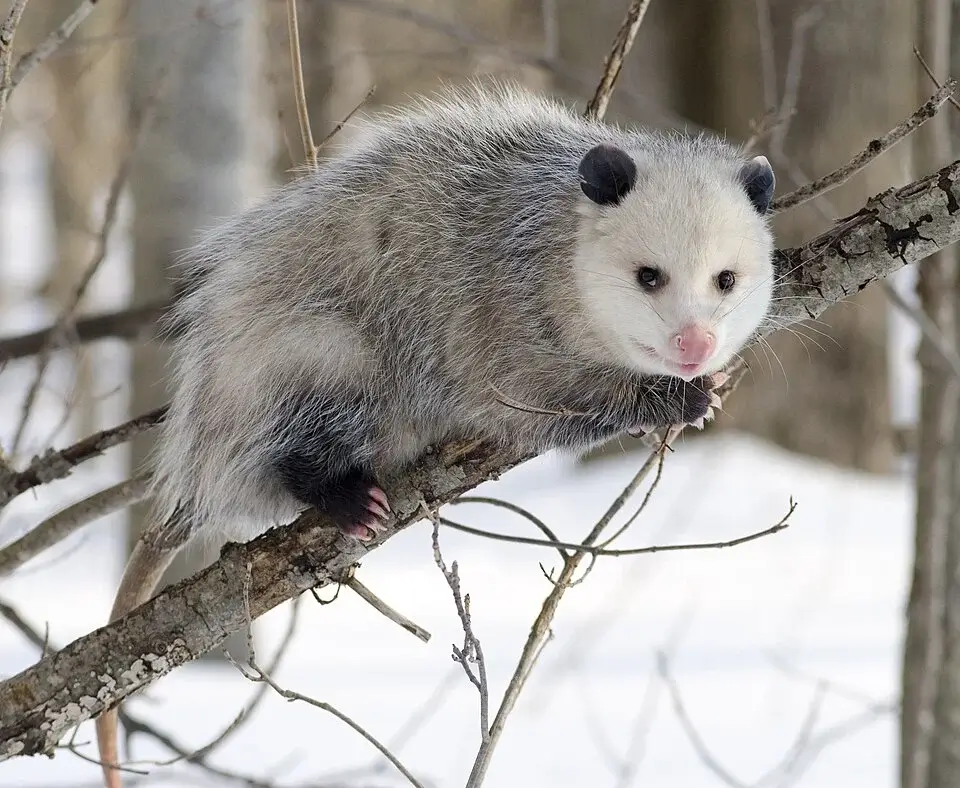
The Virginia opossum, also known as the North American opossum, is a member of the opossum family found from southern Canada to northern Costa Rica, making it the northernmost marsupial in the world. Commonly referred to simply as the possum, it is a solitary nocturnal animal about the size of a domestic cat, and a successful opportunist.
Habitat & Range
The Virginia opossum's ancestors evolved inSouth America, but spread into North America as part of theGreat American Interchange, which occurred mainly after the formation of theIsthmus of Panamaabout 3 million years ago.Didelphiswas apparently one of the later migrants, entering North America about 0.8 million years ago.[11]It is now found throughoutCentral AmericaandNorth AmericafromCosta Ricato southernOntarioand is expanding its range northward, northwesterly and northeasterly at a significant pace.[9] Its pre-European settlement range was generally as far north asMaryland; southernOhio,IndianaandIllinois;MissouriandKansas. The clearing of dense forests in these areas and further north by settlers allowed the opossum to move northward. Elimination of the opossum's main predators in these areas also contributed to their expansion. Since 1900, it has expanded its range to include most ofNew England(includingMaine);New York, extreme southwesternQuebec; most of southern and eastern Ontario; most ofMichiganandWisconsin; most ofMinnesota, southeasternSouth Dakotaand most ofNebraska. Areas such asRhode IslandandWaterloo RegionandSimcoe Countyin southern Ontario rarely had sightings of opossums in the 1960s, but now have them regularly; some speculate that this is likely due to global warming causing winters to be warmer.[12]Some people speculate the expansion into Ontario mostly occurred by opossums accidentally being transferred across theSt. Lawrence,Niagara,DetroitandSt. Clairrivers by motor vehicles or trains they may have climbed upon. As the opossum is not adapted to colder winters or heavy snow, its population may be significantly reduced if a colder winter with heavier snow occurs in a particular northern region. The Virginia opossum was not originally native to the West Coast of the United States. It was intentionally introduced into the West[9]during theGreat Depression, probably as a source of food,[13]and now occupies much of the Pacific coast. Its range has been expanding steadily northward intoBritish Columbia. Small isolated populations also occur in EasternNew Mexicoand parts of Southern and CentralArizona, particularly aroundTucson. It is unknown if these populations are native or were introduced.[14]
Life History
Didelphis marsupialisvirginiana[6] TheVirginia opossum(Didelphis virginiana), also known as theNorth American opossum, is a member of theopossumfamily found from southernCanadato northernCosta Rica, making it the northernmostmarsupialin the world.[7]Commonly referred to simply as thepossum,[8]it is a solitarynocturnal animalabout the size of adomestic cat, and a successfulopportunist. Opossums are familiar to many North Americans as they frequently inhabit settled areas near food sources like trash cans, pet food,compostpiles, gardens or housemice. Their slow, nocturnal nature and their attraction to roadsidecarrionmake opossums more likely to becomeroadkillthan other animals in their range. Virginia opossums can vary considerably in size, with larger specimens found to the north of the opossum's range and smaller specimens in the tropics. They measure 33–55 cm (13–22 in) long from their snout to the base of the tail, with the tail adding another 25–54 cm (9.8–21.3 in). Males are slightly larger, with an average body length of 40.8 cm (16.1 in) with an average tail length of 29.4 cm (11.6 in), while females are 40.6 cm (16.0 in) long with a 28.1 cm (11.1 in) tail. Weight for males ranges from 2.1–2.8 kg (4.6–6.2 lb) and for females from 1.9–2.1 kg (4.2–4.6 lb).[15] Their coats are a dull grayish brown, other than on their faces, which are white. Opossums have long, hairless,prehensiletails, which can be used to grab branches and carry small objects. They also have hairless ears and a long, flat nose. Opossums have50 teeth, more than any other North American land mammal,[16]and opposable, clawless thumbs on their rear limbs. Opossums have 13nipples, arranged in a circle of 12 with one in the middle.[17][18] The dental formula of an opossum is5.1.3.44.1.3.4.[19]No other mammal in North America has more than 6 upperincisors, but the Virginia opossum has 10. Perhaps surprisingly for such a widespread and successful species, the Virginia opossum has one of the lowestencephalization quotientsof any marsupial.[20]Its brain is one-fifth the size of a raccoon's.[21] Opossums areomnivorousand eat a wide range of plant-based food, as well as animal-based food like small invertebrates,carrion, eggs, fish, amphibians, reptiles, birds, small mammals, and other small animals.[28] Insectssuch as grasshoppers, crickets, and beetles make up the bulk of the animal foods eaten by opossums.[29]It is a commonmisconception[30]that opossums eat up to 95% of theticksthey encounter[27][31]and it is claimed they may eat up to 5,000 ticks per season, preventing the spread of tick-born illnesses, includingLyme diseaseandRocky Mountain spotted fever.[31]A widely publicized 2009 study by theCary Institutetheorized that Virginia opossums in a laboratory setting could eat thousands of ticks per week bygrooming.[32][33]However, a 2021 study of the stomach contents of wild Virginia opossums in Illinois did not find any ticks in their diet.[34]No scientific paper as of 2023 has reported ticks in the stomach contents of Virginia opossums.[30] Small animals include young rabbits, meadow voles, mice, rats, birds, snakes, lizards, frogs, fish, crayfish, gastropods, and earthworms.[35][36][37][38][39]The Virginia opossum has been found to be very resistant to snake venom,[40][31], due to unique blood proteins such aslethal toxin neutralizing factor.[41]Attracted to carrion on the side of the highway, opossums are at an increased risk of being hit by motor vehicles.[26] Plant foods are mainly eaten in late summer, autumn, and early winter.[29]These include raspberries, blackberries, apples, acorns, beechnuts, seeds, grains, bulbs, and vegetables.[29][39]Persimmonsare one of the opossum's favorite foods during the autumn.[42]Opossums in urban areas scavenge from bird feeders, vegetable gardens, compost piles, garbage cans, and food dishes intended for dogs and cats.[29][35] Opossums in captivity are known to engage incannibalism, though this is probably uncommon in the wild.[43]Because of this, placing an injured opossum in a confined space with its healthy counterparts is inadvisable. The breeding season for the Virginia opossum can begin as early as December and continue through October with most young born between February and June.[45]A female opossum may have one to three litters per year.[45]During the mating season, the male attracts the female by making clicking sounds with his mouth.[45]The female'sestrus cycleis 28 days and lasts 36 hours.[45]Gestation lasts 11–13 days and the average litter size is 8–9 infants, although over 20 infants may be born.[45]Opossums have a very highmortality rateof their young; only one in ten offspring survive to reproductive adulthood.[46] Newborns are the size of ahoneybee.[29]Once delivered through the median vagina or central birth canal, newborn opossums climb up into the female opossum's pouch and latch onto one of her 13 teats.[45]The young remain latched for two months and in the pouch for2+1⁄2months.[45]The young then climb onto the mother's back, where she carries them for the remainder of their time together.[45]It is during this time that the young learn survival skills.[45]They leave their mother after about four or five months.[47] Like all femalemarsupials, the female's reproductive system is bifid, with two lateral vaginae, uteri, and ovaries.[48]The male's penis is also bifid, with two heads, and as is common in New World marsupials, the sperm pair up in the testes and only separate as they come close to the egg.[48]Males have three pairs ofCowper's glands.[49]
Hunting Season
Hunting: Nov 15 - Feb 28. Trapping: Nov 15 - Feb 28.
Frequently Asked Questions
Regulations for hunting Virginia Opossum in Alabama
Virginia opossum may be hunted and trapped in Alabama during the November 15 to February 28 season. No bag limit. Opossums are also classified as furbearers.
When is Virginia Opossum hunting season in Alabama?
Hunting: Nov 15 - Feb 28. Trapping: Nov 15 - Feb 28.
What is another name for Virginia Opossum?
Virginia Opossum is also known as Possum in Alabama.
References
| State | Category | Directory | Subcategory | Content | Source |
|---|---|---|---|---|---|
| Alabama | Hunting | Regulations | Season Dates | Hunting: Nov 15 - Feb 28. Trapping: Nov 15 - Feb 28. | Link |
| Alabama | Hunting | Regulations | Regulations | Virginia opossum may be hunted and trapped in Alabama during the November 15 to February 28 season. No bag limit. Opossu | Link |