Also known as: Eastern wild turkey, gobbler
The wild turkey is an upland game bird native to North America, one of two extant species of turkey and the heaviest member of the order Galliformes. It is the ancestor to the domestic turkey, which was originally derived from a southern Mexican subspecies of wild turkey.
Habitat & Range
Wild turkeys preferhardwoodand mixedconifer-hardwood forests with scattered openings such aspastures,fields,orchardsand seasonalmarshes. They seemingly can adapt to virtually any dense native plant community as long as coverage and openings are widely available. Open, mature forest with a variety of interspersion of tree species appear to be preferred. In the Northeast of North America, turkeys are most profuse in hardwood timber ofoak-hickory(Quercus-Carya) and forests of red oak (Quercus rubra), beech (Fagus grandifolia), cherry (Prunus serotina) and white ash (Fraxinus americana). Best ranges for turkeys in theCoastal PlainandPiedmontsections have an interspersion of clearings, farms, and plantations with preferred habitat along principal rivers and in cypress (Taxodium distichum) and tupelo (Nyssa sylvatica) swamps. In theAppalachian PlateauandCumberland Plateaubirds occupy mixed forest of oaks and pines on southern and western slopes, also hickory with diverse understories. Bald cypress and sweet gum (Liquidambar styraciflua) swamps of southFlorida; also hardwood ofCliftonia(a heath) and oak in north-central Florida.LykesFisheating Creekarea of south Florida has up to 51% cypress, 12% hardwood hammocks, 17% glades of short grasses with isolated live oak (Quercus virginiana); nesting in neighboring prairies. Original habitat here was mainly longleaf pine (Pinus palustris) with turkey oak (Quercus laevis) and slash pine (Pinus elliottii) "flatwoods", now mainly replaced by slash pine plantations. InCalifornia, turkeys live in a wide range of habitats;acornsare a favorite food, in addition to wild oats (Avena barbata), drawing turkeys to areas of open oak forest and oak savanna across the central areas of the state. They frequent the lower-elevation oak woodlands of theSierra Nevadafoothills andCoast Ranges, and the central coast north throughMendocino County, which is primarily open conifer forest with various species offernsgrowing in the understory. They can also be found in the conifer foothills and fern-heavy forested areas of theKlamath MountainsandCascade Rangein the northern areas of the state. InSan Diego County, turkeys tend to be found farther from the coast, usually a minimum of 30–50 miles inland, at reasonably higher elevation; there is a healthy turkey population inhabiting the montane conifer woods and open oak forest habitats of theCleveland National Forest, a region which borders onhigh desertand generally receives very minimal annual precipitation. Turkeys in these areas can be found in dense thickets of manzanita (Arctostaphylos), often growing on arid hillsides, for shelter and nesting sites, as well as rocky and boulder-strewnchaparralfoothills.
Life History
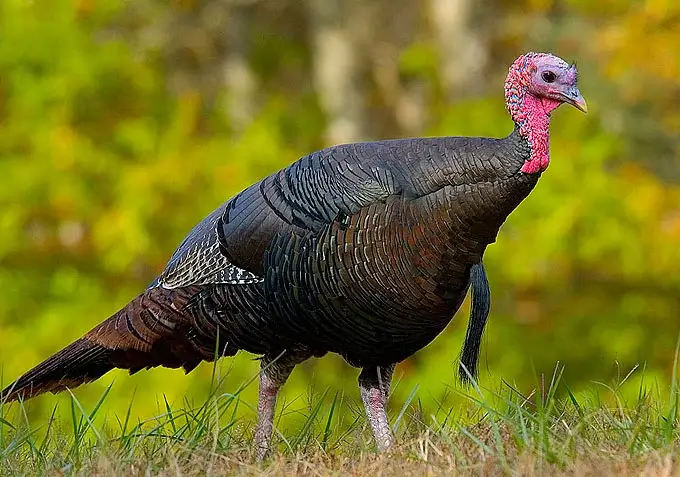
Thewild turkey(Meleagris gallopavo) is anupland game birdnative toNorth America, one of two extant species ofturkeyand the heaviest member of the orderGalliformes. It is the ancestor to thedomestic turkey(M. g. domesticus), which was originally derived from a southern Mexicansubspeciesof wild turkey (not the relatedocellated turkey). An adult male (tom or gobbler) normally weighs from 5 to 11 kg (11 to 24 lb) and measures 100–125 cm (39–49 in) in length. The adult female (hen) is typically much smaller at 2.5–5.4 kg (5.5–11.9 lb) and is 76 to 95 cm (30 to 37 in) long.[8][9]Per two large studies, the average weight of adult males is 7.6 kg (17 lb) and the average weight of adult females is 4.26 kg (9.4 lb).[10][11]The record-sized adult male wild turkey, according to theNational Wild Turkey Federation, weighed 16.85 kg (37.1 lb), with records of tom turkeys weighing over 13.8 kg (30 lb) uncommon but not rare. Considering its maximum and average weight, it is among the heaviest flying birds in the world.[12] The wings are relatively small, as is typical of the galliform order, and the wingspan ranges from 1.25 to 1.44 m (4 ft 1 in to 4 ft 9 in). Thewing chordis only 20 to 21.4 cm (7.9 to 8.4 in). Thebillis also relatively small, as adults measure 2 to 3.2 cm (0.79 to 1.26 in) inculmenlength.[13]Thetarsusof the wild turkey is quite long and sturdy, measuring from 9.7 to 19.1 cm (3.8 to 7.5 in). The tail is also relatively long, ranging from 24.5 to 50.5 cm (9.6 to 19.9 in).[14] Fully-grown wild turkeys have long, reddish-yellow to grayish-green legs. Each foot has three front toes, with a shorter, rear-facing toe; males have a spur behind each of their lower legs, used to spar with other males.[15] The body feathers are generally blackish and dark, sometimes gray-brown, overall, with a coppery sheen that becomes more complex in older males. Mature males have a large, featherless, reddish head and red throat, with redwattleson the throat and neck. The head has fleshy, unique growths calledcaruncles, which may be used to identify certain birds from one another. When toms are excited, a fleshy flap on the bill (called asnood) expands, and this, the wattles and the bare skin of the head and neck all become red with enhanced flow of blood to the head. Tail feathers are of the same length in adults but of different lengths in juveniles. Males have a long, dark, fan-shaped tail and glossy, bronze wings. As with many other species ofGalliformes, turkeys exhibit strongsexual dimorphism. The male is substantially larger than the female, and his feathers have areas of red, purple, green, copper, bronze, and goldiridescence. The preen gland (uropygial gland) is also larger in males compared to females. In contrast to the majority of other birds, they are colonized by bacteria of unknown function (Corynebacterium uropygiale).[16]Males typically have at least one "beard", a tuft of coarse hair-like filaments (mesofiloplumes), growing from the center of the breast.[17]Beards grow continuously during the turkey's lifespan[18]and a one-year-old male has a beard up to 5 in (13 cm) long.[17]Approximately 10% of females have a beard, usually shorter and thinner than that of the male.[17][18] Females have feathers that are duller overall, in shades of brown and gray. Parasites can dull the coloration of both sexes; in males, vivid coloration may serve as a signal of health.[19]The primary wing feathers have white bars. Turkeys have approximately 5,000 to 6,000 feathers.[20]Juvenile males are called jakes; the difference between jakes and toms is that jakes have very short "beards" and tail fans with longer feathers in the middle. The tom's tail fan feathers are uniform in length.[21] The turkey has the second-highest maximum average weight of any North American bird, after thetrumpeter swan(Cygnus buccinator). By average mass, however, several other American birds surpass the mean weight of the turkey, including theAmerican white pelican(Pelecanus erythrorhynchos), thetundra swan(Cygnus columbianus columbianus), the endangeredCalifornia condor(Gymnogyps californianus), andwhooping crane(Grus americana).[22][10]
Hunting Season
Spring season: Mar 15 - Apr 30 (bearded turkeys only). Fall season: No open season in most zones. Check ADCNR regulations for specific zone dates.
Frequently Asked Questions
Regulations for hunting Wild Turkey in Alabama
Wild turkey hunting in Alabama focuses on the spring breeding season when only bearded turkeys (typically males/gobblers) may be harvested. The daily bag limit is 1 bird with a season limit of 5. Alabama's turkey population is managed through the Turkey Management Program. Hunters must call in harvest via Game Check within 24 hours.
How many wild turkeys are in Alabama?
Alabama has an estimated wild turkey population of 300,000 to 400,000 birds. They are found throughout the state in suitable woodland habitats.
When is turkey hunting season in Alabama?
Spring turkey season typically runs from March 15 to April 30. Only bearded turkeys may be taken. Fall turkey season is not currently open.
What is the bag limit for Wild Turkey in Alabama?
5 bearded turkeys per spring season (1 per day). No more than 1 bird per day.
What is another name for Wild Turkey?
Wild Turkey is also known as Eastern wild turkey, gobbler in Alabama.
References
| State | Category | Directory | Subcategory | Content | Source |
|---|---|---|---|---|---|
| Alabama | Hunting | Regulations | Season Dates | Spring season: Mar 15 - Apr 30 (bearded turkeys only). Fall season: No open season in most zones. Check ADCNR regulation | Link |
| Alabama | Hunting | Regulations | Regulations | Wild turkey hunting in Alabama focuses on the spring breeding season when only bearded turkeys (typically males/gobblers | Link |