Also known as: Timberdoodle, Woodcock, Bogsucker
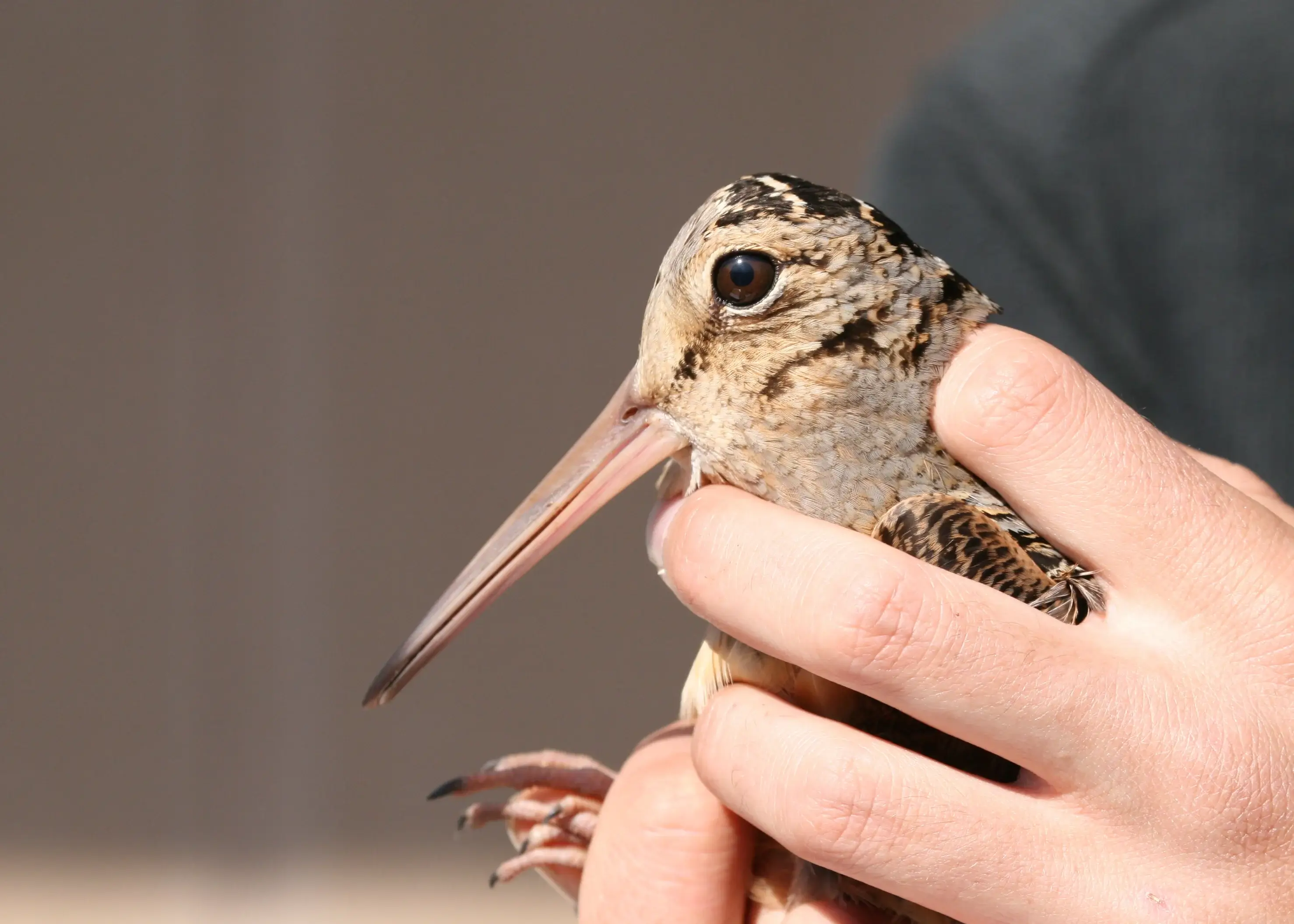
The American woodcock (Scolopax minor), sometimes colloquially referred to as the timberdoodle, mudbat, becasse, bogsucker, brush snipe, night partridge, or Labrador twister is a small shorebird species found primarily in the eastern half of North America. Woodcocks spend most of their time on the ground in brushy, young-forest habitats, where the birds' brown, black, and gray plumage provides excellent camouflage.
The American woodcock is the only species of woodcock inhabiting North America. Although classified with the sandpipers and shorebirds in the family Scolopacidae, the American woodcock lives mainly in upland settings.
The population of the American woodcock has fallen by an average of slightly more than 1% annually since the 1960s. Most authorities attribute this decline to a loss of habitat caused by forest maturation and urban development. It is also a popular game bird, with about 540,000 killed annually by some 133,000 hunters in the United States.
In 2008, wildlife biologists and conservationists released an American woodcock conservation plan presenting figures for the acreage of early successional habitat that must be created and maintained in the United States and Canada to stabilize the woodcock population at current levels, and to return it to 1970s densities.
The American woodcock has a plump body, short legs, a large, rounded head, and a long, straight prehensile bill. Adults are 10 to 12 inches (25 to 30 cm) long and weigh 5 to 8 ounces (140 to 230 g). Females are considerably larger than males. The bill is 2.5 to 2.8 inches (6.4 to 7.1 cm) long. Wingspans range from 16.5 to 18.9 inches (42 to 48 cm).
The plumage is a cryptic mix of different shades of browns, grays, and black. The chest and sides vary from yellowish-white to rich tans. The nape of the head is black, with three or four crossbars of deep buff or rufous. The feet and toes, which are small and weak, are brownish gray to reddish brown. Woodcocks have large eyes located high in their heads, and their visual field is probably the largest of any bird, 360° in the horizontal plane and 180° in the vertical plane.
The woodcock uses its long, prehensile bill to probe in the soil for food, mainly invertebrates and especially earthworms. A unique bone-and-muscle arrangement lets the bird open and close the tip of its upper bill, or mandible, while it is sunk in the ground. Both the underside of the upper mandible and the long tongue are rough-surfaced for grasping slippery prey.
The genus Scolopax was introduced in 1758 by the Swedish naturalist Carl Linnaeus in the tenth edition of his Systema Naturae. The genus name is Latin for a snipe or woodcock. The type species is the Eurasian woodcock (Scolopax rusticola).
Habitat & Range
Woodcocks inhabit forested and mixed forest-agricultural-urban areas east of the 98th meridian. Woodcocks have been sighted as far north as York Factory, Manitoba, and east to Labrador and Newfoundland. In winter, they migrate as far south as the Gulf Coast of the United States and Mexico.
The primary breeding range extends from Atlantic Canada (Nova Scotia, Prince Edward Island, and New Brunswick) west to southeastern Manitoba, and south to northern Virginia, western North Carolina, Kentucky, northern Tennessee, northern Illinois, Missouri, and eastern Kansas. A limited number breed as far south as Florida and Texas. The species may be expanding its distribution northward and westward.
After migrating south in autumn, most woodcocks spend the winter in the Gulf Coast and southeastern Atlantic Coast states. Some may remain as far north as southern Maryland, eastern Virginia, and southern New Jersey. The core of the wintering range centers on Louisiana, Mississippi, Alabama, and Georgia. Based on the Christmas Bird Count results, winter concentrations are highest in the northern half of Alabama.
American woodcocks live in wet thickets, moist woods, and brushy swamps. Ideal habitats feature early successional habitat and abandoned farmland mixed with forest. In late summer, some woodcocks roost on the ground at night in large openings among sparse, patchy vegetation.
Courtship/breeding habitats include forest openings, roadsides, pastures, and old fields from which males call and launch courtship flights in springtime.
Nesting habitats include thickets, shrubland, and young to middle-aged forest interspersed with openings.
Feeding habitats have moist soil and feature densely growing young trees such as aspen (Populus spp.), birch (Betula spp.), and mixed hardwoods less than 20 years of age, and shrubs, particularly alder (Alnus spp.).
Roosting habitats are semiopen sites with short, sparse plant cover, such as blueberry barrens, pastures, and recently heavily logged forest stands.
Life History
Breeding: In spring, males occupy individual singing grounds, openings near brushy cover from which they call and perform display flights at dawn and dusk, and if the light levels are high enough, on moonlit nights. The male's ground call is a short, buzzy peent. After sounding a series of ground calls, the male takes off and flies from 50 to 100 yd (46 to 91 m) into the air. He descends, zigzagging and banking while singing a liquid, chirping song. This high spiralling flight produces a melodious twittering sound as air rushes through the male's outer primary wing feathers.
Males may continue with their courtship flights for as many as four months running, sometimes continuing even after females have already hatched their broods and left the nest. Females, known as hens, are attracted to the males' displays. A hen will fly in and land on the ground near a singing male. The male courts the female by walking stiff-legged and with his wings stretched vertically, and by bobbing and bowing. A male may mate with several females. The male woodcock plays no role in selecting a nest site, incubating eggs, or rearing young. In the primary northern breeding range, the woodcock may be the earliest ground-nesting species to breed.
The hen makes a shallow, rudimentary nest on the ground in the leaf and twig litter, in brushy or young-forest cover usually within 150 yd (140 m) of a singing ground. Most hens lay four eggs, sometimes one to three. Incubation takes 20 to 22 days. The down-covered young are precocial and leave the nest within a few hours of hatching. The female broods her young and feeds them. When threatened, the fledglings usually take cover and remain motionless, attempting to escape detection by relying on their cryptic coloration. Some observers suggest that frightened young may cling to the body of their mother, who will then take wing and carry the young to safety. Woodcock fledglings begin probing for worms on their own a few days after hatching. They develop quick
Status, Trends & Threats
Conservation: The American woodcock is not considered globally threatened by the IUCN. It is more tolerant of deforestation than other woodcocks and snipes; as long as some sheltered woodland remains for breeding, it can thrive even in regions that are mainly used for agriculture. The estimated population is 5 million, so it is the most common sandpiper in North America.
The American Woodcock Conservation Plan presents regional action plans linked to bird conservation regions, fundamental biological units recognized by the U.S. North American Bird Conservation Initiative. The Wildlife Management Institute oversees regional habitat initiatives intended to boost the American woodcock's population by protecting, renewing, and creating habitat throughout the
Hunting Season
North Zone: Oct 18 - Oct 25 and Oct 28 - Nov 29, 2025. South Zone: Nov 8 - Dec 6 and Dec 20 - Jan 1, 2025-2026.
Frequently Asked Questions
Regulations for hunting American Woodcock in New Jersey
American woodcock is a migratory game bird hunted in New Jersey during fall. The state is split into North and South Zones with slightly different dates. Hunting hours: sunrise to sunset. HIP certification is required. Lead shot permitted (nontoxic encouraged). Possession limit: 3x daily limit.
When is American Woodcock hunting season in New Jersey?
North Zone: Oct 18 - Oct 25 and Oct 28 - Nov 29, 2025. South Zone: Nov 8 - Dec 6 and Dec 20 - Jan 1, 2025-2026.
What is the bag limit for American Woodcock in New Jersey?
3 woodcock per day.
What is another name for American Woodcock?
American Woodcock is also known as Timberdoodle, Woodcock, Bogsucker in New Jersey.
References
| State | Category | Directory | Subcategory | Content | Source |
|---|---|---|---|---|---|
| New Jersey | Upland Game Birds | Regulations | Season Dates | North Zone: Oct 18 - Oct 25 and Oct 28 - Nov 29, 2025. South Zone: Nov 8 - Dec 6 and Dec 20 - Jan 1, 2025-2026. | Link |
| New Jersey | Upland Game Birds | Regulations | Regulations | American woodcock is a migratory game bird hunted in New Jersey during fall. The state is split into North and South Zon | Link |