Also known as: Eastern coyote, Brush wolf
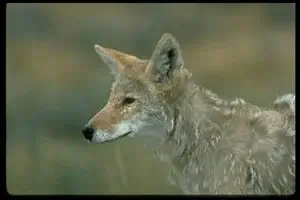
The coyote (Canis latrans) is a species of canine also known as the American jackal, prairie wolf, and brush wolf. It is native to North America, and it is smaller than its close relative, the gray wolf, and slightly smaller than the closely related eastern wolf and red wolf. It fills much of the same ecological niche as the golden jackal does in Eurasia but the coyote is generally larger.
The coyote is listed as least concern by the International Union for Conservation of Nature, due to its wide distribution and abundance throughout North America. The species is versatile, able to adapt to and expand into environments modified by humans; urban coyotes are common in many cities. The coyote was sighted in eastern Panama (across the Panama Canal from their home range) for the first time in 2013.
The coyote has 19 recognized subspecies. The average male weighs 8 to 20 kg (18 to 44 lb) and the average female 7 to 18 kg (15 to 40 lb). Their fur color is predominantly light gray and red or fulvous interspersed with black and white, though it varies somewhat with geography. It is highly flexible in social organization, living either in a family unit or in loosely knit packs of unrelated individuals. Primarily carnivorous, its diet consists mainly of deer, rabbits, hares, rodents, birds, reptiles, amphibians, fish, and invertebrates, though it may also eat fruits and vegetables on occasion. Its characteristic vocalization is a howl that changes rapidly in tone and pitch.
Humans are the coyote's greatest threat, followed by cougars and gray wolves. While coyotes have never been known to mate with gray wolves in the wild, they do interbreed with eastern wolves and red wolves, producing "coywolf" hybrids. In the northeastern regions of North America, the eastern coyote (a larger subspecies, though still smaller than wolves) is the result of various historical and recent matings with various types of wolves. Eastern wolves also still mate with gray wolves, providing an avenue for further genetic exchange across canid species. Genetic studies show that most North American wolves contain some level of coyote DNA.
The coyote is a prominent character in Native American folklore, mainly in Aridoamerica, usually depicted as a trickster that alternately assumes the form of an actual coyote or a man. As with other trickster figures, the coyote uses deception and humor to rebel against social conventions. The animal was especially respected in Mesoamerican cosmology as a symbol of military might. After the European colonization of the Americas, it was seen in Anglo-American culture as a cowardly and untrustworthy animal. Unlike wolves, which have seen their public image improve, attitudes towards the coyote remain largely negative.
Coyote males average 8 to 20 kg (18 to 44 lb) in weight, while females average 7 to 18 kg (15 to 40 lb), though size varies geographically. Northern subspecies, which average 18 kg (40 lb), tend to grow larger than the southern subspecies of Mexico, which average 11.5 kg (25 lb). Total length ranges on average from 1.0 to 1.35 m (3 ft 3 in to 4 ft 5 in); comprising a tail length of 40 cm (16 in), with females being shorter in both body length and height. The largest coyote on record was a male killed near Afton, Wyoming, on November 19, 1937, which measured 1.5 m (4 ft 11 in) from nose to tail, and weighed 34 kg (75 lb). Scent glands are located at the upper side of the base of the tail and are a bluish-black color.
The color and texture of the coyote's fur vary somewhat geographically. The hair's predominant color is light gray and red or fulvous, interspersed around the body with black and white. Coyotes living at high elevations tend to have more black and gray shades than their desert-dwelling counterparts, which are more fulvous or whitish-gray. The coyote's fur consists of short, soft underfur and long, coarse guard hairs. The fur of northern subspecies is longer and denser than in southern forms, with the fur of some Mexican and Central American forms being almost hispid (bristly). Generally, adult coyotes (including coywolf hybrids) have a sable coat color, dark neonatal coat color, bushy tail with an active supracaudal gland, and a white facial mask. Albinism is extremely rare in coyotes. Out of a total of 750,000 coyotes killed by federal and cooperative hunters between March 1938 and June 1945, only two had traits consistent with albinism.
The coyote is typically smaller than the gray wolf, but has longer ears and a relatively larger braincase, as well as a thinner frame, face, and muzzle. The scent glands are smaller than the gray wolf's, but are the same color. Its fur color variation is much less varied than that of a wolf. The coyote also carries its tail downwards when running or walking, rather than horizontally as the wolf does.
Coyote tracks can be distinguished from those of dogs by their more elongated, less rounded shape. Unlike dogs, the upper canines of coyotes extend past the mental foramina.
Hunting Season
Regular Season: Oct 4, 2025 - Mar 15, 2026 (bow only Oct 4 - Nov 7; bow or shotgun Nov 8 - Mar 15). Special Permit Day Season: Jan 1 - Mar 15, 2026 (bow, shotgun, or rifle). Special Permit Night Season: Jan 1 - Mar 15, 2026 (shotgun only).
Frequently Asked Questions
Regulations for hunting Coyote in New Jersey
Coyote hunting in New Jersey has three distinct seasons. The Regular Season starts with bow-only in October, transitioning to bow/shotgun in November. The Special Permit Season allows rifle hunting during the day. Night hunting with shotgun and spotlight is permitted with a special permit. Coyotes may also be taken incidentally during deer firearm seasons. All coyote harvests must be reported via AHRS by 8 p.m. on the day of harvest.
Can I hunt coyote at night in New Jersey?
Yes, with a Special Permit for night hunting. The Night Season runs Jan 1 - Mar 15, 2026, and allows shotgun use only. Spotlighting is permitted with the special night permit.
Can I hunt coyote during deer season?
Yes. Coyotes may be taken incidentally during deer firearm seasons (Six-Day Firearm, Permit Muzzleloader, Permit Shotgun) only if encountered before reaching the deer bag limit. Only deer-legal projectiles may be used.
When is Coyote hunting season in New Jersey?
Regular Season: Oct 4, 2025 - Mar 15, 2026 (bow only Oct 4 - Nov 7; bow or shotgun Nov 8 - Mar 15). Special Permit Day Season: Jan 1 - Mar 15, 2026 (bow, shotgun, or rifle). Special Permit Night Season: Jan 1 - Mar 15, 2026 (shotgun only).
What is another name for Coyote?
Coyote is also known as Eastern coyote, Brush wolf in New Jersey.
References
| State | Category | Directory | Subcategory | Content | Source |
|---|---|---|---|---|---|
| New Jersey | Furbearers | Regulations | Season Dates | Regular Season: Oct 4, 2025 - Mar 15, 2026 (bow only Oct 4 - Nov 7; bow or shotgun Nov 8 - Mar 15). Special Permit Day S | Link |
| New Jersey | Furbearers | Regulations | Regulations | Coyote hunting in New Jersey has three distinct seasons. The Regular Season starts with bow-only in October, transitioni | Link |