Also known as: Cottontail rabbit, Eastern cottontail rabbit
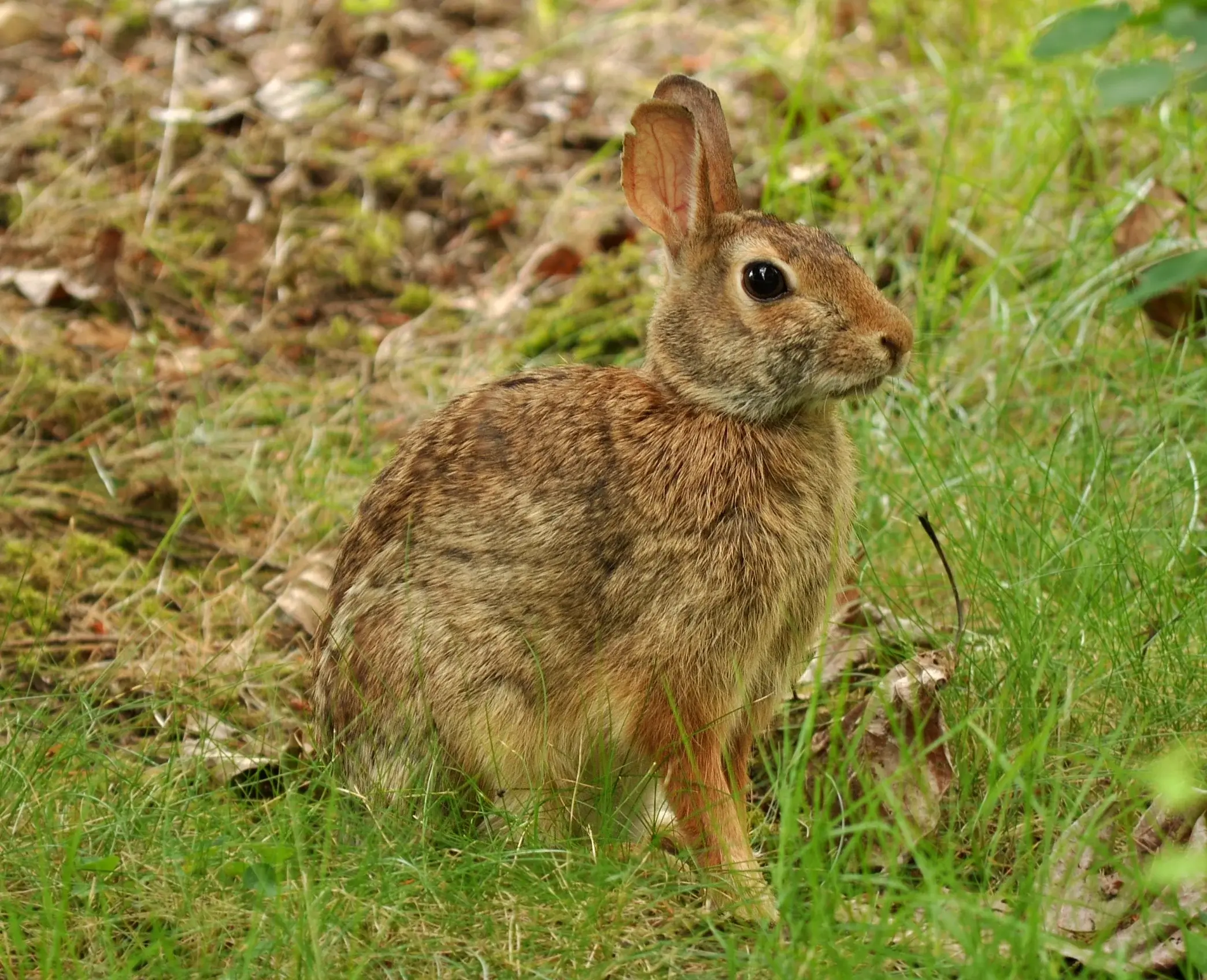
The eastern cottontail (Sylvilagus floridanus) is a species of rabbit in the family Leporidae. It is the most widespread and abundant rabbit species in North America, inhabiting a wide range that extends from southern Canada throughout most of the United States and into parts of Mexico, Central America, and the northern regions of South America. Known for its distinctive fluffy white tail, which resembles a cotton ball and gives the species its common name, the eastern cottontail typically inhabits open fields, meadows, and brushy areas where it can easily find cover and food. It is a primarily herbivorous, crepuscular mammal that feeds on grasses, herbs, twigs, and bark, and plays an important role in the ecosystem as prey for a variety of predators including foxes, hawks, and owls. Due to its adaptability to human-altered landscapes such as suburban and agricultural areas, the eastern cottontail has maintained stable population levels and is not considered threatened. It is also well known for its high reproductive rate, with females capable of producing multiple large litters annually, which contributes to its widespread presence.
The eastern cottontail has a distinctive white spot on its forehead when young and fur that ranges from reddish-brown to grayish-brown, with large hind feet, long ears, and a short, fluffy white tail. Its underside is white, and there is a rusty patch near the tail. It differs from a hare in its overall smaller size and brownish-gray coloring around the head and neck, with a lighter-colored body and a white underside on the tail. The species also has large brown eyes and long ears adapted for detecting predators. During winter, the eastern cottontail's pelage becomes more gray than brown. Kits (young rabbits) develop a similar coloring after a few weeks but are born with a white blaze running down their forehead, which fades as they mature.
This rabbit is medium-sized, measuring 36–48 cm (14–19 in) in total length, including a tail that averages 5.3 cm (2.1 in).
Adults typically weigh between 1.8 and 4.4 lb (800 and 2,000 g), with an average of around 2.6 lb (1,200 g). Females tend to be slightly heavier than males, although the sexes broadly overlap in size. The species exhibits slight geographic variation in body size, with individuals generally increasing in mass from southern to northern latitudes, in line with Bergmann's rule. For example, adult specimens from the Florida Museum of Natural History have a mean weight of 2.24 lb (1.018 kg), whereas a study of 346 adults from Michigan found an average mass of 3.19 lb (1.445 kg).
Sylvilagus floridanus is a member of the family Leporidae within the order Lagomorpha. It was first formally described by French naturalist Charles Alexandre Lesueur in 1827. The genus Sylvilagus includes around 15 species of New World cottontail rabbits, which are widespread throughout the Americas.
Habitat & Range
The eastern cottontail inhabits meadows, shrubby areas, and edge habitats throughout the eastern and south-central United States, southern Canada, eastern Mexico, Central America, and northernmost South America. It is also present on Margarita Island in the Caribbean. The species is especially abundant across the Midwest of North America, and its range expanded northward as forests were cleared by settlers. Originally absent from New England, it has since been introduced there, where it now competes with the native New England cottontail (Sylvilagus transitionalis). It has also been introduced to parts of Oregon, Washington, and British Columbia. In the 1950s and 1960s, the species was introduced to France and northern Italy, where it underwent rapid territorial expansion and population growth.
Populations in the mountainous regions of the southwestern United States and western Mexico are now considered a separate species, the robust cottontail (S. holzneri).
Optimal eastern cottontail habitat includes open grassy areas, clearings, and old fields that support abundant green vegetation, with shrubs or hedgerows providing cover. Critical habitat components include dense, well-distributed escape cover interspersed with open foraging areas such as pastures or grasslands. In the western United States, they occupy diverse habitats such as ponderosa pine, mixed conifer, and pinyon (Pinus spp.)–juniper (Juniperus spp.) woodlands, where woody debris, shrubby understories, and patchy cover are important for survival. Eastern cottontails also thrive in agricultural and suburban environments, especially near fencerows, forest edges, and thickets. They can be found in swamps and marshes but generally avoid dense forests.
Life History
Reproduction: Eastern cottontails reach sexual maturity at 2–3 months of age. Breeding season varies by latitude and climate, beginning as early as January in the southern United States and around March in New England, continuing through late summer. Mating is promiscuous, with males competing for access to females.
The nest is typically a slanted hole in soft soil lined with fur and grasses, measuring about 7.1 in × 4.9 in × 4.7 in (18 cm × 12 cm × 12 cm). Gestation lasts 25–35 days (average 28). Kits are born blind with fine hair and a white blaze on the forehead, which fades as they mature. Their eyes open at 4–7 days, and they begin leaving the nest by 12–16 days. Weaning occurs by 4–5 weeks, and dispersal begins around 7 weeks.
Females can have 1–7 litters per year (averaging 3–4), with 3–8 kits per litter (average 5). In southern states, breeding is nearly continuous, while northern populations have shorter seasons but larger litters.
Diet: Eastern cottontails feed primarily on a wide variety of plants, with some studies documenting 70–145 plant species in their diet. They prefer tender herbaceous vegetation, such as grasses, clovers (Trifolium spp.), crabgrasses (Digitaria spp.), and wild rye (Elymus spp.). In Connecticut, their summer diet includes alfalfa, timothy (Phleum pratense), quackgrass (Elytrigia repens), ragweed (Ambrosia psilostachya), goldenrod (Solidago spp.), plantains (Plantago spp.), chickweed (Stellaria media), and dandelion (Taraxacum officinale).
During winter or when snow covers vegetation, cottontails browse on twigs, buds, and bark of woody plants such as gray birch (Betula populifolia), red maple (Acer rubrum), and smooth sumac (Rhus glabra). They are also coprophagous, re-ingesting soft fecal pellets to extract additional nutrients.
Hunting Season
Sep 27, 2025 - Feb 21, 2026. Closed Dec 8-13 and Dec 17, 2025. Sunday hunting prohibited.
Frequently Asked Questions
Regulations for hunting Eastern Cottontail in New Jersey
Eastern cottontail rabbit hunting shares the same season and weapon restrictions as squirrel season. Legal weapons: air gun, bow, or shotgun (no rifle). Sunday hunting is prohibited. New Jersey's cottontail season covers the full fall and winter period.
When is Eastern Cottontail hunting season in New Jersey?
Sep 27, 2025 - Feb 21, 2026. Closed Dec 8-13 and Dec 17, 2025. Sunday hunting prohibited.
What is the bag limit for Eastern Cottontail in New Jersey?
4 cottontail rabbits per day. No season limit.
What is another name for Eastern Cottontail?
Eastern Cottontail is also known as Cottontail rabbit, Eastern cottontail rabbit in New Jersey.
References
| State | Category | Directory | Subcategory | Content | Source |
|---|---|---|---|---|---|
| New Jersey | Small Game | Regulations | Season Dates | Sep 27, 2025 - Feb 21, 2026. Closed Dec 8-13 and Dec 17, 2025. Sunday hunting prohibited. | Link |
| New Jersey | Small Game | Regulations | Regulations | Eastern cottontail rabbit hunting shares the same season and weapon restrictions as squirrel season. Legal weapons: air | Link |