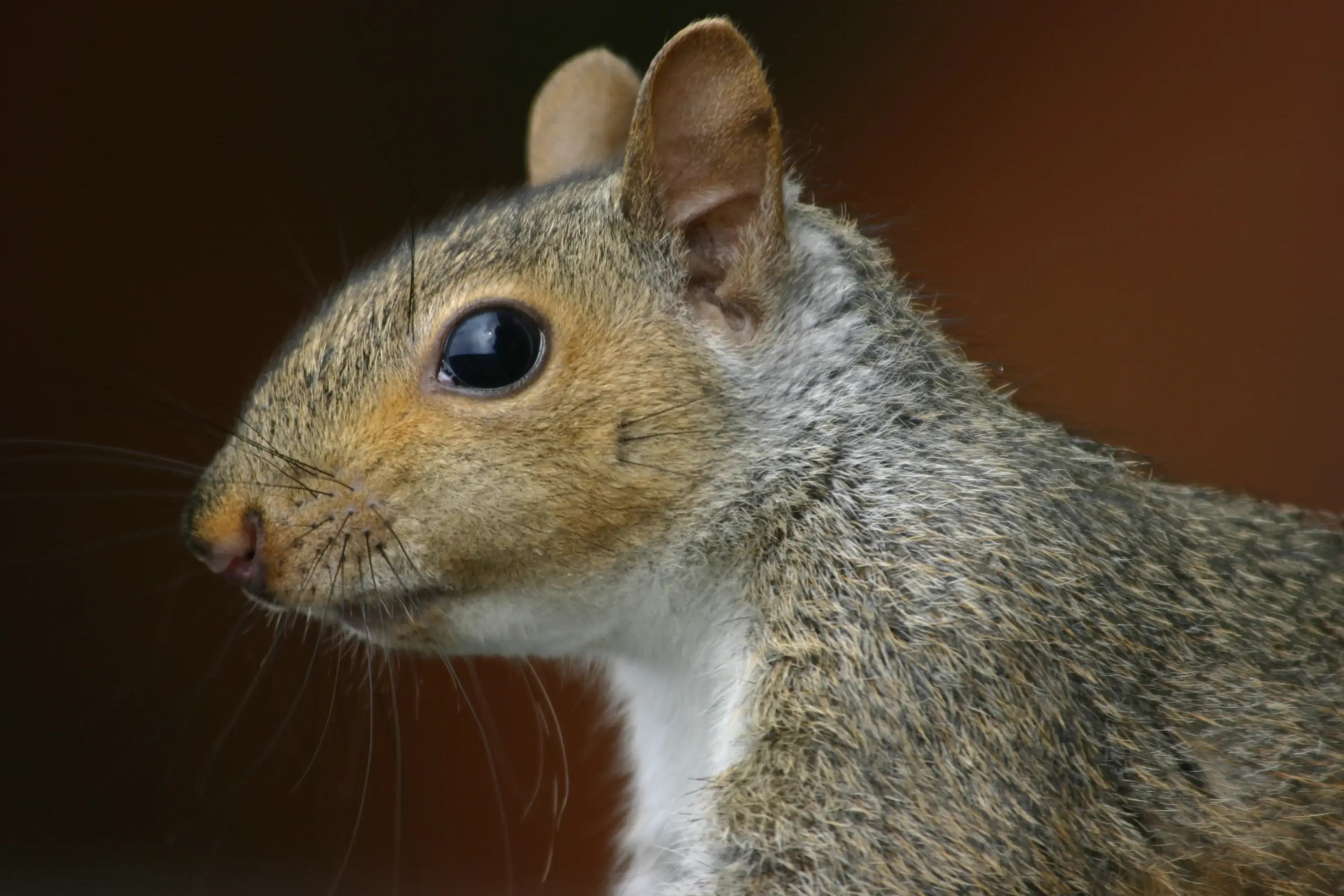
Also known as: Eastern grey squirrel, Gray squirrel
The eastern gray squirrel (Sciurus carolinensis), spelled as grey squirrel outside of the United States, is a species of tree squirrel in the genus Sciurus. It is native to eastern North America, where it is the most prodigious and ecologically essential natural forest regenerator. Widely introduced to certain places around the world, the eastern gray squirrel in Europe, in particular, is regarded as an invasive species.
In Europe, Sciurus carolinensis is included (since 2016) in the list of Invasive Alien Species of Union concern (the Union list). This implies that this species cannot be imported, bred, transported, commercialized, or intentionally released into the environment in the whole of the European Union.
Habitat & Range
Sciurus carolinensis is native to the eastern and midwestern United States, and to the southerly portions of the central provinces of Canada. In the mid-1800s the population in the midwestern United States was described as being "truly astonishing," but human predation and habitat destruction through deforestation resulted in drastic population reductions, to the point that the animal was almost absent from Illinois by 1900.
The native range of the eastern gray squirrel overlaps with that of the fox squirrel (Sciurus niger), with which it is sometimes confused, although the core of the fox squirrel's range is slightly more to the west. The eastern gray squirrel is found from New Brunswick, through southwestern Quebec and throughout southern Ontario plus in southern Manitoba, south to East Texas and Florida. Breeding eastern gray squirrels are found in Nova Scotia, but whether this population was introduced or came from natural range expansion is not known.
A prolific and adaptable species, the eastern gray squirrel has also been introduced to, and thrives in, several regions of the western United States. In 1966, this squirrel was introduced onto Vancouver Island in Western Canada in the area of Metchosin, where it is considered highly invasive and a threat to both the local ecosystem and the native squirrel, the American red squirrel.
Overseas, eastern gray squirrels in Europe are a concern because they have displaced some of the native squirrels there. For example, in Britain, they have largely displaced the red squirrel; in Ireland, they compete with the Eurasian red squirrel. They have also been introduced into Italy, South Africa, and Australia (where they were extirpated by 1973).
Life History
Reproduction: Eastern gray squirrels can breed twice a year, but younger and less experienced mothers normally have a single litter per year in the spring. Depending on forage availability, older and more experienced females may breed again in summer. In a year of abundant food, 36% of females bear two litters, but none will do so in a year of poor food. Their breeding seasons are December to February and May to June, though this is slightly delayed in more northern latitudes. The first litter is born in February or March, the second in June or July, though, again, bearing may be advanced or delayed by a few weeks depending on climate, temperature, and forage availability. In any given breeding season, an average of 61 – 66% of females bear young. If a female fails to conceive or loses her young to unusually cold weather or predation, she re-enters estrus and has a later litter. Five days before a female enters estrus, she may attract up to 34 males from up to 500 meters away. Eastern gray squirrels exhibit a form of polyandry, in which the competing males will form a hierarchy of dominance, and the female will mate with multiple males depending on the hierarchy established.
Normally, one to four young are born in each litter, but the largest possible litter size is eight. The gestation period is about 44 days. The young are weaned around 10 weeks, though some may wean up to six weeks later in the wild. They begin to leave the nest after 12 weeks, with autumn born young often wintering with their mother. Only one in four squirrel kit
Hunting Season
Sep 27, 2025 - Feb 21, 2026. Closed Dec 8-13 and Dec 17, 2025. Sunday hunting prohibited.
Frequently Asked Questions
Regulations for hunting Eastern Gray Squirrel in New Jersey
Eastern gray squirrel hunting in New Jersey runs from late September through February. Legal weapons: air gun (.177-.22 cal, 600+ fps), bow (35+ lbs draw), or shotgun (10-20 ga, shot no larger than #4 fine). Muzzleloading rifle (up to .36 cal) allowed in designated zones Sep 27 - Nov 7. No Sunday hunting.
Can I use a rifle for squirrel hunting in New Jersey?
No. Rifles are not legal for squirrel hunting in New Jersey. Only air guns, bows, and shotguns (with shot no larger than #4 fine) are permitted for small game.
When is Eastern Gray Squirrel hunting season in New Jersey?
Sep 27, 2025 - Feb 21, 2026. Closed Dec 8-13 and Dec 17, 2025. Sunday hunting prohibited.
What is the bag limit for Eastern Gray Squirrel in New Jersey?
5 squirrels per day. No season limit.
What is another name for Eastern Gray Squirrel?
Eastern Gray Squirrel is also known as Eastern grey squirrel, Gray squirrel in New Jersey.
References
| State | Category | Directory | Subcategory | Content | Source |
|---|---|---|---|---|---|
| New Jersey | Small Game | Regulations | Season Dates | Sep 27, 2025 - Feb 21, 2026. Closed Dec 8-13 and Dec 17, 2025. Sunday hunting prohibited. | Link |
| New Jersey | Small Game | Regulations | Regulations | Eastern gray squirrel hunting in New Jersey runs from late September through February. Legal weapons: air gun (.177-.22 | Link |