Also known as: American beaver, Canadian beaver
The North American beaver (Castor canadensis) is one of two extant beaver species, along with the Eurasian beaver (Castor fiber). It is native to North America and has been introduced in South America (Patagonia) and Europe (primarily Finland and Karelia). The North American beaver is one of the national symbols of Canada and the official state mammal of Oregon and New York. North American beavers are widespread across the continental United States, Canada, southern Alaska, and some parts of northern Mexico.
In Canada and the United States, the North American beaver is often referred to simply as "beaver", although this can cause some confusion because another distantly related rodent, Aplodontia rufa, is often called the "mountain beaver". Other vernacular names, including American beaver and Canadian beaver, distinguish this species from the other extant beaver species, Castor fiber, which is native to Eurasia.
The beaver is the largest rodent in North America and competes with its Eurasian counterpart, the European beaver, for being the third-largest in the world, both following the South American capybara and lesser capybara. The European species is slightly larger on average but the American has a larger known maximum size. Adults usually weigh from 11 to 32 kg (24 to 71 lb), with 20 kg (44 lb) being typical. In New York, the average weight of adult male beavers was 18.9 kg (42 lb), while non-native females in Finland averaged 18.1 kg (40 lb). However, adults of both sexes averaged 16.8 kg (37 lb) in Ohio. The species seems to conform to Bergmann's rule, as northern animals appear to be larger. In the Northwest Territory, adults weighed a median of 20.5 kg (45 lb). The American beaver is slightly smaller in average body mass than the Eurasian species. The head-and-body length of adult North American beavers is 74–90 cm (29–35 in), with the tail adding a further 20–35 cm (7.9–13.8 in). Very old individuals can exceptionally exceed normal sizes, weighing more than 40 kg (88 lb) or even as much as 50 kg (110 lb).
The beavers are semiaquatic with physical traits suited to this lifestyle. It has a large, scaly, paddle-shaped tail and webbed hind feet. The unwebbed front feet are smaller, have claws, and are highly dexterous. Beavers use their front feet for digging, to feed themselves, and to maneuver small stems as they gnaw bark off trees. The eyes are covered by a nictitating membrane which allows the beaver to see underwater. The nostrils and ears are sealed while submerged. Their lips can be closed behind their front teeth so that they can continue to gnaw underwater. A thick layer of fat under its skin provides insulation.
The beaver's fur consists of long, coarse outer hairs and short, fine inner hairs, and is usually dark brown. Scent glands near the genitals secrete an oily substance known as castoreum, which the beaver uses to waterproof its fur. There is also another set of oil glands producing unique chemical identifiers in the form of waxy esters and fatty acids.
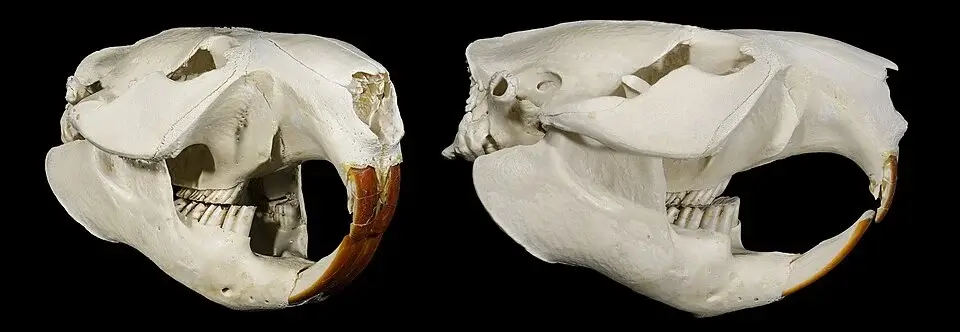
The beaver, like all rodents, possesses continuously growing incisors, and is a hindgut fermenter whose cecum, populated by symbiotic bacteria, helps to digest plant-based material. The beaver is specialized for efficient digestion of its lignocellulose-heavy diet.
Habitat & Range
Beavers were practically ubiquitous and lived from south of the arctic tundra to the deserts of northern Mexico, and from the Atlantic to the Pacific Oceans, but were trapped across the continent for economic gain and political competition, leading to regional extirpation in many regions like the Great Plains. Certain areas saw near-extirpations and declining numbers, but not extirpation, partially due to various conservation measures were taken, with mixed results, by the Hudson's Bay Company. By the 1900s and 1910s, beavers existed largely in isolated pockets, but where those pockets existed is not well documented. However, despite these difficulties reintroduction and natural spread has restored the species back into most of it natural range, with innovations in management allowing sustainable harvest yields now exceeding previous record harvests. They are widely distributed in boreal and temperate ecoregions, where populations are rebounding from historic over-exploitation. Recently, beaver have been observed colonizing arctic tundra, likely as a result of climate-induced increases in riparian shrubs.
Physician naturalist Edgar Alexander Mearns' 1907 report of beaver on the Sonora River may be the earliest report on the southernmost range of this North American aquatic mammal. However, beavers have also been reported both historically and contemporarily in Mexico on the Colorado River, Bavispe River, and San Bernardino River in the Mexican states of Sonora and Chihuahua.
Life History
Behavior: Beavers are active mainly at night. They are excellent swimmers and may remain submerged up to 15 minutes. More vulnerable on land, they tend to remain in the water as much as possible. They use their flat, scaly tail both to signal danger by slapping the surface of the water and as a location for fat storage.
They construct their homes, or "lodges", out of sticks, twigs, rocks, and mud in lakes, streams, and tidal river deltas. These lodges may be surrounded by water, or touching land, including burrows dug into river banks. Beavers are well known for building dams across streams and constructing their lodges in the artificial ponds which form. When building in a pond, the beavers first make a pile of sticks and then eat out one or more underwater entrances and two platforms above the water surface inside the pile. The first is used for drying off. Towards winter, the lodge is often plastered with mud which, when it freezes, has the consistency of concrete. A small air hole is left in the top of the lodge.
Hunting Season
Dec 26, 2025 - Feb 9, 2026 (zones 1-30). Jan 1 - Feb 9, 2026 (stocked WMAs).
Frequently Asked Questions
Regulations for hunting North American Beaver in New Jersey
Beaver trapping in New Jersey requires a Special Permit ($17) or Damage Control Permit. Lottery application period: Oct 1-31. Permits are zone-specific. Legal traps: body-gripping traps (max 10-inch jaw spread) or cable restraints. All pelts must be presented at an official check station by Feb 28, 2026. No traps may be set on stocked WMAs before Jan 1.
When is North American Beaver hunting season in New Jersey?
Dec 26, 2025 - Feb 9, 2026 (zones 1-30). Jan 1 - Feb 9, 2026 (stocked WMAs).
What is the bag limit for North American Beaver in New Jersey?
8 beavers per Special Permit. 10 per Damage Control Permit. Max 5 traps per day per zone.
What is another name for North American Beaver?
North American Beaver is also known as American beaver, Canadian beaver in New Jersey.
References
| State | Category | Directory | Subcategory | Content | Source |
|---|---|---|---|---|---|
| New Jersey | Furbearers | Regulations | Season Dates | Dec 26, 2025 - Feb 9, 2026 (zones 1-30). Jan 1 - Feb 9, 2026 (stocked WMAs). | Link |
| New Jersey | Furbearers | Regulations | Regulations | Beaver trapping in New Jersey requires a Special Permit ($17) or Damage Control Permit. Lottery application period: Oct | Link |