Also known as: Coypu, River rat, Nutria rat
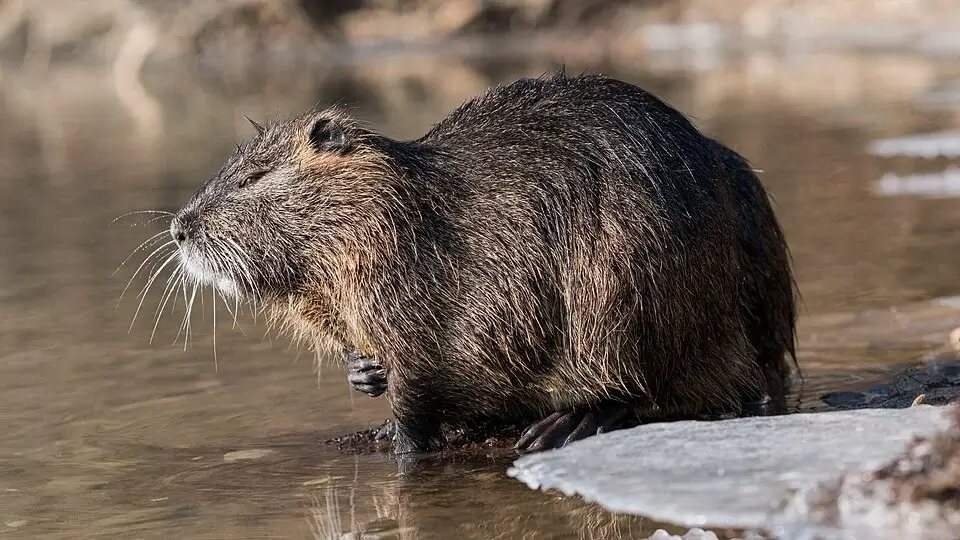
The nutria () or coypu () (Myocastor coypus) is an herbivorous, semiaquatic rodent from South America.
Classified for a long time as the only member of the family Myocastoridae, Myocastor has since been included within Echimyidae, the family of the spiny rats.
The nutria lives in burrows alongside stretches of water and feeds on river plant stems.
Native to subtropical and temperate South America, it was introduced to North America, Europe and Asia, primarily by fur farmers. Although it is still hunted and trapped for its fur in some regions, its destructive burrowing and feeding habits often bring it into conflict with humans, and it is considered an invasive species in several countries. Nutrias also transmit various diseases to humans and animals, mainly through water contamination.
The nutria was first described by Juan Ignacio Molina in 1782 as Mus coypus, a member of the mouse genus. The genus Myocastor was assigned in 1792 by Robert Kerr. Geoffroy Saint-Hilaire, independently of Kerr, named the species Myopotamus coypus, and it is occasionally referred to by this name.
Four subspecies are generally recognized:
M. c. bonariensis: northern Argentina, Bolivia, Paraguay, Uruguay, southern Brazil (RS, SC, PR, and SP)
M. c. coypus: central Chile, Bolivia
M. c. melanops: Chiloé Island
M. c. santacruzae: Patagonia
M. c. bonariensis, the subspecies present in the northernmost (subtropical) part of the nutria's range, is believed to be the type of nutria most commonly introduced to other continents.
Habitat & Range
Native to subtropical and temperate South America, its range includes Chile, Argentina, Uruguay, Paraguay and the southern parts of Brazil and Bolivia. It has been introduced to North America, Europe and Asia, primarily by fur ranchers.
The distribution of nutrias outside South America tends to contract or expand with successive cold or mild winters. During cold winters, nutrias often suffer frostbite on their tails, leading to infection or death. As a result, populations of nutria often contract and even become locally or regionally extinct as in the Scandinavian countries and such U.S. states as Idaho, Montana, and Nebraska during the 1980s. During mild winters, their ranges tend to expand northward. For example, in recent years, range expansions have been noted in Washington and Oregon, as well as Delaware.
According to the U.S. Geological Survey, nutrias were first introduced to the United States in California, in 1899 by William Franklin Frakes. As of 2024, they had spread to the San Francisco Bay Area, where their digging threatened storm levees, and the California Department of Fish and Wildlife had an active eradication program.
They were first brought to Louisiana in the early 1930s for the fur industry, and the population was kept in check, or at a small population size, because of trapping pressure from the fur traders. The earliest account of nutrias spreading freely into Louisiana wetlands from their enclosures was in the early 1940s; a hurricane hit the Louisiana coast for which many people were unprepared, and the storm destroyed the enclosures, enabling the nutrias to escape into the wild. According to the Louisiana Department of Wildlife and Fisheries, nutrias were also transplanted from Port Arthur, Texas, to the Mississippi River in 1941 and then spread due to a hurricane later that year.
Life History
Life History: Nutrias can live up to six years in captivity, but individuals rarely live past three years old in the wild. According to one study, 80% of nutrias die within the first year, and less than 15% of a wild population is over three years old. A nutria is considered to have reached old age at four years of age. Male nutrias reach sexual maturity as early as four months, and females as early as three months; however, both can have a prolonged adolescence, up to the age of nine months. Once a female is pregnant, gestation lasts 130 days, and she may give birth to as few as one or as many as 13 offspring. The average nutria reproduction is four pups. Female nutrias will mate within two days after giving birth. The years of reproduction cycle by litter size. Year one might be large, year two litter size will be smaller and year three the litter size will be another larger size. Females can only produce six litters in her life, rarely seven litters. A female on average will have two litters a year.
Nutrias generally line nursery nests with grasses and soft reeds. Baby nutrias are precocial, born fully furred and with open eyes; they can eat vegetation and swim with their parents within hours of birth. A female nutria can become pregnant again the day after she gives birth to her young. If timed properly, a female can become pregnant three times within a year. Newborn nutrias nurse for seven to eight weeks, after which they leave their mothers. Nutrias have been known to be territorial and aggressive when caught or cornered. They will bite and attack humans and dogs when threatened. Nutrias are mainly crepuscular or nocturnal, with most activity occurring around dusk and sunset with highest activity around midnight. When food is scarce, nutrias will forage during the day. When food is plentiful, nutrias will rest and groom during the day.
Hunting Season
North Zone: Nov 15, 2025 - Mar 15, 2026. South Zone: Dec 1, 2025 - Mar 15, 2026.
Frequently Asked Questions
Regulations for hunting Nutria in New Jersey
Nutria (coypu) is an invasive species in New Jersey. Trapping follows the same North/South Zone schedule as mink and muskrat. No bag limits. Trappers are encouraged to target nutria for population control. Same trap restrictions as mink (body-gripping traps max 6-inch jaw spread, must be set below water).
When is Nutria hunting season in New Jersey?
North Zone: Nov 15, 2025 - Mar 15, 2026. South Zone: Dec 1, 2025 - Mar 15, 2026.
What is another name for Nutria?
Nutria is also known as Coypu, River rat, Nutria rat in New Jersey.
References
| State | Category | Directory | Subcategory | Content | Source |
|---|---|---|---|---|---|
| New Jersey | Furbearers | Regulations | Season Dates | North Zone: Nov 15, 2025 - Mar 15, 2026. South Zone: Dec 1, 2025 - Mar 15, 2026. | Link |
| New Jersey | Furbearers | Regulations | Regulations | Nutria (coypu) is an invasive species in New Jersey. Trapping follows the same North/South Zone schedule as mink and mus | Link |