Also known as: Whitetail, Virginia deer
The white-tailed deer (Odocoileus virginianus), also known commonly as the whitetail and the Virginia deer, is a medium-sized species of deer native to North and South America. It is the most widely distributed mainland ungulate herbivore in the Americas; coupled with its natural predator, the mountain lion (Puma concolor), it is one of the most widely distributed terrestrial mammal species in the Americas and the world. Highly adaptable, the various subspecies of white-tailed deer inhabit many different ecosystems, from arid grasslands to the Amazon and Orinoco basins; from the Llanos to the high-elevation terrain of the Andes.
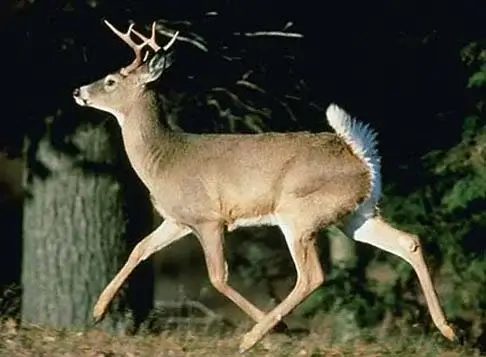
The white-tailed deer's coat is a reddish-brown in the spring and summer, and turns to a grey-brown throughout the fall and winter. The white-tailed deer can be recognized by the characteristic white underside to its tail. It raises its tail when it is alarmed to warn the predator that it has been detected.
An indication of a deer's age is the length of the snout and the color of the coat, with older deer tending to have longer snouts and grayer coats.
A population of white-tailed deer in New York is entirely white except for the nose and hooves – not albino – in color. The former Seneca Army Depot in Romulus, New York, has the largest known concentration of white deer. Strong conservation efforts have allowed white deer to thrive within the confines of the depot.
The white-tailed deer's horizontally slit pupil allows for good night vision and color vision during the day. Whitetails process visual images at a much more rapid rate than humans and are better at detecting motion in low-light conditions.
Some taxonomists have attempted to separate white-tailed deer into a host of subspecies, based largely on morphological differences. Genetic studies, however, suggest fewer subspecies within the animal's range, as compared to the 30 to 40 subspecies that some scientists have described in the last century. The Florida Key deer, O. v. clavium, and the Columbian white-tailed deer, O. v. leucurus, are both listed as endangered under the U.S. Endangered Species Act. In the United States, the Virginia white-tail, O. v. virginianus, is among the most widespread subspecies. Several local deer populations, especially in the southern United States, are descended from white-tailed deer transplanted from various localities east of the Continental Divide. Some of these deer populations may have been from as far north as the Great Lakes region to as far west as Texas, yet are also quite at home in the Appalachian and Piedmont regions of the south. These deer, over time, have intermixed with the local indigenous deer (O. v. virginianus and/or O. v. macrourus) populations.
Central and South America have a complex number of white-tailed deer subspecies that range from Guatemala to as far south as Peru. This list of subspecies of deer is more exhaustive than the list of North American subspecies, and the number of subspecies is also questionable. However, the white-tailed deer populations in these areas are difficult to study, due to overhunting in many parts and a lack of protection. Some areas no longer carry deer, so assessing the genetic difference of these animals is difficult.
Habitat & Range
In North America, the white-tailed deer is very common (even considered a nuisance in some areas) in states to the east and south of the Rocky Mountains, including southwestern Arizona, with the exception of the American West Coast and Baja California Peninsula, where its ecological niche is filled by the black-tailed deer (in the Pacific Northwest) or the mule deer (Odocoileus hemionus) from that point west except for mixed deciduous riparian corridors, river valley bottomlands, and lower foothills of the northern Rocky Mountain region from Wyoming west to eastern Washington and eastern Oregon, and north to northeastern British Columbia and southern Yukon, including in the Montana valley and foothill grasslands. The westernmost population of the species, known as the Columbian white-tailed deer, was once widespread in the mixed forests along the Willamette and Cowlitz River valleys of western Oregon and southwestern Washington, but current numbers are considerably reduced, and it is classified as near-threatened by the IUCN. This population is separated from other white-tailed deer populations.
Texas is home to by far the most individual white-tailed deer of all U.S. states, Canadian provinces, or Latin American countries, with an estimated population of 5.3 million, with both wild deer and farmed herds, the latter raised for large rack size and breeding. High populations of white-tailed deer are known to exist on the Edwards Plateau of Central Texas, as well as in Illinois, Indiana, Iowa, Maryland, Michigan, Minnesota, Mississippi, Missouri, New Jersey, New York, North Dakota, Ohio, Pennsylvania, and Wisconsin. The conversion of land adjacent to the Canadian Rockies to agricultural use, and partial clear-cutting of coniferous trees (resulting in widespread deciduous vegetation), has been favorable to the white-tailed deer and has extended its distribution to as far northwest as the Yukon. Populations of white-tailed deer around the Great Lakes have expanded their range north and westward, also due to conversion of land to agricultural use, with local caribou, elk, and moose populations declining. White-tailed deer are crepuscular, meaning they are most active at dawn and dusk, sporadically resting throughout the day and night.
Globally, the white-tailed deer has been introduced (primarily for sport hunting) to New Zealand, Nova Scotia (where they killed off the native caribou via brainworm), Prince Edward Island (where they were eradicated), New Brunswick (although native in some areas around Quebec), the Greater Antilles of the Caribbean (Cuba, Jamaica, Hispaniola, and Puerto Rico), and some countries in Europe (mainly the Czech Republic, Finland, France, Germany, Romania and Serbia).
Hunting Season
Fall Bow: Sep 13 - Oct 31, 2025 (Earn-A-Buck Sep 13 - Oct 3). Permit Bow: Nov 1 - Dec 31, 2025. Six-Day Firearm: Dec 8 - Dec 13, 2025. Permit Muzzleloader: various dates Dec 2025 - Feb 2026. Permit Shotgun: various dates Nov 2025 - Feb 2026. Winter Bow: Jan 1 - Feb 21, 2026.
Frequently Asked Questions
Regulations for hunting White-tailed Deer in New Jersey
New Jersey offers extensive white-tailed deer hunting across multiple seasons including Fall Bow, Permit Bow, Winter Bow, Six-Day Firearm, Permit Muzzleloader, and Permit Shotgun. Bag limits range from 1 deer (Set 0 zones) to unlimited antlerless + 1 antlered (Set 8 zones). Earn-A-Buck requires taking an antlerless deer first during early Fall Bow. Six-Day Firearm allows up to 2 antlered deer. Sunday hunting is permitted for archery only on WMAs and private property. All harvests must be reported via AHRS by 7-8 p.m. on the day of harvest.
Can I hunt deer on Sundays in New Jersey?
Sunday deer hunting is limited to archery only and is permitted on Wildlife Management Areas (WMAs) and private property. Sunday hunting is not allowed on state parks and forests.
Do I need a special permit to hunt antlered deer in New Jersey?
During Permit Bow, Permit Muzzleloader, and Permit Shotgun seasons, a separate Antlered Buck Permit is required in addition to the zone-specific antlerless permit. Only one buck may be taken per season.
When is White-tailed Deer hunting season in New Jersey?
Fall Bow: Sep 13 - Oct 31, 2025 (Earn-A-Buck Sep 13 - Oct 3). Permit Bow: Nov 1 - Dec 31, 2025. Six-Day Firearm: Dec 8 - Dec 13, 2025. Permit Muzzleloader: various dates Dec 2025 - Feb 2026. Permit Shotgun: various dates Nov 2025 - Feb 2026. Winter Bow: Jan 1 - Feb 21, 2026.
What is the bag limit for White-tailed Deer in New Jersey?
Unlimited antlerless and 1 antlered buck per season (set 8 zones). 2 antlered deer during Six-Day Firearm season. Bag limits vary by Regulation Set (0-8).
What is another name for White-tailed Deer?
White-tailed Deer is also known as Whitetail, Virginia deer in New Jersey.
References
| State | Category | Directory | Subcategory | Content | Source |
|---|---|---|---|---|---|
| New Jersey | Big Game | Regulations | Season Dates | Fall Bow: Sep 13 - Oct 31, 2025 (Earn-A-Buck Sep 13 - Oct 3). Permit Bow: Nov 1 - Dec 31, 2025. Six-Day Firearm: Dec 8 - | Link |
| New Jersey | Big Game | Regulations | Regulations | New Jersey offers extensive white-tailed deer hunting across multiple seasons including Fall Bow, Permit Bow, Winter Bow | Link |